ADHD Traits Checklist for Adults, Teens and Parents

An ADHD traits checklist is a structured list of inattentive and hyperactive-impulsive behaviours that you tick against your own life, or your child’s, to decide whether a professional assessment is worth seeking. It cannot diagnose ADHD, but a well-used one gives a clinician a far clearer picture than “I can’t concentrate”. Below you will find the traits grouped by type, how they differ in adults, teens and children, and what to do with your answers.
Key Takeaways
- ADHD traits fall into two groups: inattention, and hyperactivity-impulsivity. Some people show mainly one, many show both.
- A checklist is one part of a full evaluation, not a diagnosis. Self-report tools can also over-identify ADHD, so treat a high score as a reason to talk to a clinician.
- Traits count when they appear in more than one setting, began in childhood and cause real difficulty day to day.
- Write down concrete examples next to each tick. Specific incidents are what clinicians can use.
- Our free self-assessment gives an instant plain-language profile with no email, account or data collection.
What is on an ADHD traits checklist?
Most checklists mirror the diagnostic criteria, which split into two symptom groups. The US National Institute of Mental Health describes inattention as difficulty paying attention to details, concentrating, listening, following instructions, organising tasks, finishing tasks that need sustained attention and remembering daily activities. The hyperactive-impulsive group covers fidgeting, restlessness, talking excessively, interrupting and struggling to wait.
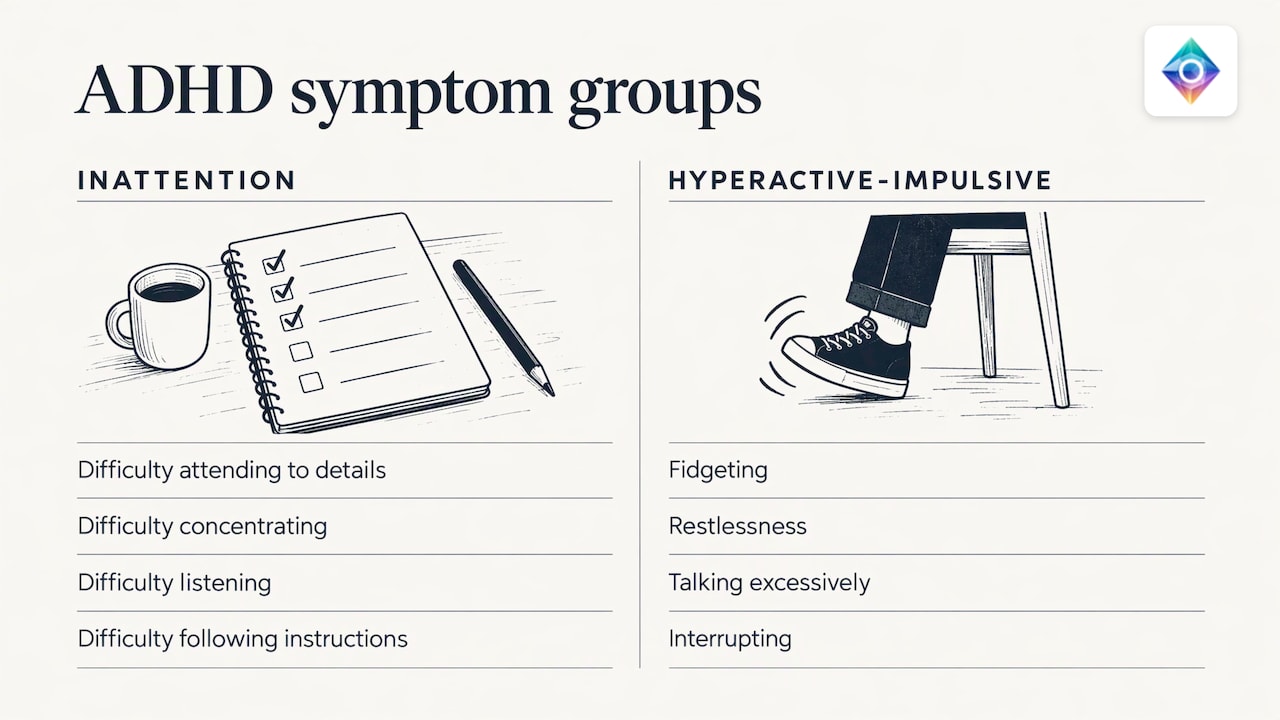
A practical way to use the list is to read each trait and ask whether it happens often, whether it happens in more than one place, and whether it has been true for years rather than weeks.
Inattentive traits
- Makes careless mistakes or misses details in work or paperwork
- Finds it hard to keep attention on tasks, conversations or reading
- Seems not to listen when spoken to directly
- Starts tasks but does not follow through
- Struggles to organise tasks, time and belongings
- Avoids or delays tasks that need sustained mental effort
- Loses things needed for daily life, such as keys, phone or documents
- Is easily distracted by unrelated sights and sounds
- Forgets appointments, errands or routine tasks
This list follows the CDC-based symptom checklist, which also states that symptoms must be present in more than one setting for at least six months.
Hyperactive and impulsive traits
- Fidgets or taps hands and feet, or squirms when seated
- Leaves their seat when expected to stay in it
- Feels restless, often as an inner sense of being driven
- Finds quiet leisure activities hard
- Talks a lot, or blurts out answers before a question is finished
- Finds it hard to wait a turn
- Interrupts or intrudes on others
In children the NHS lists high energy, fidgeting, noisy talking, getting up when expected to sit, and interrupting as typical hyperactive and impulsive signs. In adults these often turn inward, so restlessness can look like an inability to relax rather than running about.
How many traits mean it is worth seeking an assessment?
There is no personal score that settles it. For reference, the diagnostic thresholds quoted by NIMH are at least six symptoms for children up to 16, and at least five for adults and young people over 16. Ticking five or six boxes does not mean you meet the criteria, because clinicians also look at how long the traits have been there and how much they get in the way.
In England, NICE guidance says that for a diagnosis, symptoms of hyperactivity, impulsivity or inattention must cause significant impairment, for example in education, work or relationships. The Australian clinical guideline puts it similarly: symptoms typically begin before age 12 and occur in two or more important settings.
If your ticks cluster in one area, such as work only, it is still worth noting, but the pattern across home, work or school matters more. Our guide to when impairment spans two areas in a UK diagnosis explains how that plays out in practice.
What is an ADHD symptoms checklist for adults?
Adults rarely describe ADHD in diagnostic language. NIMH notes that adults may notice difficulty finishing tasks, remembering appointments, being easily distracted and fidgeting. In practice that can look like:
- A permanent pile of unopened post or unanswered messages
- Starting several projects and finishing few
- Being late despite real effort, because time estimates are unreliable
- Needing a deadline or pressure before work begins
- Interrupting in meetings and then regretting it
- Feeling exhausted from holding it all together
The last point is often masking, where you compensate so well that others see little. If that rings true, our piece on unmasking without burning out is a good next read.
The ASRS, the best-known adult screener
The Adult ADHD Self-Report Scale (ASRS v1.1) has 18 items, and the first six, known as Part A, are the most predictive for screening. Many online adult ADHD checklists, including PDFs, are built on it. Screeners are quick, but they are blunt: a study of two general-population samples found the ASRS led to 7 to 10 times over-identification of ADHD, and the researchers recommend pairing it with clinical assessment. A positive screen therefore tells you to look further, not that you have ADHD.
What does an inattentive ADHD checklist include?
Inattentive ADHD, sometimes still called ADD, uses only the inattention list above: careless mistakes, trouble sustaining attention, seeming not to listen, not following through, poor organisation, avoiding effortful tasks, losing things, distractibility and forgetfulness.
It is easy to miss because there is little outward disruption. Guidance from Australia notes that inattentive symptoms may not be identified until secondary school or later, and compensation strategies can mask them. The NHS adds that ADHD is thought to be recognised less often in girls, who more commonly have inattentive symptoms.
Inattentive versus combined ADHD
The NHS says that most children and young people with ADHD have both inattentive and hyperactive-impulsive symptoms, while some show only one type. Combined presentation means you meet the threshold in both groups. Predominantly inattentive means the inattention group is where your traits sit. Presentations can also shift over a lifetime, which is why a clinician asks about childhood as well as now.
What should an ADHD checklist for teens cover?
Teen checklists use the same two symptom groups, but the examples change because the demands change. Instead of toys and classroom seating, think about:
- Homework that is started late, lost or never handed in
- Losing phones, kit, keys and bus passes repeatedly
- Difficulty planning revision and long-term projects
- Zoning out in lessons, or being told they are not trying
- Impulsive comments, risk-taking or sudden decisions
- Restlessness that shows up as constant movement or needing background noise
- Emotional overwhelm after a school day spent holding it together
The NHS lists forgetting everyday tasks and finding it hard to follow instructions among the signs in children and young people, and says symptoms usually start before the age of 12. A teenager with new difficulties and no earlier history is a different picture from one whose primary-school reports mentioned the same things.
Our article on teen ADHD signs and turning everyday behaviours into evidence shows how to record examples. If your teen is willing to take part, our Youth Briefing is designed for young people, and there is a young person’s assessment for ages 11 to 13.
How do I use an ADHD checklist as a parent?
A parent checklist works best when it describes behaviour you have actually seen, across situations and over time. The Australian guideline says a comprehensive assessment should include observer reports, and CHADD notes that clinicians gather information from patients, parents, teachers and others.
So before you fill anything in:
- Ask the school for a short, factual note on attention, organisation and behaviour in lessons and at break.
- Note what happens at home on school days and at weekends.
- Add anything from other adults, such as a club leader or grandparent.
- Keep the examples dated and specific.
Checklists also need context. The American Academy of Family Physicians summary says children with ADHD should be evaluated for mood disorders and past trauma, and that language and learning disorders can be masked by or overlap with ADHD. If speech or language is part of your worry, a speech delay checklist for parents can help you describe what you see. For younger children, our notes for parents of preschoolers cover what is typical and what to record, and our guide to classroom adjustments in UK schools covers what can help while you wait.
Is an ADHD checklist a diagnosis?
No. CHADD states that rating scales and checklists are one component of a comprehensive evaluation. A diagnosis comes from a qualified clinician who considers your history, current functioning, other conditions and information from other people.
Two cautions apply to self-report. Questions about the past depend on memory, and a Norwegian study notes that retrospective self-report can be affected by memory bias and lack of recall. That is why a school report, an old report card or a relative’s recollection can be worth more than another questionnaire.
In the UK you can ask your GP about referral, and the NHS says you can ask for an NHS appointment at any clinic, including a private clinic in the children and young people context. For adults, the route and waiting times vary by area, so check with your GP or integrated care board.
What paperwork should I prepare for an ADHD assessment?
Clinicians generally want evidence, not just scores. A tidy folder might include:
- Your completed checklist, with a dated example beside each tick
- Childhood school reports or comments from teachers, if you still have them
- A list of the situations where traits cause difficulty: work, study, home, relationships
- Names of someone who knew you as a child and someone who sees you now
- Notes on sleep, mood, anxiety and anything else you have been told about
- A list of medicines and past diagnoses
Our guide to five things to bring after a self screen goes through this in more detail, and the post on describing ADHD symptoms to a clinician helps you put the examples into words.
Pro Tip: For every trait you tick, write one sentence beginning with where and when it last happened. Ten specific sentences are more useful in a consultation than a score out of 18.
Where can I find a free ADHD checklist that keeps my answers private?
Our free self-assessment gives you an instant profile across 14 areas, including ADHD, autism, dyslexia, masking, dyspraxia, dyscalculia and sensory processing. It needs no email or account, we do not collect your data, and the results are written in plain language. Parents can use the guided assessments for children and young people.
If you decide to see a clinician, the optional Specialist Briefing summarises your results in a form designed for healthcare professionals. It costs €20 one-off. The Youth Briefing for younger people is also €20 one-off. Neither is a diagnosis, and we do not present them as one.
Our perspective on checklists
Most people arrive at a checklist late and tired. They have usually spent years explaining themselves badly, and a list of named traits is the first time their experience has a shape.
I was diagnosed with ADHD at 42, and that is the reason Omniprism exists as a private, instant tool: a profile you can read in your own time, without handing over an email address, before deciding what to do next.
We built it to look at 14 areas rather than one, because neurodivergent traits overlap and a single-condition checklist can hide that. Our aim is a clearer conversation with your GP or specialist, with your own words and examples on the table from the first minute.
Valerio Cozzi
Frequently asked questions
Can I diagnose myself with an ADHD checklist?
No. A checklist shows whether your experiences resemble ADHD traits, and it is one part of a wider evaluation. Screening tools can also flag more people than a clinician would diagnose, so use your result to start a conversation with your GP or a specialist.
Is there an adult ADHD checklist PDF I can print?
Yes, several exist, and the ASRS is the most widely used. Printing is fine for your own notes, but add dated examples and bring them to the appointment. Our online self-assessment gives you a profile instantly without an account.
How is a teen checklist different from an adult one?
The core traits are the same two groups. The examples shift towards homework, revision, lost belongings and school-day exhaustion, and a parent or teacher view is usually needed alongside the teen’s own answers.
What if I tick traits from both groups?
That is common, and it fits what the NHS describes for most children and young people with ADHD. A clinician decides whether your pattern is combined, inattentive or something else, and checks for other conditions that overlap.
Sources
- ADHD in children and young people, NHS
- Attention deficit hyperactivity disorder: diagnosis and management (NG87), NICE
- Attention-Deficit/Hyperactivity Disorder: What You Need to Know, NIMH
- Screening for adult ADHD using brief rating tools, PubMed Central
- Validity and accuracy of the Adult ADHD Self-Report Scale, PubMed Central
- Australian Evidence-Based Clinical Practice Guideline for ADHD
- Clinical Practice Tools, CHADD
- ADHD symptom checklist (CDC-based)
- Adult ADHD, ASRS v1.1 documentation
- Practice Guidelines on ADHD, American Family Physician
Recommended
- ADHD Red Flags: What Parents and Adults Should Know
- Describe ADHD symptoms: clinician checklist and private assessment
- Teen ADHD Signs: Turn Everyday Behaviors Into Evidence for Clinicians
- DSM-5 ADHD Criteria: What They Ask, and What They Can’t See
Written and edited by Valerio Cozzi, founder of Omniprism. Omniprism began after my own ADHD diagnosis at 42.
This article is educational. It is not medical advice, not a diagnosis, and not a substitute for assessment by a qualified clinician. The Omniprism self-assessment is free, needs no account and no email address, and runs entirely in your browser — your answers are never sent to a server. The optional Specialist Briefing report is a paid add-on.