ADHD Masking: Five Steps to Unmask Without Burning Out

ADHD masking is the practice of hiding, suppressing, or overcompensating for ADHD traits so you appear more organized, calm, or attentive than you actually feel. It’s often called camouflaging, and it can be a deliberate strategy or an automatic habit built over years. The problem: it works well enough to fool everyone, including doctors, which is why so many people mask for decades before getting an accurate diagnosis. This article walks through the signs, the emotional toll, and how to unmask without falling apart in the process.
TL;DR:
- Masking relies on elaborate routines and scripts that often go unnoticed, making it difficult for clinicians to distinguish it from genuine competence.
- Hidden effort and self-monitoring fatigue caused by masking can lead to burnout, anxiety, depression, and a fragmented sense of identity.
- Women, girls, and gifted children tend to mask more often, which contributes to delayed diagnoses and masking being hidden in assessment.
- Unmasking should be approached gradually with support, using tools like self-assessment profiles and establishing small disclosures to reduce burnout risk.
- Formal evaluations and tailored accommodations are essential for confirming diagnosis and easing the daily masking burden over the long term.
Table of Contents
- What Is ADHD Masking, and How Is It Different From Coping?
- Why People Mask: Stigma, Feedback, and Gender
- What Masking Actually Looks Like Day to Day
- The Real Cost: Burnout, Anxiety, and Late Diagnosis
- How Clinicians Can Spot Masking During an Assessment
- A Staged Plan for Unmasking Without Burning Out
- Masking Looks Different Across People
- Recognizing Your Own Mask
- See Your Masking Patterns Clearly With Omniprism
- Sources
What Is ADHD Masking, and How Is It Different From Coping?
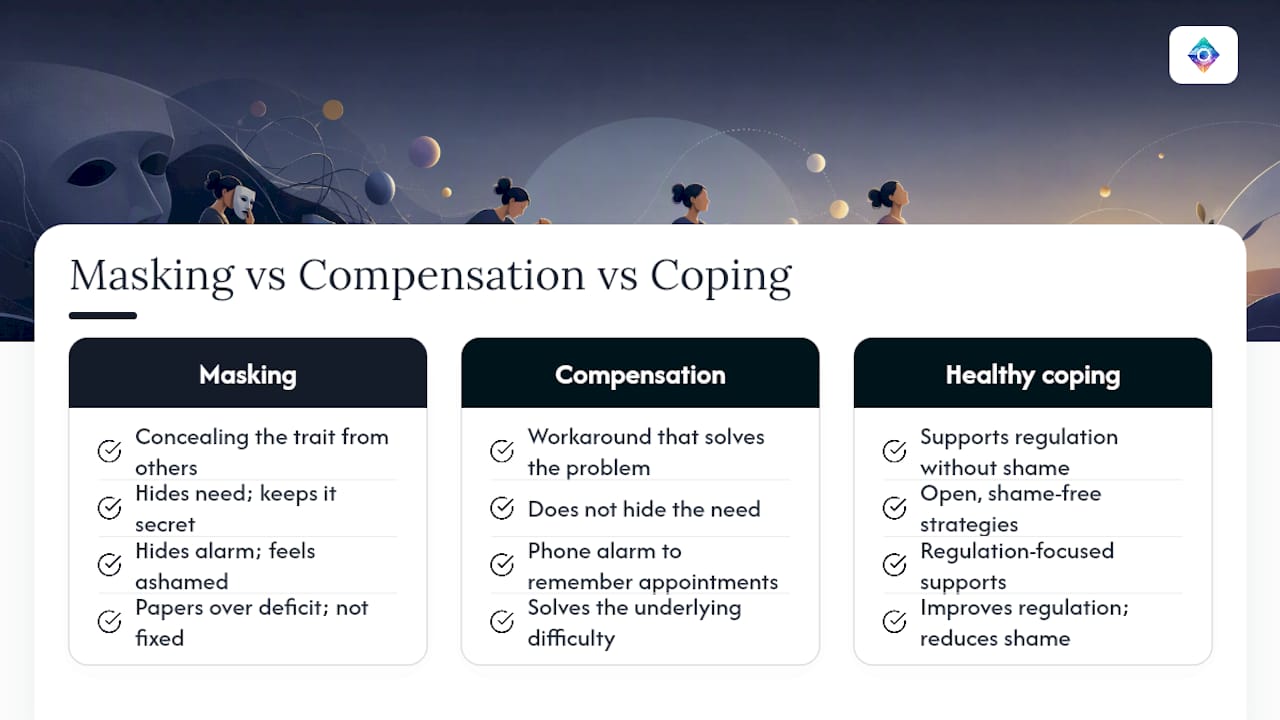
Masking, compensation, and healthy coping strategies get lumped together, but they aren’t the same thing. Masking specifically means concealing the trait itself so others don’t see it. Compensation means building a workaround that solves the underlying problem without hiding it. A person using a phone alarm to remember appointments is compensating. A person who feels ashamed of needing that alarm and hides it from coworkers is masking.
Some masking is conscious: rehearsing a phrase before saying it out loud, forcing eye contact that feels uncomfortable, or mentally scripting how to respond in a meeting before it starts. Other masking runs automatic, something ADDA describes as a pattern that often begins in childhood and becomes so ingrained the person doing it barely notices anymore. That’s the trap. What started as a survival skill during a rough third-grade year turns into an identity by age 30, and unpicking it later takes real effort.
Both forms trace back to the same root: executive-function deficits in planning, working memory, and impulse control. Masking papers over the deficit instead of fixing it, which means the underlying struggle with attention, time, or emotional regulation never actually goes away. It just gets a better disguise.
Why People Mask: Stigma, Feedback, and Gender
Masking rarely starts as a choice. It starts as a response to being told, repeatedly, that something about you is a problem. A kid who gets called lazy, disruptive, or “not living up to potential” enough times learns fast that the safest move is to hide whatever behavior triggered that label. By adolescence, that hiding becomes reflexive.
Social norms shape who masks hardest and longest. Girls and women tend to mask more than boys and men, likely because inattentive symptoms like daydreaming or disorganization draw less obvious punishment than hyperactive ones, and because girls face stronger social pressure to appear composed, tidy, and agreeable. A distracted boy gets called energetic; a distracted girl gets called scattered or careless, and she adjusts accordingly.
The developmental arc usually runs from childhood compliance to adult exhaustion. A child masks to avoid detention or disappointed parents. A teenager masks to fit in socially. An adult masks to keep a job, hold a relationship together, or avoid being seen as difficult in a meeting. Each stage raises the stakes and the cost, which is part of why so many adults only get diagnosed after a life event, a new job, or parenthood, finally breaks the system down.
What Masking Actually Looks Like Day to Day
Masking behaviors split roughly into two camps: hiding inattentive symptoms and hiding hyperactive or impulsive ones. Both take enormous effort, and both tend to look like competence from the outside.
For inattentive-type masking, common patterns include:
- Setting multiple alarms and calendar reminders for a single task to avoid missing it
- Overpreparing for meetings or conversations far beyond what the situation requires
- Rereading emails five or six times before sending to catch mistakes
- Using intense hyperfocus on one task to compensate for scattered attention everywhere else
- Memorizing scripts for small talk so social interactions feel less improvised
For hyperactive and impulsive-type masking, the patterns shift toward physical and emotional suppression:
- Clenching muscles or sitting on hands to stop stimming in public
- Forcing stillness during long meetings, even when it produces physical discomfort
- Swallowing frustration or excitement to avoid seeming “too much”
- Rehearsing responses before speaking to prevent blurting something out
At work, this might look like a project manager who volunteers to draft every meeting agenda, not out of enthusiasm, but because writing it down is the only way to keep from losing track of the discussion. At school, it’s the student who stays up until 2 a.m. rewriting notes that were already fine, because “fine” doesn’t feel safe. At home, it’s the parent who holds it together all day and then snaps or shuts down the second the front door closes, because home is the only place the mask comes off.
The Real Cost: Burnout, Anxiety, and Late Diagnosis
Chronic masking runs on a finite resource: mental energy. Every hour spent monitoring your own behavior, rehearsing responses, and suppressing impulses is an hour not spent on the actual task in front of you. That constant, invisible labor produces something specialists increasingly call masking burnout, distinct from ordinary burnout because it stems from self-monitoring fatigue rather than workload alone. Someone can have a light schedule and still be depleted, because the exhausting part was never the to-do list. It was the performance.
The hidden toll: Research comparing camouflaging across diagnostic groups finds that adults with ADHD report more camouflaging behavior than neurotypical comparison groups, though generally less than autistic adults, and that the effort required to sustain it correlates with measurable psychological strain.
Over time, that strain shows up as anxiety, depression, and a fraying sense of identity. People start to wonder which parts of their personality are real and which are just armor. Simply Psychology’s review of masking notes that this depletion of cognitive and emotional resources feeds directly into burnout and mood disorders, and that the pattern often persists for years before anyone connects it to ADHD.
Late diagnosis is the other major cost. Masking is, by design, good at hiding the exact symptoms a clinician would look for. A person can walk into a doctor’s office, perform competence for forty-five minutes, and walk out with no diagnosis, even though they haven’t been able to function at home in months. That gap between how someone looks and how someone feels is where most missed diagnoses happen.

How Clinicians Can Spot Masking During an Assessment
Standard ADHD screening tools were built around visible symptoms, which is exactly what masking is designed to hide. Clinicians need different questions to see past the performance.
Watch for red flags like elaborate compensatory systems: color-coded planners, redundant reminder apps, obsessive double-checking rituals. These aren’t quirks; they’re often the visible tip of an invisible struggle. Also worth flagging is a pattern where someone functions fine in structured settings but collapses at home, or reports co-occurring anxiety and depression that seem disproportionate to their circumstances.
Direct interview prompts help surface what standard checklists miss. Asking “how much effort does it take you to appear fine in a normal day?” or “how do you feel after a few hours in a social situation?” often reveals more than asking about symptoms directly. Clinical guidance for complex ADHD presentations recommends using specific behavioral anchors, like counting how many alarms someone sets or how often they rehearse conversations, rather than vague questions about general functioning.
When these patterns show up, referral for formal testing typically includes a clinical interview, standardized rating scales, and a review of the DSM-5 diagnostic criteria alongside a developmental history that traces symptoms back to childhood, even if they were well hidden at the time.
A Staged Plan for Unmasking Without Burning Out
Unmasking isn’t a light switch. Dropping every compensatory behavior overnight tends to backfire, leaving people more exposed and more exhausted than before. A staged, harm-reduction approach works better.
- Build awareness first. Track when and where you mask most. Journaling for a week or using a structured self-assessment can surface patterns you’ve never consciously named.
- Make one small disclosure. Tell a trusted friend, partner, or manager one true thing about how much effort a task takes you. Start small; you’re testing the water, not diving in.
- Replace masking with real supports. Swap performance for tools: externalized reminders, shared calendars, written scripts for hard conversations, or workplace accommodations that reduce the need to fake competence.
- Get a clinical evaluation. A formal assessment can confirm what self-reflection suggests and open the door to therapy or medication, both of which reduce the daily load masking has been carrying alone.
- Ask for accommodations where they matter. Whether at school or work, requesting flexibility on deadlines, seating, or communication style takes pressure off the mask permanently, not just temporarily.
Pro Tip: Pick one domain, one relationship, one room, one hour of your week, and relax the mask there first. Keep everything else stable while that one area adjusts. Trying to unmask everywhere at once is the fastest route back to burnout.
Masking Looks Different Across People
Women and girls mask at higher rates partly because inattentive symptoms are easier to hide than hyperactive ones, and partly because the social cost of appearing scattered is steeper for them. That combination is a major reason ADHD in women gets diagnosed years, sometimes decades, later than in men.
Gifted children present another pattern worth watching: high intelligence lets a child mask symptoms well enough to earn good grades, while the effort required shows up only at home, in meltdowns or shutdowns nobody at school ever sees. Parents often describe this as a switch flipping the second the child walks through the door.
There’s also real overlap with autistic camouflaging. Research comparing the two groups found autism traits predicted camouflaging behavior more strongly than ADHD traits did, though people with ADHD still camouflaged more than neurotypical comparison groups. That overlap matters for anyone weighing an autism versus ADHD question, since the tools used to measure camouflaging were largely built for autism and may not fully capture how ADHD masking shows up.
Recognizing Your Own Mask
Realizing how much of yourself has been performance rather than personality brings relief and grief at the same time. Relief, because the exhaustion finally makes sense. Grief, because you start wondering who you’d have been without it. Both reactions are normal, and neither means something is wrong with you.
Go slow. Unmasking in stages, with support from people who won’t punish you for it, beats trying to tear the whole thing down at once. A structured starting point, like mapping your own traits before you talk to anyone else, can make the next conversation with a clinician or a loved one much easier to have.
— Valerio
See Your Masking Patterns Clearly With Omniprism
Most people who mask can’t tell you exactly which traits they’re hiding, only that something feels like constant effort. Omniprism’s free Neurodivergence Self-Assessment gives you an instant profile across 14 domains, including masking, ADHD, and autism traits, without months of tracking or a waiting list for an evaluation.

The results lay out your patterns in plain language, which makes it far easier to walk into a conversation with a clinician already knowing what to describe instead of trying to explain years of hidden effort in a rushed appointment. If you want that conversation backed by something concrete, the optional Specialist Briefing report turns your results into a summary built for exactly that purpose. Parents wondering whether a child’s masking is starting early can use the guided assessment for ages 7 to 10 to get a clearer picture sooner rather than later. Start with the free assessment and see which of your own patterns finally have a name.
Sources
For deeper research and clinical context, see ADDA’s overview of masking, the camouflaging comparison study, Simply Psychology’s masking guide, and Medical News Today’s coverage of ADHD masking.
This article is general information, not a substitute for advice from a qualified doctor. Consult a qualified healthcare professional about your own circumstances before acting on anything here.
- ADHD masking: Why hiding your symptoms comes at a hidden cost — Simply Psychology