ADHD Test Accuracy: How Reliable Are Online Tests?
No single ADHD test is accurate enough to diagnose ADHD on its own, and online tests are best treated as screening tools that show whether a full assessment is worth pursuing. Their value depends on the tool, who completes it, and what you do with the result afterwards.
This guide explains what “accuracy” means for a screening questionnaire, why results can be wrong in both directions, and how to turn a self-test into something a clinician can use.
Key Takeaways
- A screening questionnaire estimates the likelihood of ADHD traits. A diagnosis comes from a clinical interview, history and information from other people, according to published assessment guidance.
- Brief tools can over-identify. In population samples, one widely used adult screener overestimated expected prevalence by 7 to 10 times.
- False positives and false negatives both happen, so a score is a prompt for a conversation, never a verdict.
- The most useful thing you can do with an online result is bring it, with concrete examples from daily life, to a qualified clinician.
- Privacy matters when you self-test: choose tools that tell you plainly what they collect.
How accurate is an ADHD test?
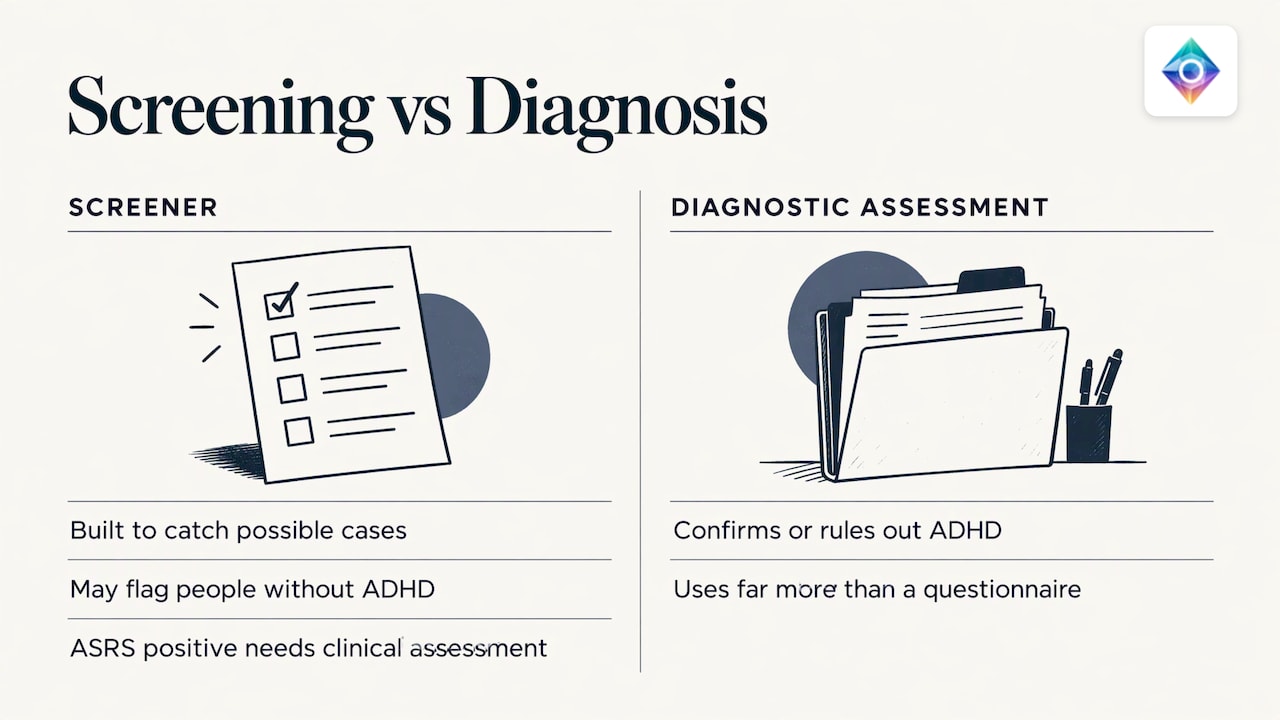
Accuracy depends on what the test is for. A screener is built to catch as many possible cases as it can, which means it will also flag people who do not have ADHD. A diagnostic assessment is built to confirm or rule out ADHD, and it uses far more than a questionnaire.
A 2025 comparative analysis of ADHD screening tools concluded that tool selection should be guided by population, content and context. The same paper examined how predictive values change at different prevalence rates. In practice, the same questionnaire can mean different things in a specialist clinic, where many people already have symptoms, and in a general population, where far fewer do.
The Adult ADHD Self-Report Scale (ASRS v1.1) shows why. A review of brief rating tools reported that in population-based samples it can overestimate prevalence by 7 to 10 times compared with expected rates. The same review describes it as a brief screening tool whose positive result should be followed by a clinical assessment before onward referral.
That is a useful way to read any score. A high result tells you that your answers resemble the pattern seen in ADHD. It does not tell you why you answered that way. If you want a closer look at what a particular number means, our guide to what your ASRS result tells you goes through it.
Are online ADHD tests accurate?
Online tests vary enormously. Some are short versions of validated clinical questionnaires. Others are quizzes written for entertainment or to sell a service, with no published evidence behind them. A questionnaire that borrows its questions from a validated scale is a reasonable starting point. One with no stated source for its questions gives you little to build on.
Three features separate a helpful online screen from a misleading one:
- A clear statement of purpose. It should say that it screens and does not diagnose.
- Questions about more than attention. ADHD affects work, relationships, routines and emotional regulation, and a good screen asks about impairment, not only symptoms.
- Transparency about your data. You are answering personal questions, so you should know what happens to the answers.
Even a well-built online screen has the same limits as its paper version, because it relies on how you see yourself. Clinical guidance for assessment stresses collecting symptom onset, persistence, duration and impairment across several areas of life, with information from multiple sources and settings. A questionnaire taken alone at a kitchen table captures one source, at one moment, from one point of view.
That does not make it pointless. A person who has wondered about ADHD for years often finds that a structured screen gives them words for experiences they could not describe. The risk comes when a score is read as an answer instead of a question.
Why do ADHD tests give false positives or false negatives?
A false positive means the test suggests ADHD when a clinician would not diagnose it. A false negative means the opposite. Both have understandable causes.
Why a screen can flag ADHD that is not there
The core symptoms of ADHD, such as difficulty concentrating, restlessness and forgetfulness, are not unique to it. Anxiety, low mood, poor sleep, chronic stress and some medications can produce the same experiences. A questionnaire that asks how often you lose focus cannot tell which of these is responsible.
The prevalence effect described above also plays a part. When a condition is relatively uncommon in the group being tested, a larger share of positive screens will turn out to be false alarms. This is why predictive values at different prevalence rates matter when researchers compare tools.
Why a screen can miss ADHD that is there
Self-report depends on insight and on comparison. If you have compensated for years with elaborate routines, extra hours or constant vigilance, you may rate your difficulties as lower than they are, because you remember the effort less than the outcome. People who work hard to hide their traits, often called masking, can score lower than their daily experience would suggest. A clinician who asks about your history, your childhood and the cost of your coping strategies can often see what a tick-box misses.
If you recognise this pattern, it is worth knowing that a low score on a short checklist does not cancel years of lived experience. Parents wondering about the early signs in a young child may find a plain-language checklist for recognising speech delays a helpful companion, since developmental differences are best understood by looking at the whole picture rather than one list.
Conditions that overlap
Autism, dyslexia, dyspraxia, sensory sensitivity and other neurodivergent profiles frequently sit alongside ADHD or resemble it. A tool that only asks about ADHD may attribute everything to ADHD. This is one reason we built our assessment to look across 14 areas instead of one.
Why can’t one test diagnose ADHD?
Because ADHD is a clinical diagnosis, not a score. The practice standards synthesised from eight international guidelines state that a licensed, qualified clinician must document the criteria, working within a standard diagnostic framework. The World Federation of ADHD consensus statement is among the guidance they draw on.
Australian clinical guidance makes the same point from another angle: diagnosis should not rest solely on rating scales or observations, and neuropsychological testing is not required. In other words, the computer-based attention tests some clinics advertise are not a necessary part of the process, and a questionnaire cannot replace the conversation.
A 2025 academic review describes the preferred approach as a clinical interview followed by other assessment tools and information from informants, within a multifaceted evaluation.
What does a proper ADHD assessment involve?
A thorough adult assessment normally includes:
- A structured clinical interview covering current symptoms and how they affect work, study, home life and relationships.
- A developmental history, because symptoms need to have been present from childhood.
- Information from someone who knows you, such as a parent, partner or old school reports, where available.
- Questionnaires and rating scales as supporting evidence.
- Screening for other conditions that can mimic or sit alongside ADHD.
In the UK, quality has been a concern. The Adult ADHD Assessment Quality Assurance Standard (AQAS) was published in 2024 to improve the quality, consistency and accuracy of assessment across practitioners working in different settings. If you are choosing a provider, ask whether their process follows a recognised standard and whether they will contact someone who knew you as a child.
For how the UK pathway works in practice, see our notes on when impairment in two areas suggests it is time to seek a diagnosis, and on what to bring to an appointment after a self-screen. Costs differ between NHS and private routes, and we summarise them in our ADHD assessment cost guide.
What should you do with an online ADHD result?
Treat the result as the start of a record. The strongest thing you can bring to a GP or specialist is not a number but a set of examples.
- Write down specifics. “I missed three deadlines this quarter because I could not start tasks” is more useful than “I am disorganised”.
- Note when it began. Think about school reports, childhood comments from teachers, and patterns that have lasted decades.
- List where it hurts. Work, money, relationships, health and household routines each count as separate areas of impairment.
- Mention what else is going on. Sleep, mood, anxiety, medication and substance use all affect attention, and a clinician will want to know.
- Ask someone close to you for their view. Informant information is part of standard assessment.
If a school is involved, the picture can be built partly by teachers. Our guide to classroom adjustments that help ADHD in UK schools covers what can be put in place while a formal route is under way. Some families also look for activities that build confidence outside school, such as piano lessons for autistic children, which focus on enjoyment and progress at the child’s own pace.
Can an online ADHD test be useful?
I was diagnosed with ADHD at 42, and I remember how much I wanted a clear, calm way to describe what I had lived with before anyone examined it. That is the reason I started Omniprism.
We believe a self-assessment earns its place when it is honest about its limits and generous with its detail. Our assessment gives an instant profile across 14 areas, including ADHD, autism, dyslexia, masking, dyspraxia, dyscalculia, sensory processing, high sensitivity, OCD traits and synesthesia. Looking across that range matters because neurodivergent traits rarely arrive one at a time, and a profile that shows several patterns together gives a clinician more to work with than a single score.
We designed it to use plain language, and it asks for no email, no account and no data collection. We want people to answer candidly without worrying where the answers go. Our optional Specialist Briefing turns the results into a summary designed for clinicians, so the first appointment can start from the evidence instead of from a blank page.
Valerio Cozzi
How can Omniprism help before an assessment?
Our self-assessment is free and gives you an instant, plain-language profile. If you decide to see a clinician, the Specialist Briefing is a one-off €20 report that summarises your results in a format designed for healthcare professionals. For families, we offer guided assessments for children and teens, with the Youth Briefing at €20 one-off, and age-specific versions for ages 7 to 10 and ages 11 to 13. If you work with clients, our professionals page explains how the profiles can be used.
The free assessment and the briefing support a clinical conversation. They are not a diagnosis, and we say so on the page.
If you want to see how an online screen can be turned into evidence, our article on using an online ADHD test covering 14 domains as clinician-ready evidence walks through it.
FAQ
Can an online ADHD test tell me if I have ADHD?
It can tell you whether your answers match patterns common in ADHD, which helps you decide whether to seek an assessment. It cannot confirm a diagnosis, because diagnosis requires a licensed clinician documenting criteria rather than a score. Use the result as the starting point for a conversation with your GP or a specialist.
Why did my ADHD test say yes when I am not sure I have it?
Brief screeners are designed to be sensitive, so they flag many people who go on to receive a different explanation. One review found that a common adult screener can overestimate prevalence by 7 to 10 times in general population samples. Stress, poor sleep, anxiety and low mood can also raise scores, which is why a clinician looks at your history before drawing conclusions.
Can I have ADHD if my test came back low?
Yes, it is possible. A short questionnaire reflects how you see your own difficulties on the day, and years of compensating can make those difficulties look smaller on paper. If your daily life still feels harder than it should, bring examples to a clinician instead of relying on the number.
Do I need a special test such as a computer-based attention task?
Not as a requirement. Australian clinical guidance states that neuropsychological testing is not required for an ADHD diagnosis, and that diagnosis should not be based solely on rating scales. The core of the assessment is the interview, your history and information from other people.
How do I make my result useful to a clinician?
Pair it with specific examples, the age your difficulties started, and the areas of life affected. Guidance on assessment highlights onset, persistence, duration and impairment across domains, so organising your notes around those points saves appointment time.
Sources
- Screening for adult ADHD using brief rating tools (PMC)
- Evaluating ADHD screening tools: a comparative analysis (PubMed)
- How should ADHD be assessed, diagnosed and monitored (Australian ADHD guideline)
- Evaluating attention deficit and hyperactivity disorder assessment (Frontiers in Psychology, 2025)
- Practice Standards for the Assessment of ADHD: a synthesis of eight international guidelines
- The adult ADHD assessment quality assurance standard (PMC, 2024)
- Clinical practice guidelines for assessment and management of ADHD in children and adolescents (Indian Psychiatric Society)
Recommended
- Turn an Online ADHD Test Covering 14 Domains Into Clinician Ready Evidence
- Self Assessment vs Diagnosis: ADHD and Autism Quizzes Aren’t Diagnoses
- Speed Your UK ADHD Diagnosis: 5 Things to Bring After a Self Screen
- ADHD Score Meaning: What Your ASRS Result Tells You
Written and edited by Valerio Cozzi, founder of Omniprism. Omniprism began after my own ADHD diagnosis at 42.
This article is educational. It is not medical advice, not a diagnosis, and not a substitute for assessment by a qualified clinician. The Omniprism self-assessment is free, needs no account and no email address, and runs entirely in your browser — your answers are never sent to a server. The optional Specialist Briefing report is a paid add-on.