ADHD Score Meaning: What Your ASRS Result Tells You
An ADHD score from a screening scale such as the ASRS tells you how closely your reported symptoms match the pattern seen in adult ADHD, and it is a reason to seek assessment, not a diagnosis. On the six-question ASRS screener, four or more marks in the shaded boxes mean your symptoms are highly consistent with adult ADHD and further investigation is warranted, according to the official ASRS v1.1 checklist.
This guide explains how the scoring works, why you may see different “bands” on different websites, how reliable a score is, and what to do with the number once you have it.
Key Takeaways
- A score measures how often you report certain symptoms. A clinician decides whether those symptoms amount to ADHD.
- On ASRS Part A, four or more marks in the shaded boxes is the usual threshold for “worth investigating”.
- Part B has no official total score. Banded totals you see online come from individual services, not from the checklist itself.
- Screens produce false positives, so a high score needs specialist assessment, ideally with evidence from childhood and from more than one setting.
- The ASRS is built for adults. Children and teenagers are assessed with different scales completed by parents, carers or teachers.
What does an ADHD score mean?
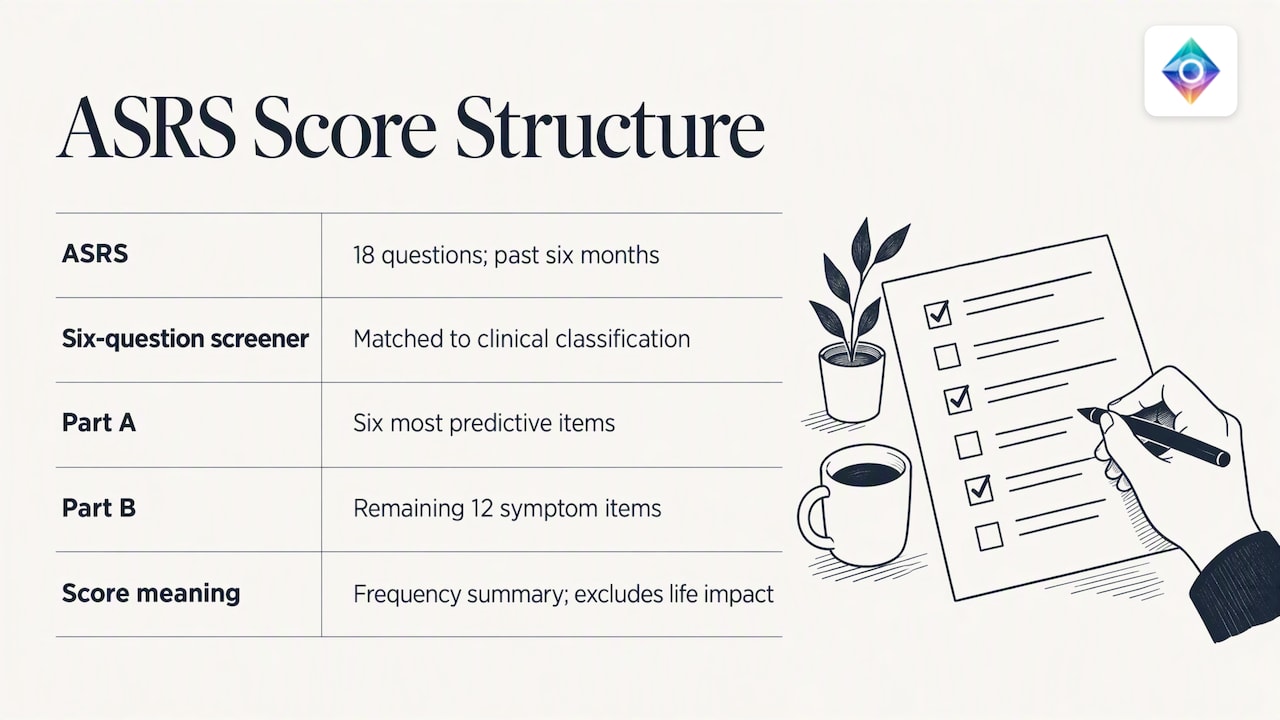
Most ADHD scores come from rating scales, which are structured questionnaires asking how often you notice particular symptoms. The best known for adults is the Adult ADHD Self-Report Scale (ASRS). It was developed with the World Health Organization, and its 18 questions ask about symptom frequency over the past six months; the six-question screener was chosen to match clinical classification as closely as possible, as described in the original 2005 validation paper.
The ASRS v1.1 checklist is split in two. Part A holds the six most predictive items, and Part B holds the remaining 12, all based on DSM-IV-TR symptom wording, per the checklist itself. Your score is therefore a summary of self-reported frequency, and it says nothing yet about how much those symptoms get in the way of your life, which is what a diagnosis also requires.
How do you score the ASRS Part A?
The method is short enough to do in a minute with a pen. These are the steps in the official checklist:
- Answer the six Part A questions, choosing the frequency that best describes how you have felt and behaved over the past six months.
- Look at which answer boxes are darkly shaded for each question. The shading differs between questions, because some items count at “sometimes” and others only at “often” or “very often”.
- Count the marks that fall inside darkly shaded boxes.
- Four or more means your symptoms are highly consistent with ADHD in adults and further investigation is warranted. Three or fewer means the screener does not flag you, though it cannot rule ADHD out.
A Harvard-hosted scoring update for the same screener is one of the pages that ranks for this search, and the Australian comorbidity guidelines repeat the same four-mark rule for Part A.
What do ASRS score bands mean?
Part B gives extra symptom detail and prompts for a conversation. The official checklist assigns it no total score and no diagnostic likelihood, as stated on the checklist.
Yet some pages show bands for a summed score. A GP practice questionnaire, for example, labels 9 or less as low, 10 to 13 as mild to moderate, 14 to 17 as high and 18 or more as very high. These cut-offs are that practice’s own way of sorting a total, so they are not interchangeable with the Part A rule or with another service’s bands.
Results also differ between sites for ordinary reasons:
- Different scoring methods. One tool counts shaded boxes, another adds up points from 0 to 4 per item.
- Different questions. The 18-item v1.1 checklist is not the same instrument as the 6-item screener, and newer versions have been revised against the more recent DSM.
- Different purposes. A GP practice may use a band to decide how urgently to follow up, while a research tool wants the best balance of missed cases and false alarms.
When you compare two results, check which version and which scoring rule produced each number before reading anything into the gap.
Does a high ADHD score mean you have ADHD?
No. A high ASRS score means the pattern you reported deserves a proper look. A clinical review of brief adult ADHD tools lists the reasons: screens give false positives, ADHD symptoms overlap with other conditions, self-report is subjective, and diagnosis rests on clinical evaluation of impairment, childhood onset, symptoms across settings and alternative explanations.
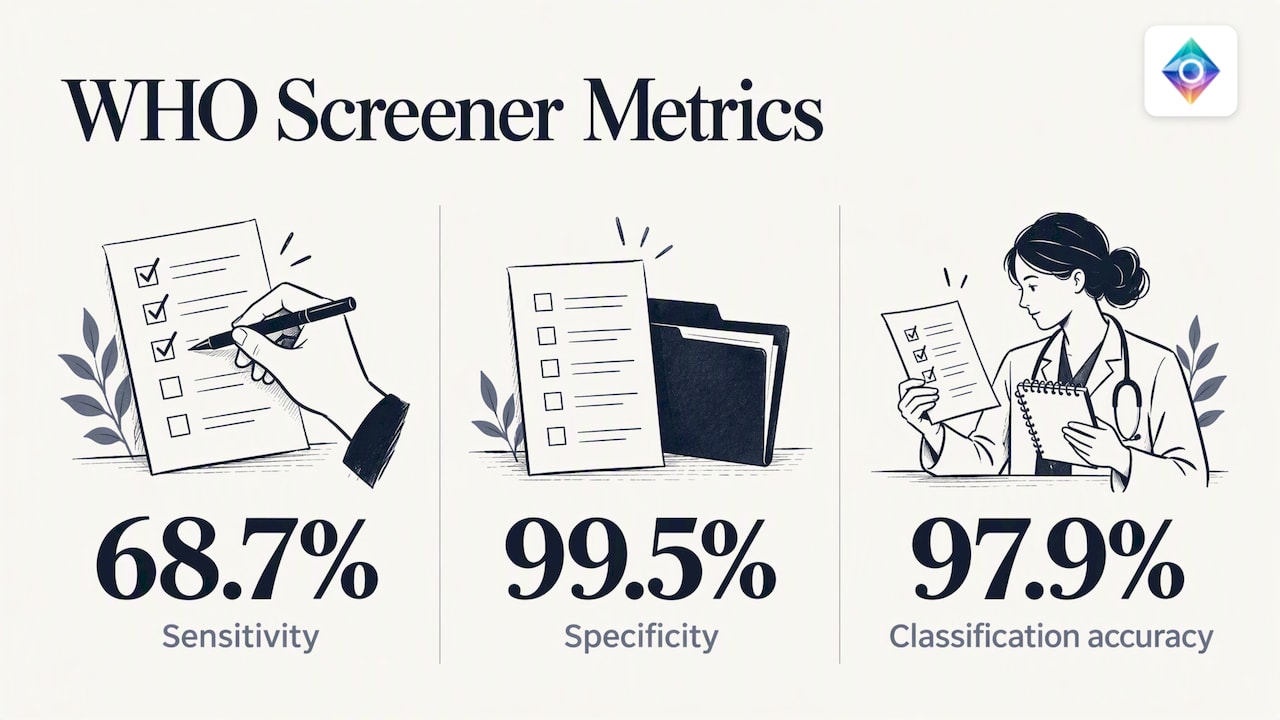
The numbers show why. In the original WHO validation, the six-question screener reached 68.7% sensitivity and 99.5% specificity in a community sample, with 97.9% total classification accuracy (Kessler et al., 2005). That means it caught roughly seven in ten people with clinically rated ADHD while rarely flagging people without it, in that sample.
A later analysis found a different picture in general population samples. It reported ASRS-positive rates of 26.0% in a UK sample and 17.3% in a US sample, against an expected ADHD prevalence of 2.5%, and estimated a positive predictive value of about 11.5% (2020 peer-reviewed analysis). Taken together, these findings say that the same screener can look very accurate in one study design and produce many false alarms in another.
The Australian ADHD Professional Association guideline gives the vocabulary. Sensitivity is the share of people with ADHD who are correctly identified, specificity is the share of people without ADHD who are correctly identified, and moving a cut-off trades missed cases against false positives (AADPA guideline). It also warns that specificity can be low in people with other mental-health conditions whose symptoms overlap with ADHD, such as anxiety or low mood.
Pro Tip: Before you book an assessment, write down two or three examples from childhood and two from today, one from work or study and one from home. Clinicians look for symptoms in at least two settings, and concrete examples carry more weight than a score.
What should you do after a high ADHD score?
The clinical review recommends specialist assessment, and suggests gathering a few things first: corroboration from a partner or family member, evidence that symptoms began in childhood, symptoms in at least two settings such as work and home, and any alternative explanations (PMC review). CHADD likewise recommends that significant people in your life, such as a spouse, relative, employer or colleague, complete rating forms too, because self-report is subjective (CHADD clinical tools).
A practical order of action looks like this:
- Keep your score and the version of the scale you used, so a clinician can read it correctly.
- Ask someone who knew you as a child, or find old school reports, to help show onset before adulthood.
- Note where symptoms cost you something: missed deadlines, relationships, safety, money, health.
- Rule out contributors that mimic ADHD, such as poor sleep, anxiety, depression or thyroid problems, with your GP.
- Ask your GP about an NHS referral and your options for a private assessment, and bring your notes.
Our guides on when impairment spans two areas in a UK ADHD diagnosis and five things to bring after a self-screen go through this preparation in more detail. If study is where symptoms bite hardest, the question of self-paced versus scheduled courses can also matter while you wait for an assessment.
Can adults use the ASRS to assess a child or teenager?
They should not. The ASRS is an initial symptom-assessment tool for adults, whereas children and teenagers are assessed with youth rating scales completed by parents, caregivers, family members or educators, and these scales are one component of a comprehensive evaluation, according to CHADD.
If you are a parent, that means your own answers about your child’s behaviour belong on a child-specific form, ideally alongside a teacher’s view. Our guide to teen ADHD signs shows how everyday behaviour can be turned into notes a clinician can use.
How Omniprism helps you use your score
Omniprism is a free self-assessment that gives an instant plain-language profile across 14 areas, including ADHD, autism, dyslexia, masking and sensory processing. It needs no email, account or data collection. Families can use guided versions for children aged 7 to 10 and 11 to 13.
Once you have finished, the optional Specialist Briefing turns your results into a summary written for clinicians, for a one-off €9.99. You can start with the free self-assessment and decide afterwards whether a briefing is useful. If you are weighing the options, what an ADHD assessment costs compares the free and paid routes.
Our perspective on ADHD scores
We built Omniprism because a number on its own rarely helps anyone. A score can feel like a verdict, either relief or alarm, when it is really a prompt for a better conversation. The people we hear from most often are those who want to arrive at an appointment with something organised instead of a vague feeling.
I was diagnosed with ADHD at 42, and what would have helped me earlier was a clear picture of my patterns that I could put in front of a professional.
Our view is that a good self-assessment should be private, readable without a psychology degree and honest about its limits. It is not a diagnosis, and we say so. Its job is to help you describe your experience in terms a clinician recognises, and to show your strengths as well as your difficulties. Our article on why self-assessment is not diagnosis sets out where that line sits.
— Valerio Cozzi
FAQ
What is a good or bad ADHD score?
There is no good or bad score. A higher score means you reported symptoms more often, and on Part A of the ASRS, four or more shaded marks is the threshold for further investigation (ASRS v1.1 checklist). A lower score does not exclude ADHD if impairment and history point to it.
Is the ASRS accurate?
It depends on who is being screened. In the 2005 WHO validation the six-question screener had 99.5% specificity, while a later analysis estimated a positive predictive value of about 11.5% in population samples (Kessler et al.; 2020 analysis). It is a useful first filter, and a clinician makes the diagnosis.
Can I get diagnosed from an online ADHD score?
No. Diagnosis needs a clinical evaluation of impairment, childhood onset, symptoms across settings and other explanations (clinical review). Your score is best treated as supporting information for that appointment.
Why did I get a different result on a different website?
Versions, question sets and scoring rules vary. One page may count shaded boxes on six questions, another may total all 18 items into bands, as one GP practice page does, so the numbers are not comparable.
Who should I show my score to?
Start with your GP, who can check for other causes and discuss referral. You can also bring the score and your notes to a private specialist, and our clinician-ready evidence guide explains how to present them.
Sources
- The World Health Organization Adult ADHD Self-Report Scale (ASRS), PubMed, 2005
- Screening for adult ADHD using brief rating tools, PubMed Central
- ADHD Screening and Identification, Australian ADHD Professional Association guideline
- ASRS v1.1 Symptom Checklist, Boston Children’s Hospital
- Clinical Practice Tools, CHADD
- Appendix O: Adult ADHD Self-Report Scale, Australian comorbidity guidelines
- Adult ADHD Self-Report Scale (ASRS v1.1), St Luke’s Medical Practice
Recommended
- ADHD Assessment Cost: Free Screen or Paid Report?
- Speed Your UK ADHD Diagnosis: 5 Things to Bring After a Self Screen
- ADHD Red Flags: What Parents and Adults Should Know
- UK ADHD Diagnosis: When Impairment Spans Two Areas
Written and edited by Valerio Cozzi, founder of Omniprism. Omniprism began after my own ADHD diagnosis at 42.
This article is educational. It is not medical advice, not a diagnosis, and not a substitute for assessment by a qualified clinician. The Omniprism self-assessment is free, needs no account and no email address, and runs entirely in your browser — your answers are never sent to a server. The optional Specialist Briefing report is a paid add-on.