Stimming in Adults: Is It Normal and What Does It Mean?
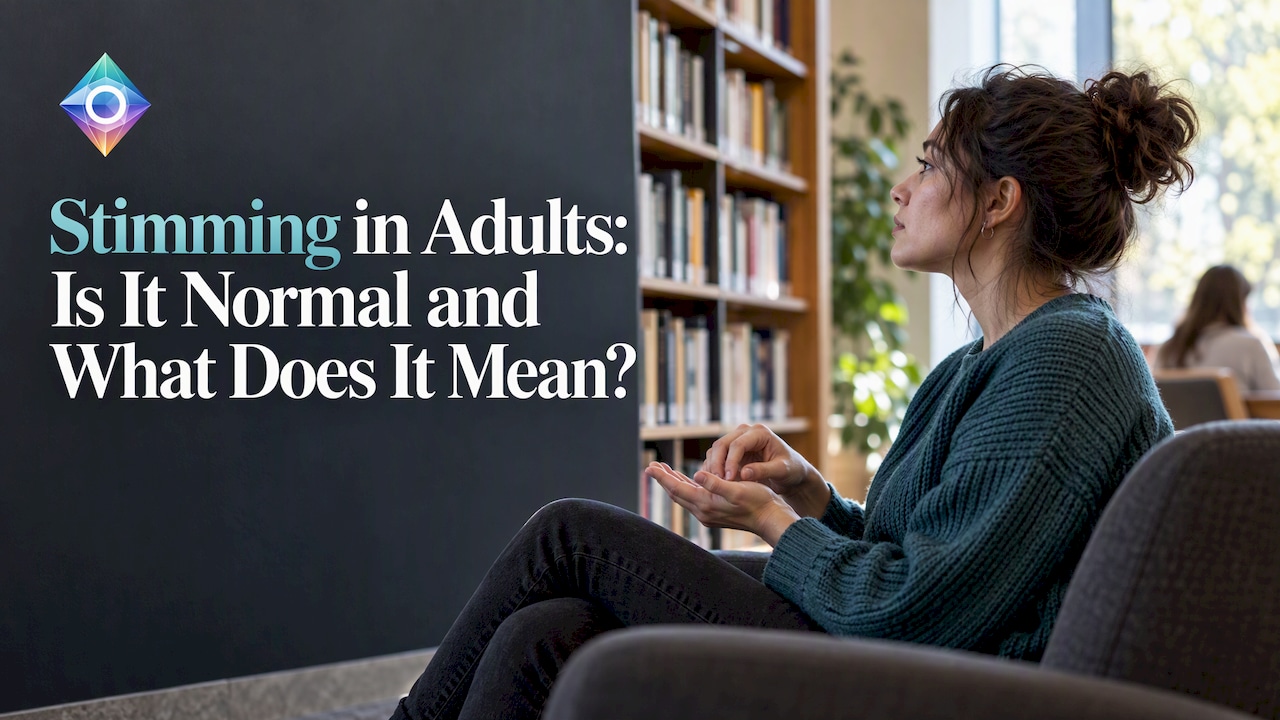
Stimming in adults is repeated movements, sounds or sensory actions that people use to regulate, enjoy or express a sensory or emotional state, and it is a normal human behaviour that becomes a concern only when it causes harm or blocks daily life. It is best known in autistic people, and research that included non-autistic adults too found that some non-autistic adults stim as well.
Key takeaways
- Stimming is common, often calming or pleasurable, and NHS guidance advises against discouraging it unless it is harmful or seriously disrupts important tasks.
- Stimming alone does not show that someone is autistic. Clinicians look for a lifelong pattern across several areas of life.
- What a stim does for you (calm, alertness, joy, expression) tells you more than how it looks.
- If a stim causes injury or signals acute distress, speak to a GP or another professional rather than relying on self-assessment.
- Notes on triggers, settings and function are more useful in an appointment than a list of movements.
Is stimming normal?
Yes. Stimming is a normal way for a nervous system to manage input, and the evidence suggests it is not limited to one diagnosis. A survey of 340 adults (160 diagnosed autistic, 139 suspected autistic and 41 non-autistic) found more stimming and greater sensory sensitivity in the diagnosed and suspected-autistic groups, while some non-autistic adults also reported stimming.
Most people have habits that look a lot like stims: tapping a foot in a meeting, twirling hair while reading, clicking a pen during a phone call. What shifts a behaviour into the territory clinicians pay attention to is frequency, intensity, distress and impact, not whether it looks unusual to other people. The Leicestershire Partnership NHS Trust describes stimming as a way to channel excess energy and self-soothe.
What are examples of stimming in adults?
Examples fall into sensory categories. The lists below draw on Nottinghamshire Healthcare NHS Foundation Trust and on the NHS signs of autism in adults page.
| Type | Examples |
|---|---|
| Movement | Rocking, swaying, spinning, pacing, jumping, fidgeting |
| Hands and fingers | Hand flapping, finger flicking, tapping |
| Tactile | Nail biting, hair twirling, skin rubbing or scratching |
| Vocal | Humming, repeating sounds or words, other vocal noises |
| Visual | Watching lights or movement, arranging objects, repeating patterns |
| Oral | Chewing, biting, sucking on objects |
The same movement can serve different purposes in different people. One person flaps when excited, another rocks when overwhelmed, a third taps to stay alert in a dull meeting. That is why a list of behaviours cannot tell you much without the context around them.
If you are unsure whether a habit is a stim or an ordinary fidget, our guide to stimming versus fidgeting walks through how to tell them apart using a 14-area self-check.
Why do adults stim?
Adults stim for several reasons, and one person often has more than one. The Leicestershire NHS page and the NHS England guidance on autistic adults in mental health services describe stimming as potentially calming, pleasurable, communicative or alerting. In practice, adults commonly report stimming to:
- Settle anxiety or sensory overload.
- Wake up when bored or drowsy.
- Enjoy a texture, sound, movement or pressure.
- Create predictability in an unpredictable setting.
- Concentrate on a task.
- Express strong feelings, positive or negative.
In the 2019 interview and focus-group study of 32 autistic adults, participants described stimming as a way to soothe or communicate intense emotions or thoughts. They also objected to interventions whose only goal is to eliminate it. Nottinghamshire Healthcare puts the underlying idea simply: the brain looks for sensory input much as the body looks for food, and if the environment does not supply it, the person may supply it themselves.
Sensory profiles differ from person to person
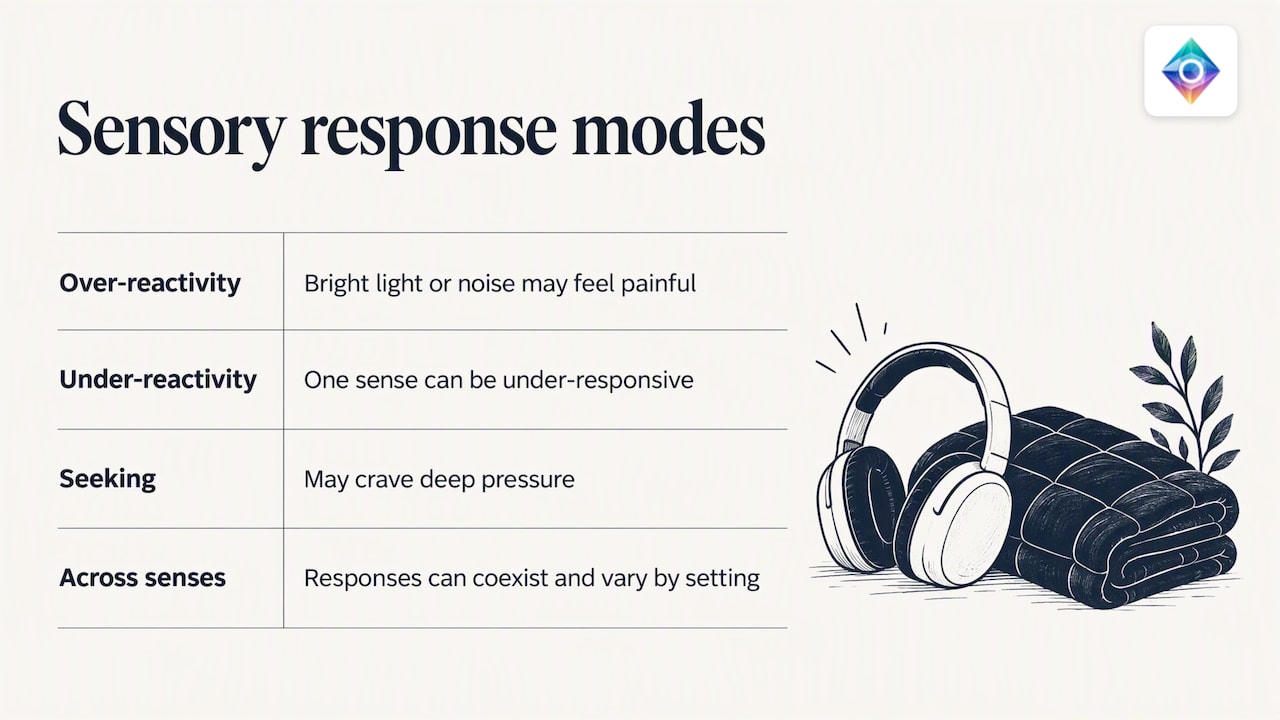
NHS England’s 2023 guidance notes that sensory over-reactivity, under-reactivity and sensory seeking can coexist in the same adult and vary by setting. Bright light or noise may be painful for one adult and sought out by another, and one person can be over-responsive in one sense and under-responsive in another. So a person might wear noise-cancelling headphones and also crave deep pressure.
Sensory preferences are visible well before adulthood. A parent’s guide to sensory play shows how sensory seeking and sensitivity appear in childhood. For adults, our article on sensory processing in UK neurodivergent adults covers NHS and occupational therapy routes.
Does stimming mean you are autistic or have ADHD?
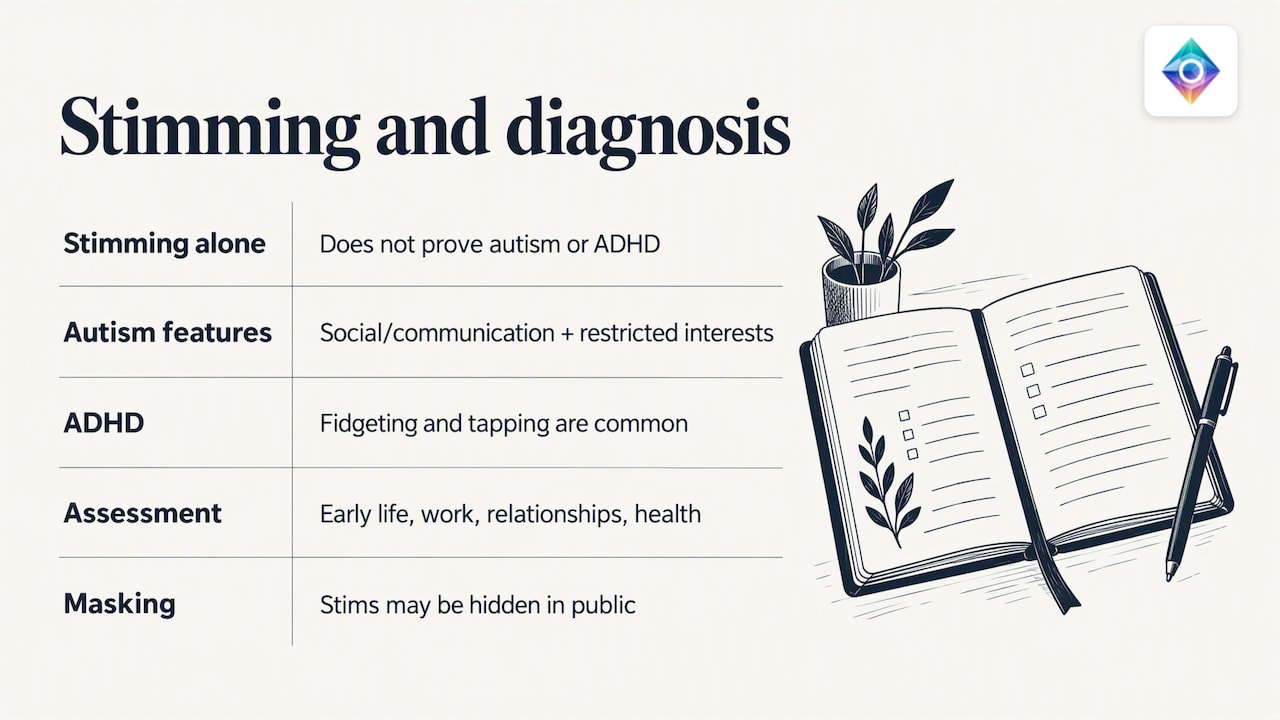
Not by itself. The NHS lists rocking, hand flapping and finger flicking among possible signs of autism in adults, but the NICE guideline on autism in adults describes a lifelong condition with persistent differences in social interaction and communication, combined with restricted interests or rigid, repetitive behaviour. Assessors consider how this plays out across early life, education or work, relationships and health.
ADHD is a separate question. Fidgeting and tapping appear on the lists above, and they are common in many people, so they cannot settle anything alone. What a clinician needs is the whole picture.
Masking complicates this. Many adults suppress visible stims in public and release them in private, which means an observer may see little. A 2024 systematic review of 35 studies of autistic adults’ self-reported repetitive behaviours found that sensory sensitivity, stress, self-regulation, masking, social pressure and recovery are linked themes. Its database search ran to February 2023, so it reflects research available up to then. For more on hidden signs, see how masking hides adult autism signs.
Is stimming a problem, and when should you seek help?
Stimming is not a problem merely because it looks unusual. The Leicestershire NHS guidance suggests not discouraging it unless it is harmful or seriously disrupts learning or important tasks.
Get professional support when a stim:
- causes injury, such as skin picking that breaks the skin or head banging;
- involves dangerous objects or substances;
- stops you doing essential things like working, eating or sleeping;
- appears suddenly or intensifies alongside acute distress.
NICE’s public information on challenging behaviour in autism says that physical or mental health problems, relationship or communication difficulties, sensory sensitivities and changes to routine can all lie behind distressing behaviour, so these are looked at first. In practice, a GP is the usual first contact. Make the environment safer in the meantime and note any pain, illness, noise or stress that coincides with the behaviour.
Why trying to stop it often backfires
NHS guidance warns against abruptly removing an established stim, because removing the behaviour can increase distress without meeting the need behind it. A safer substitution usually stays within the same sensory category, according to the Nottinghamshire Healthcare guidance: deep pressure or squeezing for pressure-seeking, rhythmic movement for movement-seeking, and a chew-safe item for oral input.
Pro Tip: For one week, write down each time you stim: where you were, what was happening, what you felt before and after. Patterns in function (calm, alertness, joy) often show up within days.
How does stimming affect work and relationships?
Suppression is costly. In the 2019 study above, participants described social non-acceptance as a problem. A UK workplace study of 285 autistic adults, 88 non-autistic neurodivergent adults and 99 neurotypical adults found masking was used as an adaptive response to workplace pressures, and that autistic and other neurodivergent participants reported distinctive pressure because of limited workplace understanding.
That supports practical conversations over blanket suppression. Reasonable steps include:
- asking for short sensory breaks away from the open-plan floor;
- agreeing that a quiet fidget item or movement break is acceptable;
- explaining to a trusted colleague or manager that a repetitive movement helps you focus.
Our guide on stopping sensory overload at work gives four quick steps for UK employees. If you are exhausted from years of holding it in, autistic burnout recovery is worth reading too.
How do you prepare for an assessment if you stim?
A list of visible movements will not carry you far in an appointment. NICE says an adult autism assessment should accommodate communication needs and sensory sensitivities, may use questionnaires such as the AQ-10, and should look at early life, education or work, relationships, health and daily functioning.
Bring notes on:
- Triggers and sensory conditions (noise, light, crowds, textures).
- What each stim achieves: calming, alerting, enjoyable, expressive.
- Whether masking changes it in public or at work.
- The impact on work, study or relationships.
- Any injury.
- What you remember from childhood, and what family members recall.
A self-assessment can organise these observations, but it cannot replace a comprehensive clinical assessment.
Our perspective on stimming
We built Omniprism because most adults who wonder about stimming do not need a verdict. They need words for what their body already does and a clearer account to hand to a clinician. I was diagnosed with ADHD at 42, and I know from that how long it can take to find a framework that fits.
Our view is that the function of a behaviour is the right starting question. A tap, a hum or a rock tells us little until we know what it gives the person. That is why our self-assessment covers 14 areas, including ADHD, autism, dyslexia, masking, sensory processing and high sensitivity, and shows a plain-language profile instantly. It asks for no email, no account and no data collection, so you can reflect without pressure.
We also hold a firm line on what a self-assessment is. It organises what you notice. It does not diagnose, and stimming alone should never be read as proof of any condition.
— Valerio Cozzi
Try the self-assessment
If you want to see how stimming sits within your wider sensory and attention profile, take the free Omniprism self-assessment. Children and teens have guided versions, including ages 7 to 10 and ages 11 to 13. If you are heading to a clinician, the optional Specialist Briefing summarises your results for them for 9.99 EUR, one-off.
FAQ
Is it normal to start stimming as an adult?
Many adults notice stimming only when they begin looking closely at their habits, rather than starting from nothing. A sudden new or escalating behaviour is different, and a GP should look at stress, pain, illness, medication and mental health. NICE lists changes to routine and health problems among the possible drivers of distress.
Can non-autistic people stim?
Yes. The survey of 340 adults linked above included 41 non-autistic participants, and some of them also reported stimming. Stimming appears more often in autistic groups, but it does not belong only to them.
How can I stim discreetly at work?
Choose a stim that keeps the same sensory function but draws less attention: pressing your palms together for pressure-seeking, or a small tactile object for touch. Do not force a swap, because abruptly removing an established stim can raise distress. A brief word with your manager about sensory breaks is often more sustainable than constant suppression.
What are examples of oral stimming?
Oral stims include chewing, biting and sucking on objects, as well as humming or repeating sounds. Where input is craved, a chew-safe sensory item is the usual same-category substitute. If chewing causes injury or involves unsafe objects, see a GP.
Sources
- Stimming and autism, Leicestershire Partnership NHS Trust
- Stimming, Nottinghamshire Healthcare NHS Foundation Trust
- Meeting the needs of autistic adults in mental health services, NHS England (2023)
- Signs of autism in adults, NHS
- Autism in adults, NICE guideline CG142
- NICE: What support should I be offered for challenging behaviour?
- NICE: How do I get help for autism?
- Autistic and non-autistic adults’ accounts of sensory experiences and stimming, Goldsmiths (2021)
- Autistic adults’ views and experiences of stimming, UCL Discovery (2019)
- Self-report of restricted repetitive behaviors in autistic adults: a systematic review, University of Bath (2024)
- The workplace masking experiences of autistic, non-autistic neurodivergent and neurotypical adults in the UK, UCL Discovery
Recommended
- Decide Faster: Stimming vs Fidgeting With a 14 Area Self Check
- Masking Hides Adult Autism Signs: UK NHS Steps to Assess
- Sensory Diets for Adults: Start With a Two Minute Self Assessment
Written and edited by Valerio Cozzi, founder of Omniprism. Omniprism began after my own ADHD diagnosis at 42.
This article is educational. It is not medical advice, not a diagnosis, and not a substitute for assessment by a qualified clinician. The Omniprism self-assessment is free, needs no account and no email address, and runs entirely in your browser — your answers are never sent to a server. The optional Specialist Briefing report is a paid add-on.