Decide Faster: Stimming vs Fidgeting With a 14 Area Self Check
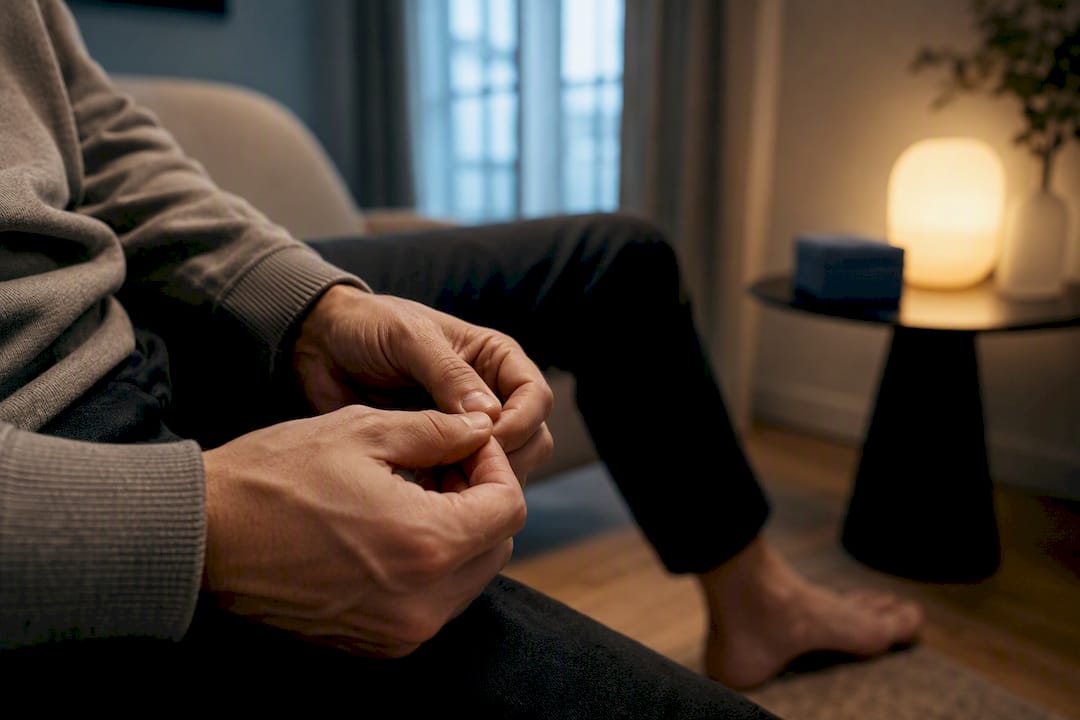
Stimming is repetitive self-stimulatory behaviour that regulates sensory input, emotion, or communication, and is strongly associated with autism. Fidgeting is smaller, lower-intensity repetitive movement that mostly regulates attention and arousal, common in ADHD and neurotypical people alike. The two overlap constantly, and context, not the movement itself, often decides which label fits.
TL;DR:
- Fidgeting is often unconscious and low-intensity, helping regulate focus and alertness, especially in ADHD, but can become disruptive if excessive.
- Stimming involves more complex, rhythmic behaviors aimed at sensory, emotional, or communicative regulation, and is more frequent in autistic individuals.
- The key difference lies in function: fidgeting primarily supports attention, while stimming manages sensory overload or emotional states.
- Many autistic stims are more elaborate and occur more frequently than ADHD-related fidgeting, with social visibility influencing suppression and wellbeing.
- Most non-harmful stimming and fidgeting require no intervention, but support is necessary if behaviors cause injury, restrict daily activities, or escalate suddenly.
What is fidgeting?
Fidgeting covers small, low-intensity repetitive movements people use to raise alertness or burn off excess restless energy. It’s usually brief, often unconscious, and rarely disrupts whatever the person is doing at the same time, which is part of why it gets dismissed as a minor habit rather than examined as a regulation strategy.
Common examples include:
- Leg bouncing or foot tapping under a desk
- Pen clicking or tapping during a meeting
- Hair twirling, ring spinning, or nail picking
- Subtle oral behaviours like chewing a pen lid or lip biting
- Doodling in the margins of a notebook
CHADD’s guidance on fidgeting describes how these small movements can genuinely help sustain focus rather than steal it, particularly for people whose brains need extra stimulation to stay engaged with a task. Fidgeting turns adaptive when it quietly supports concentration during a lecture or a long call. It turns disruptive when it becomes loud, repetitive enough to distract others, or so constant that it draws unwanted attention in a classroom or workplace.
What is stimming?
Stimming is short for self-stimulatory behaviour, and it’s a wider, more varied category than fidgeting. These are repetitive actions that serve a sensory, emotional, or sometimes communicative purpose, and they tend to be more sustained and rhythmic than a passing fidget.
Researchers and clinicians usually group stims by sensory channel:
- Movement (vestibular): rocking, spinning, jumping
- Tactile: rubbing textures, hand-flapping, skin picking
- Auditory: repeating words or sounds, humming, echolalia
- Visual: watching spinning objects, flicking fingers in front of the eyes
- Oral: chewing, mouthing objects, teeth grinding
Most stims are harmless and even useful. A smaller subset, such as skin picking to the point of injury or head banging, cause physical harm and need a different response.
Stimming is not exclusive to autism. Everyone stims to some degree, but autistic adults themselves report that stimming often serves distinct self-regulatory and social-communicative functions, and it tends to appear more frequently and with more complexity in autistic people than in the general population.
What are the key differences between stimming and fidgeting?
The clearest split is functional. Fidgeting is largely about attention and arousal, keeping a restless or under-stimulated brain engaged. Stimming more often regulates sensory overload, emotional intensity, or serves as a form of self-expression.
There’s also a measurable difference in form. A 2024 comparative analysis in European Psychiatry found autistic stimming is typically more complex and more frequent than the fidgeting seen alongside ADHD, which tends to be simpler and more sporadic, tied to moments where sustained focus is needed. Separate experimental work published in PLOS One found no general evidence that stimming harms attention, and suggested it may actually support regulation in people who stim habitually.
Social meaning matters just as much as mechanics:
- A leg bounce under a table is barely noticed; a repeated vocal stim in the same setting draws stares
- That visibility gap pushes many autistic people toward masking, suppressing stims in public
- Suppression is linked to increased anxiety and reduced wellbeing, not improved coping
Stims also differ from tics and OCD compulsions. Tics are sudden and often preceded by an urge, with little rhythm. Stims tend to be patterned, rhythmic, and frequently experienced as soothing rather than intrusive, according to Great Ormond Street Hospital’s overview of repetitive movements. OCD compulsions are driven by intrusive anxious thoughts and a need to neutralise them, which stimming and fidgeting generally are not.
Pro Tip: If a repetitive movement calms rather than distresses the person doing it, treat it as regulation first, not a problem to fix.
How do stimming and fidgeting show up in ADHD and autism?
Both behaviours appear across ADHD and autism, and plenty of people carry traits of both, which makes clean labelling difficult in practice. The Cambridge comparative analysis found autistic stimming tends toward higher complexity and frequency, while ADHD-related fidgeting more often functions to lift cortical arousal and hold attention during a task. CHADD makes the same point from a clinical perspective: fidget tools for adults with ADHD, such as spinner rings or putty, are often recommended specifically because low-level movement helps sustain concentration rather than break it.
Some practical signs that lean toward one label over the other:
- Movements tied closely to sensory triggers (bright lights, loud noise, certain textures) point toward stimming
- Movements that appear mainly during boredom or under-stimulation, and vanish once a task gets interesting, point toward fidgeting
- Rhythmic, whole-body, or vocal patterns lean stimming; small, localised, object-based movements lean fidgeting
Comorbidity between autism and ADHD is common, and self-report from autistic adults consistently describes both regulation and enjoyment as reasons for stimming, not just coping. A deeper look at how the two conditions overlap more broadly is worth reading if autism and ADHD symptoms both feel relevant to you.
When does stimming or fidgeting need extra support?
Most stimming and fidgeting needs no intervention at all. NICE guidance on autism explicitly recommends accepting non-harmful repetitive behaviour rather than trying to eliminate it, and only stepping in when a behaviour causes injury or blocks daily functioning.
Watch for these signals, and act if you see them:
- Self-injury — skin breaking, bruising, or head banging that causes pain
- Interference with learning or daily life — a stim that makes it impossible to eat, sleep, or attend school or work
- Sudden change — a new or escalating behaviour appearing out of nowhere, which can signal distress, pain, or an unmet need worth investigating
Where support is needed, Leicestershire Partnership NHS Trust’s guidance recommends offering a safe stim space, swapping a harmful stim for a safer equivalent that gives the same sensory feedback, and avoiding suppression unless there’s a genuine safety reason. Before an appointment, note when the behaviour happens, what triggers it, and how long it lasts. Clinicians typically ask exactly that.
Where does Omniprism fit into this?
Valerio Cozzi founded Omniprism after being diagnosed with ADHD at 42, an age at which many adults are only just starting to recognise patterns they’d spent decades explaining away.
“Getting a diagnosis that late means you spend years quietly wondering whether a habit is a quirk or something worth naming,” Valerio says. “A structured self-assessment won’t replace a clinician, but it gives you language and evidence you didn’t have before.”
Tracking whether a movement calms you, distracts you, or helps you focus is exactly the kind of detail a clinician wants. Omniprism’s free neurodivergence self-assessment covers 14 areas including ADHD, autism, and sensory processing, and produces a plain-language profile you can bring to that first conversation.
The take that gets missed in most explainers
Most articles on this topic treat stimming as something to manage and fidgeting as something to shrug off. That split undersells both. The PLOS One data found no general attentional cost to stimming, which quietly undercuts decades of advice built on the assumption that repetitive movement is always a distraction to eliminate.
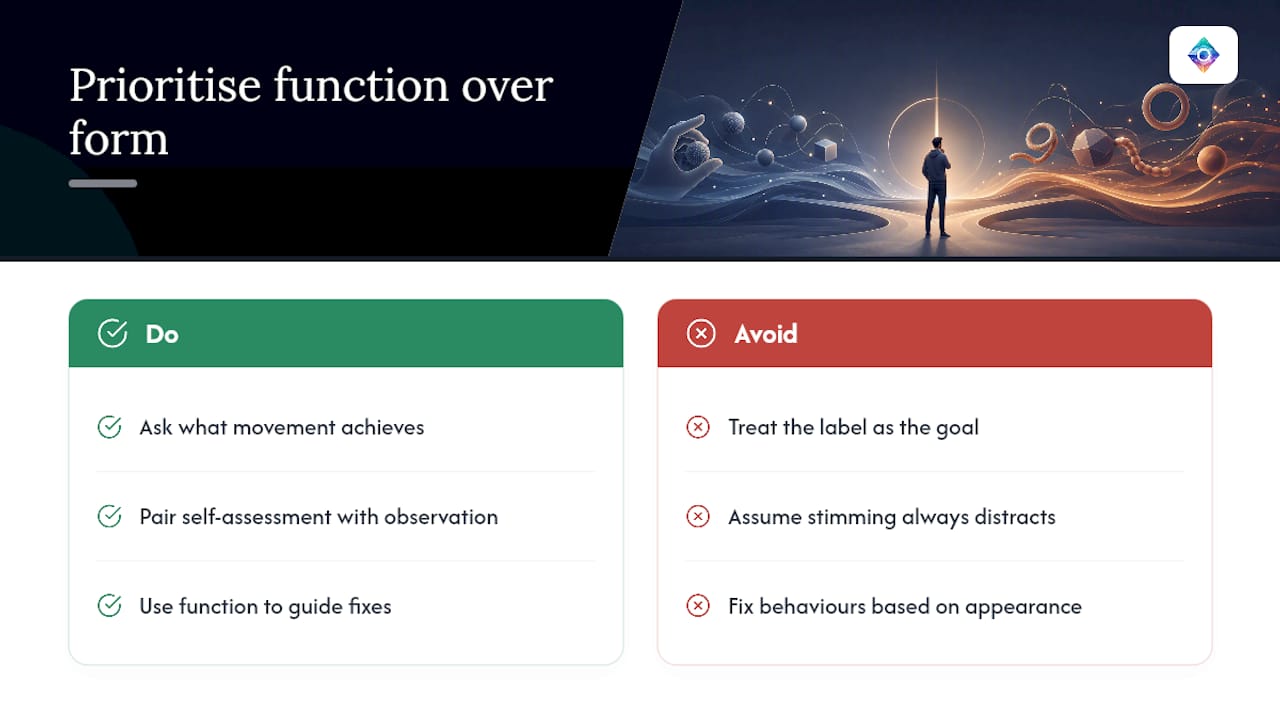
The bigger gap in conventional advice is that it treats the label as the goal, when the label is only useful insofar as it tells you what the behaviour is doing for the person. A rocking motion that soothes sensory overload and a knee bounce that keeps someone awake in a dull meeting are solving different problems, even though they look similar from across the room.
If you take one thing from this, prioritise function over form. Before reaching for a fix, ask what the movement is achieving, not what it looks like. That’s also the logic behind pairing a self-assessment with your own observation before a clinical appointment, rather than walking in with a label and hoping it sticks. For readers weighing up focus strategies more broadly, AmmarAI’s study tools cover related ground on managing attention in academic settings.
— Valerio Cozzi
This article is general information, not a substitute for advice from a qualified doctor. Consult a qualified healthcare professional about your own circumstances before acting on anything here.
Sources
- Comparative analysis of self‑stimulatory behaviors in ASD and ADHD
- Stimming and attention experimental study (PLOS One)
- Stimming and autism | Leicestershire Partnership NHS Trust
- Stimming and Fidgeting to Calm and Focus | CHADD
FAQ
Is it normal to stim without being autistic?
Yes. Everyone stims to some degree, and it’s common among neurotypical people, though it tends to appear more frequently and with more complexity in autistic people.
Why do autistic children say “eeee” or repeat sounds?
Repeating sounds is a form of auditory or vocal stimming that can regulate emotion, express excitement, or serve a self-soothing function, and it’s a well-documented pattern in autistic children.
Do people with ADHD stim like autistic people do?
Both groups can display repetitive movement, but CHADD’s clinical guidance and the 2024 Cambridge comparative analysis both note that ADHD-related movement is usually simpler and geared toward sustaining attention, while autistic stimming tends to be more frequent and complex.
Is fidgeting a form of stimming?
Fidgeting sits within the broader stimming category but is generally smaller, lower-intensity, and focused on attention and arousal rather than sensory or emotional regulation.
Recommended
- ADHD Task Paralysis: Why You Freeze and How to Start
- Spot Twice Exceptional Autism: Use a 14 Domain Self Check to Build Evidence
- ADHD vs. OCD: Key Differences, Overlap, and Next Steps
- What Is Autistic Inertia, and Why Does Starting Feel Impossible?
Written and edited by Valerio Cozzi, founder of Omniprism. Omniprism began after my own ADHD diagnosis at 42.
This article is educational. It is not medical advice, not a diagnosis, and not a substitute for assessment by a qualified clinician. The Omniprism self-assessment is free, needs no account and no email address, and runs entirely in your browser — your answers are never sent to a server. The optional Specialist Briefing report is a paid add-on.