Recover from Autistic Burnout: Start at 50–60% and Avoid Relapse
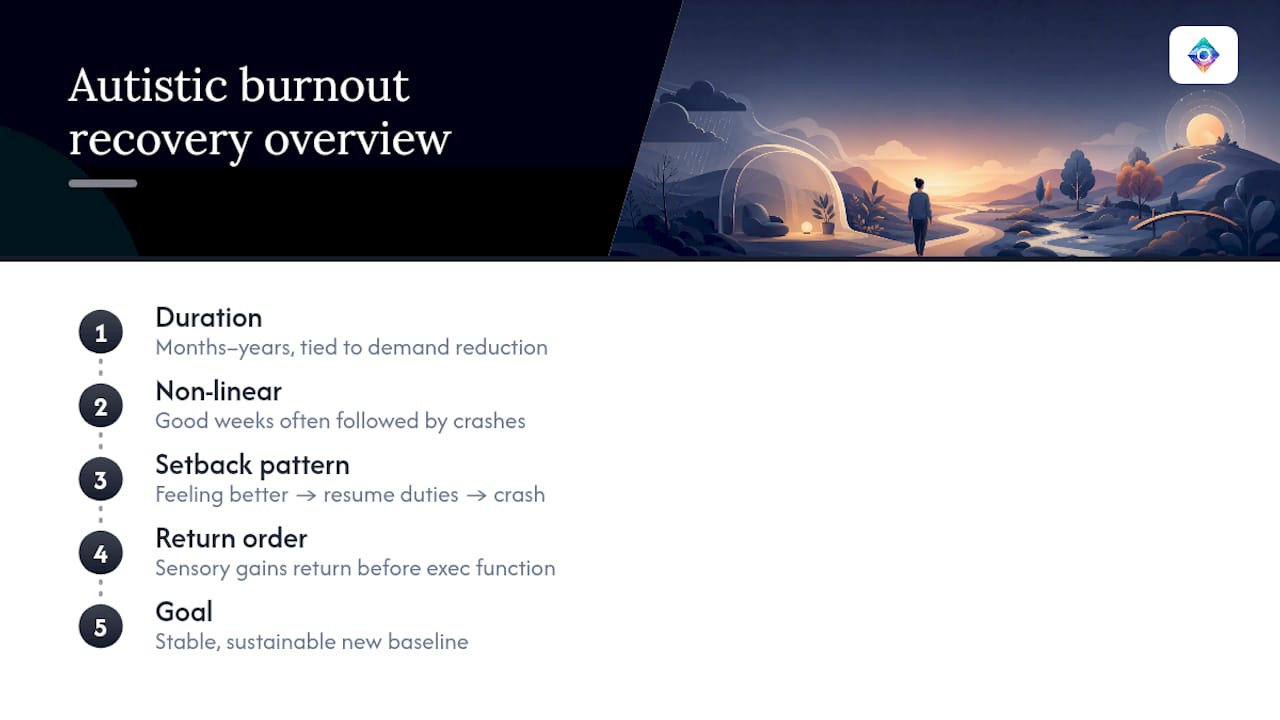
Recovery from autistic burnout is possible, but it typically takes months rather than weeks, and for many people it stretches into years. The single biggest factor is whether the demands that caused the burnout have genuinely reduced, not how much rest you’ve had or how hard you’re trying to feel better. Early signs of progress usually show up as small gains in sensory tolerance, long before energy or motivation return. The most common mistake is treating that first flicker of improvement as a green light to resume full responsibilities, which tends to trigger a relapse.
TL;DR:
- Recovery duration depends on how thoroughly demands have been reduced, with some cases taking months and others stretching into years.
- Sensory tolerance tends to improve first during recovery, while executive function and planning lag behind by months.
- Reducing workload and sensory load before attempting to rebuild routines or self-care is crucial to avoid relapse.
- Addressing masking and social demands is essential, as unmasking gradually in private and trusted settings helps conserve energy for recovery.
- Using self-assessment tools can identify the most burdensome domains, guiding personalized demand reduction and environmental redesign.
What makes autistic burnout recovery different from depression or general burnout
Autistic burnout has a specific fingerprint: chronic exhaustion that sleep doesn’t fix, a measurable loss of skills you previously had (speech, executive function, self-care), and a sharply reduced tolerance to sensory input. Research describing autistic adults’ own accounts characterises it exactly this way, distinguishing it from workplace burnout or clinical depression by the combination of skill regression and sensory sensitivity rather than low mood alone, as detailed in the foundational definition of autistic burnout.
This distinction matters clinically. Peer-reviewed work on the topic warns that depression-focused interventions, talk therapy that pushes engagement, or return-to-work plans built around graded activity, can overwhelm an already-depleted nervous system if they don’t address the underlying demand load first. A Wiley analysis of autistic burnout makes this point directly: without demand reduction, standard interventions risk deepening the very exhaustion they’re meant to treat.
Misdiagnosis is common, partly because clinicians unfamiliar with autism read the symptoms as depression or anxiety and prescribe accordingly.
- Chronic exhaustion unrelieved by sleep or rest
- Loss of previously reliable skills: speech, planning, self-care, social scripts
- Sharply reduced tolerance to noise, light, touch, or crowds
- Withdrawal from activities that used to feel manageable
- Increased meltdowns, shutdowns, or both
Masking compounds the problem. Years of camouflaging autistic traits to fit into school, work, or social settings adds a hidden layer of cumulative load that never shows up on a stress scale but drains the same finite reserve. A guide comparing autistic burnout to depression covers the practical signs worth bringing to a GP appointment, which matters if you suspect your last diagnosis missed the mark. Recovery, in other words, needs to address the mask as well as the workload behind it.
The four pillars of autistic burnout recovery
Most recovery-focused guidance converges on a similar structure, whether it comes from clinicians, trusts, or autistic-led research. Four pillars, tackled roughly in order, give you a practical roadmap rather than a vague instruction to “rest more.”
- Safety and stabilisation. Before anything else, address immediate risk: are you eating, sleeping in some form, and safe from self-harm? This is triage, not therapy.
- Demand reduction. Strip away obligations before adding anything back in. NHS trust guidance on autistic fatigue and burnout frames this as the central lever, not a nice-to-have.
- Sensory and environmental redesign. Lower the ambient sensory cost of your daily environment: lighting, noise, clothing, unpredictability.
- Unmasking, identity work and routine rebuilding. Once the load has genuinely dropped, gradually rebuild routines that reflect how you actually function, not how you performed before burnout.
The order matters more than the content. Adding self-care activities, journalling, a new hobby, a gym routine, onto a life that still demands the same output as before burnout is like bailing water into a boat with the same hole in it. Demand has to come out first.
Measuring progress requires patience with the sequence itself. Sensory tolerance tends to return first: you can suddenly cope with the kitchen light again, or tolerate a car journey without noise-cancelling headphones. Executive function, planning, initiating tasks, following multi-step instructions, lags well behind, sometimes by months. A coping strategies resource from Leicestershire Partnership NHS Trust treats sensory tolerance as the most reliable early indicator, which is worth knowing if you’re tracking your own recovery and feeling discouraged that your inbox still feels impossible.
Pro Tip: Track sensory tolerance, not productivity, for the first few months. A short daily note (“today I could handle the supermarket lighting, yesterday I couldn’t”) gives you a truer read on recovery than asking whether you got anything done.
How do I start recovering from autistic burnout right now?
Start with stabilisation, not ambition. The steps below are ordered by urgency, and none of them require you to have your life figured out first.
- Check basic safety first. Are you eating something, even if it’s the same three foods on rotation? Is medication being taken as prescribed? If you’re having thoughts of self-harm, that overrides every other step here, see the safety section below.
- Review medication and sleep with a GP if either has slipped. Burnout often disrupts sleep architecture and appetite together; a medication review can catch interactions or dosage issues that are making things worse.
- Identify the three heaviest demands in your week and remove or delegate one immediately. This might mean cancelling a recurring social commitment, asking a partner to take over meal planning, or requesting reduced hours at work. Pick the demand costing you the most energy, not necessarily the most time.
- Cut decision load wherever possible. Eat the same few meals on rotation. Wear the same few outfits. Decision fatigue and sensory fatigue draw from the same pool, and every choice you remove is energy banked for something else.
- Set up one predictable point of contact. Whether that’s a partner, a friend, or a GP, decide who you’ll message on a bad day so you’re not trying to work out who to ask for help while already depleted.
- Negotiate a reduced-load return, not a full return. If you’re returning to work or study after time off, aim for a fraction, some guidance suggests starting around 50 to 60% of previous capacity, and hold there deliberately rather than ramping straight back up. A practical timeline and recovery guide from Simply Psychology flags “resuming full load on first improvement” as the most common way people undo weeks of progress.
- Build a simple monitoring routine. A weekly check-in with yourself, or with someone you trust, on sleep, sensory tolerance, and mood gives you an early warning system instead of discovering you’ve relapsed only once you’ve crashed again.
- Script your accommodation requests in advance. At work, something like “I need to reduce meetings to mornings only for the next month while I recover from a health issue” is specific, time-limited, and doesn’t require disclosing a diagnosis; see this educational accommodation and low-demand learning environments resource for further support on managing such needs. A practical guide to workplace accommodations has more scripts along these lines, several of which apply directly to autistic burnout even though it’s framed around ADHD.
- Protect one low-demand space in your home. A room, or even a corner, with no obligations attached to it, no work laptop, no chores, gives your nervous system somewhere to downshift without leaving the house.
None of this is about doing more. It’s about subtracting enough that whatever energy remains can go toward actual repair rather than just staying afloat.
Sensory and environmental changes that support recovery
Environmental redesign is where most people get the fastest, most measurable wins, because sensory adjustments don’t require anyone else’s permission or a diagnosis to implement.
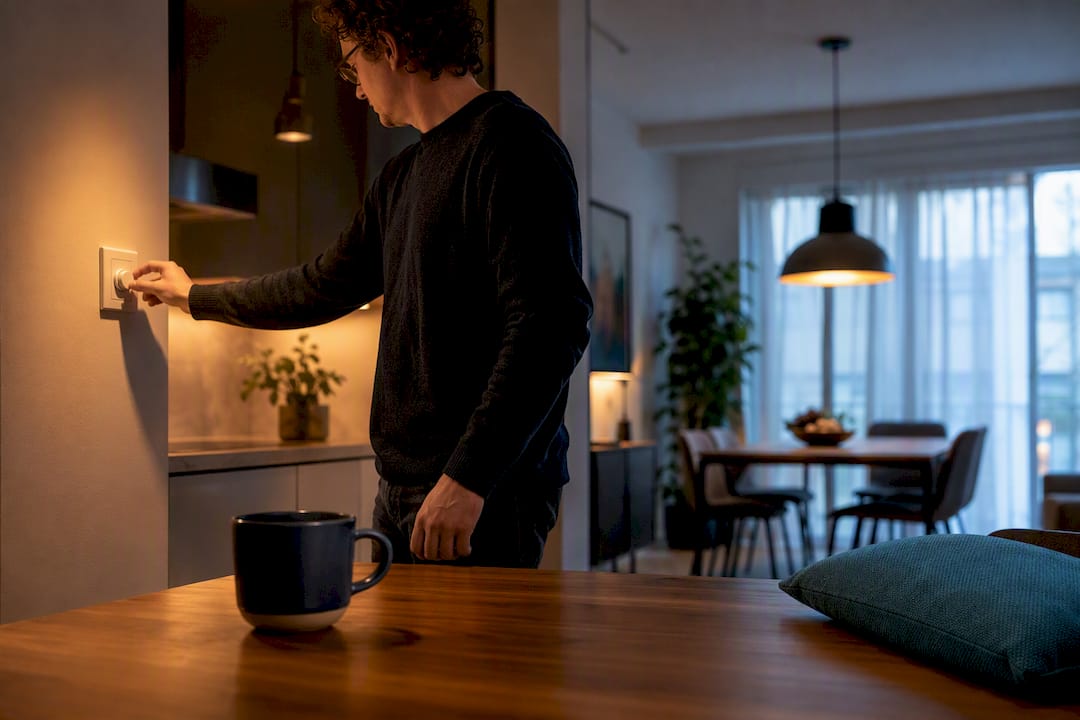
Start with what’s easiest to change and cheapest to trial. Lighting is usually the biggest lever: swapping overhead fluorescent or cool-white bulbs for warm, dimmable lighting reduces one of the most common sources of low-grade sensory drain. Noise comes next, ear defenders or noise-cancelling headphones aren’t a failure to cope, they’re a tool, and using them proactively rather than only in crisis moments tends to work better.
- Swap harsh overhead lighting for warm, dimmable, or lamp-based lighting
- Trial ear defenders or noise-cancelling headphones during predictable high-noise periods, not just emergencies
- Remove scratchy or restrictive clothing; prioritise soft, seamless fabrics
- Adjust seating: firmer or softer surfaces, weighted blankets, or rocking chairs depending on what your body seeks
- Create one entirely predictable room or corner with no sensory surprises
- Reduce background clutter and visual noise where you spend the most time
Predictability matters as much as intensity. A single loud noise is often more tolerable than living in a house where sound could spike unpredictably at any moment, because the unpredictability itself is a demand on your nervous system’s threat-detection.
Measuring change here doesn’t need to be elaborate. A simple daily check, can you tolerate the kitchen at full brightness, can you sit through a meal with background conversation, gives you a concrete signal that’s easier to trust than mood, which fluctuates for unrelated reasons. NHS trust guidance on coping strategies treats these small daily tolerance checks as a more reliable recovery marker than how “better” you feel in general terms, largely because sensory gains tend to arrive before mood or energy catch up.
Why unmasking and social support matter for recovery
Camouflaging autistic traits, forcing eye contact, scripting small talk, suppressing stimming, is expensive, and the bill comes due during burnout. Reducing that cost isn’t a lifestyle preference; guidance from the National Autistic Society on autistic burnout treats unmasking as closer to a medical necessity during recovery than an optional identity choice, because the energy masking consumes is energy your body needs for repair.
Practical unmasking doesn’t mean announcing your diagnosis to everyone at once. It’s incremental: letting yourself stim in private first, then in front of people you trust, then gradually in lower-stakes public settings. It’s also about renegotiating small daily performances, dropping the forced enthusiasm in work meetings, sitting how your body wants to sit, wearing what actually feels tolerable rather than what looks “normal.”
- Practise stimming or self-regulating behaviours somewhere private before extending to trusted company
- Drop non-essential social performances first: forced small talk, exaggerated enthusiasm, sustained eye contact
- Reintroduce eye contact, tone matching, or scripted small talk gradually, if at all, rather than all at once
- Keep a short list of people who know the real you and can be contacted without a masking tax
Saying no is a skill many autistic adults have never had to practise, because years of masking often meant saying yes by default. A useful script: “I can’t commit to that right now, I’m recovering from burnout and need to keep my load light.” It doesn’t require justification or a diagnosis disclosure, and repeating a version of it consistently tends to get easier the third or fourth time, not the first.
Peer support carries weight that professional support sometimes can’t replicate. Community-based research on burnout found that acceptance and social support from people who understood autistic experience directly correlated with better recovery outcomes, while a lack of empathy from non-autistic people in someone’s life tended to prolong it, a finding from community-based participatory research on autistic burnout. Autistic-led online communities, peer support groups, and even informal friendships with other autistic adults offer a kind of validation that’s hard to get elsewhere: being told your exhaustion makes sense, rather than being told to just try harder.

How long does autistic burnout recovery take?
There’s no fixed number, and anyone offering one is guessing. What the evidence supports is a range: months for milder or shorter episodes, years for burnout that followed prolonged, unaddressed demand mismatch. NHS trust guidance frames recovery duration as directly tied to how thoroughly demands have been reduced, not to willpower or how motivated you are to get better.
Recovery is also not linear. Expect good weeks followed by a crash that feels like starting over, it usually isn’t. A scoping review synthesising the autistic burnout literature notes that recovery patterns vary considerably between individuals, and that some people experience lasting, incomplete recovery rather than a clean return to baseline. That’s not meant to be discouraging; it’s meant to recalibrate what “recovering” looks like, which for many people means a stable, sustainable new normal rather than a return to exactly how things were before.
Setbacks often follow a predictable pattern: a stretch of feeling noticeably better, a decision to resume more responsibility, and a crash within days or weeks. The fix isn’t to avoid ever feeling better, it’s to resist the pull to immediately test that improvement against your old workload. Protect sensory gains specifically during this phase, since they’re usually the first thing to slip when demand creeps back up.
Interest in things you’d dropped, hobbies, curiosity, conversations, tends to return around the same time as sensory tolerance improves, often before executive function does. That gap between wanting to do things and being able to plan or initiate them is genuinely one of the more disorientating parts of recovery, and it’s worth knowing it’s expected rather than a sign you’re doing something wrong. An explainer on autistic inertia covers why starting tasks can feel disproportionately hard even once motivation has returned, which is directly relevant here.
When should I seek urgent help for autistic burnout?
Some signs move beyond self-management and need professional or emergency input without delay.
- Inability to manage basic self-care: not eating, not washing, not taking essential medication for more than a few days
- Thoughts of suicide or self-harm, or a sense of being unable to keep yourself safe
- Sudden, severe loss of function: loss of speech, inability to leave the house, complete shutdown lasting days
- Co-occurring conditions, anxiety, depression, or ADHD, worsening sharply alongside the burnout
If suicidal thoughts are present, contact emergency services or a crisis line in your country immediately; this takes priority over every other recommendation in this article.
When you do see a clinician, framing matters. Describing burnout purely in terms of “feeling sad” or “stressed” often leads to a depression-only treatment plan that misses the sensory and demand components entirely. Naming specific losses, “I’ve lost the ability to plan meals,” “certain sounds have become unbearable that weren’t before”, helps a clinician distinguish autistic burnout from a mood disorder. A comparison of autistic burnout and depression is worth printing out or screenshotting to bring to an appointment, particularly if you’ve had a previous diagnosis that didn’t fit.
Co-occurring conditions complicate the picture further. Anxiety often intensifies during burnout as sensory tolerance drops, and undiagnosed ADHD can mask as pure executive dysfunction rather than its own separate factor. Treating burnout in isolation, without acknowledging what else is active, tends to produce a plan that fixes one problem while ignoring another that’s making recovery harder.
What research and autistic communities say about recovery
The term “autistic burnout” has a specific academic origin worth knowing, because it grounds everything else in this article. Community-based research led by autistic researchers defined the condition through the lived accounts of autistic adults themselves, rather than imposing an external clinical framework.
“Having all of your internal resources exhausted beyond measure and being left with no clean-up crew” is how one foundational study captured the experience, distinguishing autistic burnout by its combination of pervasive exhaustion, loss of previously held skills, and reduced tolerance to stimulus, as detailed in the original defining study of autistic burnout.
The community study that followed, often cited alongside it, found burnout results from chronic life stress compounded by a mismatch between expectations and abilities, and identified acceptance, reduced expectations, and social support as the factors most associated with recovery, per the community-based participatory research that surveyed autistic adults directly about their own experiences.
Separate survey work backs this up from a different angle: sensory and social overload, not masking alone, emerged as the strongest reported contributors to burnout episodes in a BPS Research Digest summary of burnout survey findings, which is a useful corrective if you’ve assumed masking is the whole story.
None of this research claims to be complete. The 2025 scoping review of the autistic burnout literature is explicit that significant gaps remain, particularly around long-term outcomes and why some people experience lasting, incomplete recovery while others don’t. That honesty matters more than false certainty: guidance grounded in what’s actually known, with its limits acknowledged, is more useful than confident advice built on thin evidence.
A founder’s perspective on assessment and recovery planning
Valerio Cozzi, founder of Omniprism, was diagnosed with ADHD at 42, decades after the traits that shaped his working life first appeared. That late diagnosis is part of why Omniprism exists: too many adults spend years misreading their own exhaustion, sensory overwhelm, or masking as personal failure rather than something with a name and a pattern. A structured self-assessment doesn’t replace clinical care, but it does something recovery planning badly needs, it turns a vague sense of “everything is too much” into specific domains: sensory load, executive demand, masking cost. Naming the domain you’re struggling with is often the first practical step toward reducing it.
— Valerio Cozzi
Using self-assessment as an adjunct to plan your recovery
This self-assessment tool won’t diagnose autistic burnout, and it isn’t a substitute for the crisis steps or clinical review covered above. What it offers is a 14-domain instant profile covering areas including autism traits, masking, sensory processing, ADHD, and executive function, built to help you see which specific domains are carrying the heaviest load right now, without tracking apps, questionnaires that take weeks, or a waiting list.
That clarity feeds directly into the recovery pillars covered earlier. If your profile flags heavy masking load alongside sensory sensitivity, that’s a concrete signal to prioritise unmasking and environmental redesign over, say, executive function tools that won’t address the actual drain. The methodology page explains how the assessment maps these domains if you want to understand the basis before starting.
For anyone considering an assessment for a child or teenager showing early signs of burnout or masking fatigue, Omniprism also offers a guided assessment for younger people aged 11 to 13, designed to involve a caregiver in the process rather than leaving a teenager to navigate it alone. If you want a report structured specifically to bring into a clinical conversation, the optional Specialist Briefing summarises your results in a format built for that appointment, worth doing once your free profile has flagged where the load is concentrated. Full disclaimer details on scope and limitations are available on the disclaimer page.
This article is general information, not a substitute for advice from a qualified doctor. Consult a qualified healthcare professional about your own circumstances before acting on anything here.
Sources
- Having All of Your Internal Resources Exhausted Beyond Measure and Being Left with No Clean-Up Crew: Defining autistic burnout
- Defining autistic burnout — community-based participatory research (Raymaker et al.)
- Autistic burnout — distinctions and clinical implications (Wiley article)
- Autistic fatigue and burnout | Leicestershire Partnership NHS Trust
- Autistic burnout explained | National Autistic Society
FAQ
How long does it take to fully recover from autistic burnout?
Recovery typically takes months, and for burnout following prolonged unaddressed stress, it can take years; duration depends primarily on how much the underlying demands have genuinely reduced, according to NHS trust guidance.
What does an autistic shutdown look like?
A shutdown typically involves a sudden loss of speech or communication ability, withdrawal from surroundings, and an inability to process sensory input or respond to requests, distinct from a meltdown’s outward expression.
Can you fully come back from autistic burnout?
Many people recover substantially, though a recent scoping review notes recovery is variable and some people experience lasting, incomplete recovery rather than a full return to their prior baseline, which makes ongoing demand management important even after initial recovery.
How can neurodivergent individuals recover from burnout?
The core approach is reducing demands before adding recovery activities, protecting sensory tolerance as an early progress marker, and drawing on peer and social support, strategies consistently reported by autistic adults in community-based burnout research. A structured self-assessment, such as the one Omniprism offers, can help identify which specific domains, sensory, masking, executive load, need the most attention first.
Recommended
- What Is Autistic Inertia, and Why Does Starting Feel Impossible?
- What Is Pathological Demand Avoidance, and What Helps?
- Autistic Traits in Women: Signs Often Missed or Masked
Written and edited by Valerio Cozzi, founder of Omniprism. Omniprism began after my own ADHD diagnosis at 42.
This article is educational. It is not medical advice, not a diagnosis, and not a substitute for assessment by a qualified clinician. The Omniprism self-assessment is free, needs no account and no email address, and runs entirely in your browser — your answers are never sent to a server. The optional Specialist Briefing report is a paid add-on.