Sensory Seeking vs Avoiding: How to Tell the Difference
Sensory seeking is when a person looks for more sensory input, such as movement, pressure, noise or touch, while sensory avoiding is when a person steers away from input that feels too intense. Many people do both, depending on the sense, the setting and how tired or stressed they are, so the two are better read as patterns than as fixed types.
Key Takeaways
- Seeking aims to increase input and avoiding aims to reduce it, and either can show up in the same person on the same day.
- Seeking is not always under-responsiveness: an over-responsive person can also make noise or movement to block out input that distresses them.
- A checklist helps you map patterns and prepare for a conversation, but it does not diagnose anything.
- If sensory differences are constant and affect everyday life, an occupational therapist (OT) assessment is the route to personalised support.
What is the difference between sensory seeking and sensory avoiding?
The National Autistic Society describes two ends of a range. Hypersensitivity means being much more sensitive than other people, which can lead to irritation, distress or avoidance. Hyposensitivity means being much less sensitive, which can lead to looking for more intense input.
Understood puts it in everyday terms: seeking means looking for more stimulation, often because someone under-reacts or needs more input, and avoiding means pulling away from input that is experienced more intensely and feels overwhelming.
The Bury NHS sensory toolkit adds a third pattern: under-responsiveness with a passive lack of awareness, for example not noticing a hot drink or a wet sleeve. That is different from actively going after stimulation, so it is worth keeping apart when you think about your own pattern or your child’s.
| Sensory seeking | Sensory avoiding | |
|---|---|---|
| Aim | Increase input | Reduce input |
| Typical sensitivity | Often lower (under-responsive), sometimes a way to block other input | Higher (over-responsive) |
| Everyday look | Moving, touching, making noise, crashing, chewing | Covering ears, leaving crowds, refusing certain clothes or foods |
| Possible impact | Needing to move during lessons or meetings | Leaving noisy places, difficulty with washing, dressing or eating |
What are the signs of sensory seeking?
The parent-support guide from Essex County Council says seeking can appear as activity, fidgeting, being unable to sit still, running, spinning, jumping, climbing, touching, mouthing objects or making loud sounds.
Understood adds signs that are easy to overlook:
- standing too close to other people
- an unusually high pain tolerance
- heavy footsteps, jumping and crashing
- rough play
- frequent touching
- chewing non-food items such as clothing
In adults the same drive often looks quieter. The National Autistic Society gives examples such as listening to loud music, making noises or tapping and banging things. Pacing during phone calls or needing a strong flavour in every meal can belong in the same family, though those are ordinary examples rather than clinical markers.
What are the signs of sensory avoiding?
According to Essex County Council, avoidance aims to reduce input and may appear as caution with movement, leaving noisy places, covering ears, hiding, using ear defenders, disliking touch, being distracted by visual detail, selective eating, clothing dislikes or moving away from strong smells.
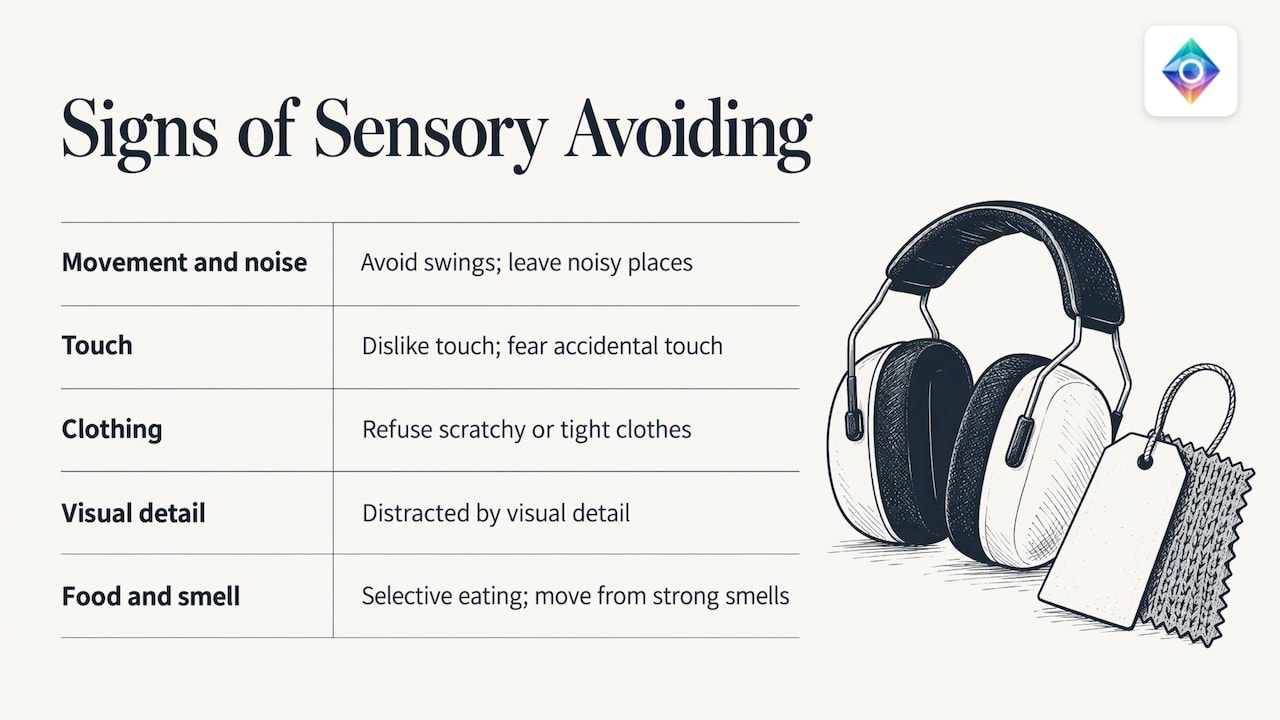
Understood lists further signs: disliking hugs, being startled by sounds or bright lights, noticing background noise, fearing accidental touch, refusing scratchy or tight clothes, avoiding swings, and preferring quiet places over crowds.
The National Autistic Society names common triggers as bright lights, clutter, unexpected touch, some food textures, strong smells and certain flavours. When input builds past a person’s limit, it says sensory overload can follow, with signs that include difficulty focusing, stimming, pacing or rocking, hiding, crying, shouting or resisting touch. If you want to separate those episodes from meltdowns, our guide to sensory overload vs meltdown shows how to map them.
Can you be both a sensory seeker and a sensory avoider?
Yes. The National Autistic Society says a person may have mixed sensory experiences, with different levels of sensitivity across senses or even to different inputs within the same sense. Sensitivity may also change over time or between environments.
A common example is someone who cannot bear the hum of a supermarket but wants deep pressure from a weighted blanket, or who avoids light touch but seeks hard, fast movement. Sheffield Children’s NHS Foundation Trust notes that needs can vary by day and context and may be influenced by mood, tiredness or stress. Understood also reports that some children show both patterns depending on their arousal or ability to self-regulate.

Why seeking can look like avoiding
The Betsi Cadwaladr University Health Board occupational-therapy guide explains that seeking can reflect under-responsiveness that needs more stimulation, but can also happen when an over-responsive person uses competing input to block distressing stimulation. Its classroom examples include fidgeting or running around to stay alert, and singing loudly or flapping hands near the eyes in busy environments.
So a child humming loudly in a noisy canteen may be avoiding the canteen’s noise by making their own. Which one it is depends on the context, which is why the Bury toolkit recommends observing across environments and consulting carers and professionals before inferring causes, since triggers may be delayed, hidden or dependent on the setting.
Is there a sensory seeking checklist?
There are several, and none of them is a diagnostic test. AIDE Canada describes a non-standardised checklist with hyper- and hyporeactive examples for each sensory area, which caregivers and clinicians can use to identify the systems causing problems and to shape an individual sensory diet or lifestyle plan.
The NELFT NHS children’s occupational therapy resource covers vision, sound, touch, smell, taste, and the vestibular and proprioceptive systems, with activity sheets for community access, bathing, dressing, feeding, toileting, hair care, toothbrushing and sensory play. Sheffield Children’s adds interoception, the sense of internal body signals, to the list of systems.
A useful way to run any checklist:
- Go sense by sense: sound, sight, touch, taste, smell, movement, body position and internal signals.
- For each, note whether the person seeks more, avoids, or does both, and in which settings.
- Record when it happens (school, work, home, after a poor night’s sleep) rather than just that it happens.
- Bring the notes to a GP, SENCo or OT as a basis for discussion.
For parents preparing for an NHS appointment, our sensory processing checklist for UK children is laid out for exactly that conversation. A guide on recognising speech delays shows the same principle for another developmental area: a checklist informs the discussion and planning with a professional, and does not replace one.
What is sensory processing disorder, and is it the same thing?
Not quite. Sensory seeking and avoiding are behaviours, while sensory processing disorder (SPD) is a label for persistent difficulty in one or more sensory systems. Berkshire Healthcare NHS Foundation Trust describes SPD as challenges from over-responsivity or under-responsivity, and says it is not a standalone diagnosable condition but is usually considered a symptom of another condition such as autism, ADHD or dyspraxia.
That matters when you are reading online material. Sensory differences are a common companion of neurodivergence, but the National Autistic Society says sensory responses are considered in autism assessment as one example of restricted and repetitive behaviours and interests. Two of the four examples must be present for a diagnosis, and sensory differences are not required.
How can you support sensory seeking and avoiding at home, school or work?
The National Autistic Society suggests identifying triggers and early signs of overload, reducing or accommodating triggers, preparing for sensory-heavy activities, providing a safe space and respecting the sensory tools a person uses. The same page recommends OT support if differences are constant and negatively affect everyday life, with interventions informed by a clinical OT assessment.
Some practical applications:
- For seekers: build movement and pressure into the day, for instance a standing desk, movement breaks or a chewable item made for the purpose. Sheffield Children’s points out that seeking may help regulation but create participation problems, such as needing to move during lessons, so agree the movement with the teacher or manager in advance.
- For avoiders: reduce the trigger before asking the person to cope with it. Ear defenders, a seat away from the door, tagless clothing or a quiet room for breaks all fit here.
- For both: keep a short log of what helped. Our guides to sensory diets for adults, sensory overload at work and a sensory-friendly classroom turn this into concrete steps.
With younger children, a visual tool can make feelings easier to name, and a guide to choosing and using an emotional regulation chart at home is one way to start that conversation.
Our perspective
We built Omniprism because most people meet sensory language only when something has already gone wrong: a child refusing a school jumper, an adult exhausted after an open-plan office. Seeking and avoiding are two ends of one picture, and the picture only makes sense when you see all of it together.
That is why our free assessment covers 14 areas in one profile, including sensory processing, high sensitivity, ADHD, autism and dyspraxia, rather than treating each in isolation. Sensory patterns often sit alongside other traits, and seeing them side by side gives you plain-language material to bring to a clinician. There is no email, no account and no data collection, so you can answer honestly.
I was diagnosed with ADHD at 42, and I wish a profile like this had existed before the appointment, because it gives you words for patterns you have lived with for years.
When you are ready to share results, our Specialist Briefing summarises them for a clinician, and the Youth Briefing does the same for children and teens. Our tool is a self-assessment that supports your conversation with a professional and does not replace a diagnosis.
Valerio Cozzi
Where can you start with an assessment?
If you want to see how your own sensory pattern sits alongside other traits, you can take the free adult self-assessment and get an instant profile. Parents can use the children and young people assessment, which has guided versions for ages 7 to 10 and ages 11 to 13.
After the free assessment, the optional Specialist Briefing costs €20 one-off and summarises results for a clinician. The Youth Briefing is also €20 one-off. Adults looking for the next step through the NHS can read our guide to NHS and OT steps for sensory processing.
FAQ
Why is my child sensory seeking?
Seeking can reflect under-responsiveness, where the child needs more input to register a sensation. It can also happen when an over-responsive child uses movement or noise to block out input that distresses them, according to the Betsi Cadwaladr OT guide. Observing across home and school helps work out which applies.
Does sensory seeking mean autism or ADHD?
Not by itself. Sensory differences are one of several examples considered in an autism assessment, and the National Autistic Society says they are not required for a diagnosis. Berkshire Healthcare describes sensory difficulties as usually a symptom of another condition, such as autism, ADHD or dyspraxia, so a clinician looks at the wider picture.
Can sensory needs change from day to day?
Yes. Sheffield Children’s says sensory needs can vary with context and be influenced by mood, tiredness or stress. A log with dates and settings shows whether the pattern is consistent.
When should I see an occupational therapist?
The National Autistic Society advises seeking OT support if sensory differences are constant and negatively affect everyday life. Your GP, a school SENCo or a health visitor can usually point you to the local referral route.
Sources
- Autism and sensory processing, National Autistic Society
- Sensory seeking and sensory avoiding: What you need to know, Understood
- Sensory seeking and avoiding, Essex County Council
- Sensory processing difficulties, Sheffield Children’s NHS Foundation Trust
- Understanding Sensory Difficulties, Betsi Cadwaladr University Health Board
- Sensory Processing Differences Toolkit, Bury / NHS
- Sensory Processing Differences Toolkit, AIDE Canada
- Understanding Sensory Processing, NELFT NHS
- Sensory processing disorder, Berkshire Healthcare NHS Foundation Trust
- How to Recognize Speech Delays: A Parent’s Checklist
- Emotional Regulation Chart: How to Choose and Use One at Home
Recommended
- Sensory Diets for Adults: Start With a Two Minute Self Assessment
- Sensory Processing Checklist for UK Children: Prepare for NHS Meetings
- NHS and OT steps for sensory processing in UK neurodivergent adults
- Sensory Overload vs Meltdown: Map Episodes for Neurodivergent Adults
Written and edited by Valerio Cozzi, founder of Omniprism. Omniprism began after my own ADHD diagnosis at 42.
This article is educational. It is not medical advice, not a diagnosis, and not a substitute for assessment by a qualified clinician. The Omniprism self-assessment is free, needs no account and no email address, and runs entirely in your browser — your answers are never sent to a server. The optional Specialist Briefing report is a paid add-on.