Monotropism and autism: how the attention theory works
Monotropism is a theory of autism built around attention: it proposes that autistic minds pour their limited attention into a small number of interests at a time, instead of spreading it across many. It was developed by autistic researchers, and it is increasingly used to explain everyday autistic experience, from deep immersion in a subject to the real difficulty of being interrupted.
Key takeaways
- Monotropism describes attention that narrows into a deep “tunnel” around a few interests. It was first set out by Dinah Murray, Mike Lesser and Wenn Lawson, and it is a theory, not a diagnostic test.
- Monotropic traits are most associated with autistic and ADHD people, but other people recognise them too.
- Hyperfocus describes a state; monotropism is a proposed way the whole attention system is organised. The two overlap, and the research linking them is still early.
- Interrupting someone mid-tunnel can be genuinely distressing, so predictable transitions help more than telling a person to “just switch”.
- Nothing here replaces an assessment. If monotropism sounds like you or your child, take your notes to a GP or clinician.
What is monotropism?
The word comes from the idea of a mind that is “mono” (one) in its direction. The National Autistic Society describes it as an attention-based theory of autism, developed in the late 1990s by the autistic researchers Dinah Murray, Mike Lesser and Wenn Lawson. Their 2005 paper argued that atypical strategies for allocating attention are central to the autistic condition.
The model starts from a simple premise: everyone has a finite pool of attention. A polytropic mind tends to share that pool across several interests and streams of information at once. A monotropic mind tends to commit most of it to one or two things, which produces what the community calls an attention tunnel. Autism Understood puts the consequence plainly: monotropic people can miss things outside the tunnel, or quickly forget what they are no longer focusing on.
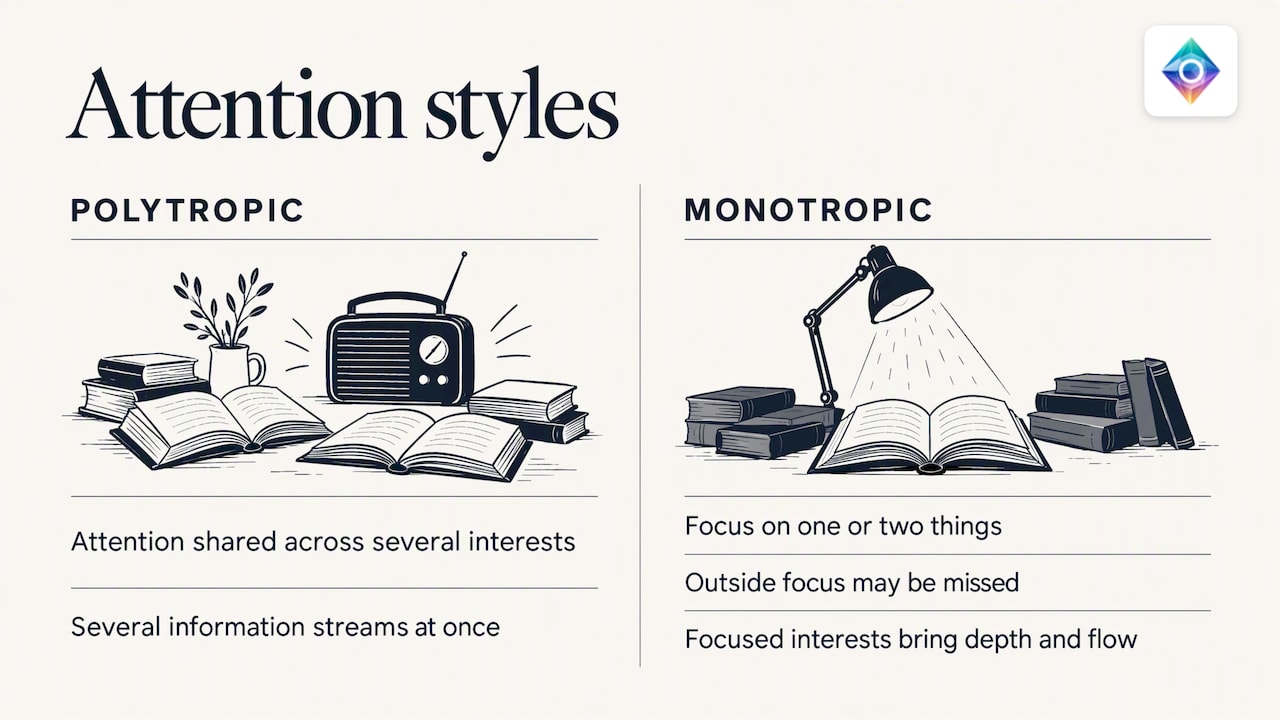
That framing matters because it shifts the question. Instead of treating intense interests as a deficit to be reduced, the theory sees them as a concentrated use of attention that brings depth, expertise and flow. The NAS page credits researchers Helen Edgar and Tanya Adkin with developing this neuroaffirming reading for educators and practitioners.
What does monotropism look like day to day?
The theory is useful because it explains behaviour that is easy to misread. A few common patterns:
- Not responding when called. A person deep in a task may not register a voice or a ticking clock, because their processing capacity is already allocated. An NHS Autism Central blog written by a parent describes how this is often mistaken for ignoring or defiance.
- Painful transitions. Switching tasks can feel disorienting or physically uncomfortable, which helps explain why an interrupted special interest can end in a meltdown or shutdown.
- Social communication strain. Reading tone, facial expression and body language at once is a multi-channel job. It is harder when attention is committed to a single channel.
- Sensory intensity. The 2025 paper by Wenn Lawson notes that, under this account, autistic sensing is more likely to be experienced as one sense heightened over another.
None of these is proof of autism on its own. They are patterns that many autistic people recognise, and that clinicians and families can describe more precisely once they have the vocabulary.
Why is flow so important to autistic people?
A qualitative study, “In a State of Flow”, interviewed autistic adults about task immersion. It was prompted by the conceptual overlap between autistic hyperfocus and flow, which had rarely been linked in the literature. Its participants described immersion as something more than a pastime: a way to feel safe, regulated and most like themselves in environments that can feel chaotic.
That is why the practical advice from the research is rarely “reduce the interest”. The more useful goal is to allow flow while making the way out of it gentle and predictable: a warning before a change, a visual timer, a clear next step. If you want to explore the distinction between the two states, our piece on hyperfocus versus flow goes through where they differ and where they overlap.
Monotropism vs hyperfocus: what is the difference?
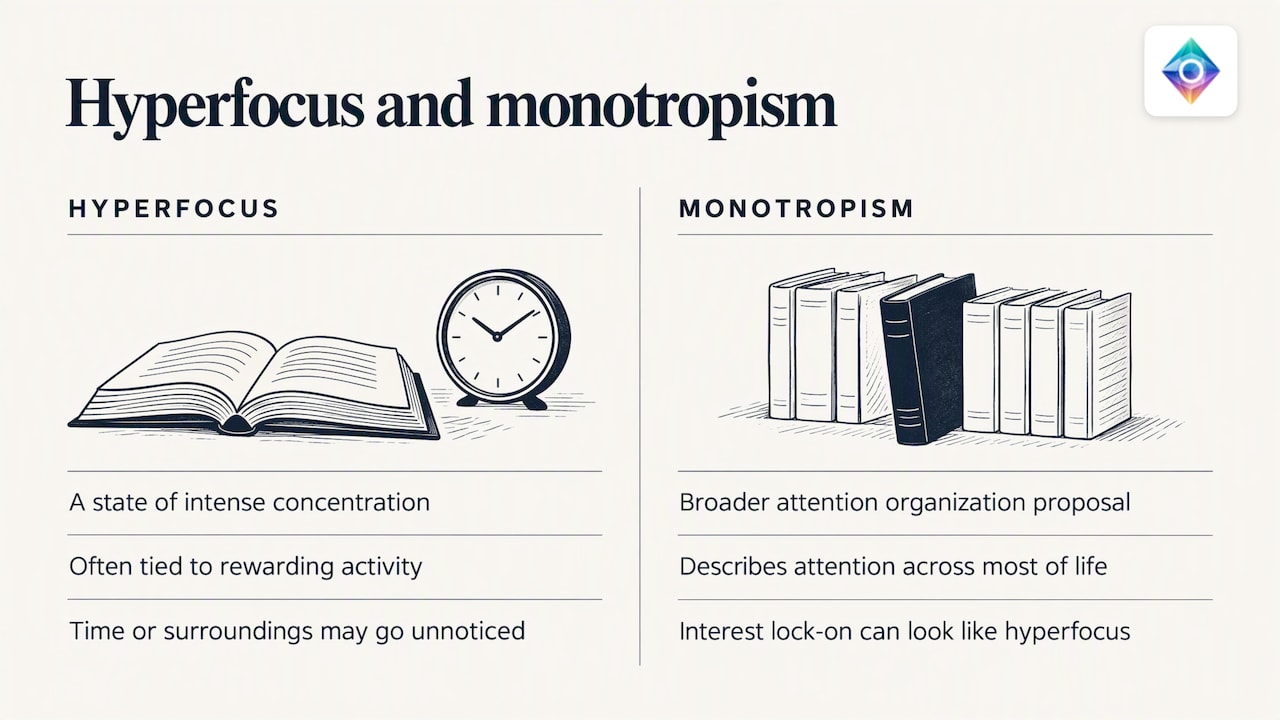
Hyperfocus is usually described as a state: a period of intense, sustained concentration, often on something rewarding, that makes it hard to notice time or surroundings. Monotropism is a broader proposal about how attention is organised in a person’s mind all the time. On that reading, hyperfocus is what a monotropic attention style can look like when an interest locks on.
The evidence connecting the two is still developing. A recent study, Investigating autistic hyperfocus and monotropism, compared self- or caregiver-report, laboratory tasks and brain-response measures, and its title reports limited convergence between them. Laboratory tasks may simply not capture what immersion feels like in real life, which is one reason qualitative work such as the flow study carries weight here.
In practice, the distinction helps when you describe yourself to a clinician. “I hyperfocus sometimes” is one observation. “My attention narrows to one thing, and switching away from it is hard and distressing, across most of my life” describes a pattern.
Do people with ADHD have monotropism?
Many do, though not all. The NAS summary of the research notes that autistic people and those with ADHD, including people who identify as AuDHD, tend to score higher on the Monotropism Questionnaire developed by Garau and colleagues in 2023. It also says that the questionnaire is a self-reflection tool, not a diagnostic one.
An NHS East London Foundation Trust information pack describes ADHD as often involving both polytropic and monotropic flows: being pulled in several directions at once, alongside effective hyperfocus and difficulty getting started or stopping. That may be one reason autism and ADHD are so often confused, or found together. If you are weighing the two, our guides to autism versus ADHD and the overlap between them lay out the comparison.
Attention style also shapes everyday risk and routine. For adults with ADHD, something as ordinary as driving can raise practical and legal questions, and there is a UK-specific explanation of ADHD and driving in the UK worth reading before you act.
Can you have monotropism and not be autistic?
The research suggests you can show monotropic traits without being autistic. The Monotropism Questionnaire was first validated with autistic and ADHD groups, but the NAS notes that many non-autistic people also report varying degrees of monotropic and polytropic attention. So attention style looks like a spectrum of tendencies, and a high score is not a diagnosis.
The reverse is worth knowing as well. Because the theory was built from autistic experience, many autistic people find it a closer fit than checklists written from the outside. A high monotropism score can be a good conversation starter with a clinician. It cannot stand in for a diagnostic assessment.
How can you support a monotropic child, student or colleague?
The themes in the sources are consistent:
- Protect the interest. Treat a deep interest as a strength and a regulation tool, not a reward to be withdrawn.
- Announce changes early. Give a warning before a transition, and say what comes next.
- Reduce channels. When you need a response, get the person’s attention first, then speak, rather than talking across a task.
- Read behaviour as information. Not answering is often a sign of full commitment, not rudeness.
- Allow recovery. After a forced switch, expect some time to re-settle.
Pro Tip: Before an unavoidable interruption, say the person’s name, wait, and then give one short instruction. A single channel at a time is easier for a monotropic mind to take in.
For families and teachers, our guide to school autism adjustments explains what schools can be asked to provide.
What does the evidence not tell us yet?
Monotropism is a well-regarded and widely used idea, but honesty about its limits is part of using it well. The 2005 paper is a theoretical argument, much of the supporting evidence is qualitative, and the newer measurement work reports limited agreement between questionnaires and laboratory tasks. The theory describes experience richly. It does not yet offer a validated way to identify autism.
That is the right way to hold it: a lens for understanding yourself or someone you support, to be combined with a proper assessment, not used instead of one. In the UK the usual first step is a conversation with your GP, and our guide to adult autism signs and NHS steps covers how that route works.
Why do we think monotropism matters for self-understanding?
We built Omniprism because people often arrive at an assessment with a feeling but no vocabulary. The theory of monotropism gives them some.
I was diagnosed with ADHD at 42, and I know how much easier any conversation with a professional becomes once you can describe a pattern rather than a vague sense that something is different.
Omniprism is not a monotropism test, and we do not claim to measure it. What we offer is a profile across 14 areas, including ADHD, autism, dyslexia, masking and sensory processing, delivered instantly in plain language, with no email, account or data collection. We see attention style as one useful piece of context to bring to that picture, particularly when autism and ADHD traits sit side by side. We would rather people ask better questions than reach for quick labels.
— Valerio Cozzi
Where can you start with a structured self-assessment?
If this article made you recognise yourself or your child, a structured profile can turn that recognition into something concrete. The Omniprism self-assessment is free, gives instant results, and has guided versions for children and teens. If you want something to hand to a clinician, the optional Specialist Briefing summarises your results for them, for a one-off 9.99 EUR.
FAQ
Is monotropism an official diagnosis?
No. Monotropism is a theory of how attention works, not a diagnosis in the clinical manuals. Autism and ADHD are diagnosed through clinical assessment, and the Monotropism Questionnaire is described by the NAS as a self-reflection tool. You can still use the concept to describe your experience to a clinician.
Is ADHD monotropic or polytropic?
Often both. An NHS trust information pack describes ADHD as involving both polytropic and monotropic flows, which can look like being pulled in many directions yet also locking into intense hyperfocus. Individual experience varies.
Why does interrupting a monotropic person cause such distress?
According to the theory, a mind deep in a tunnel has allocated most of its capacity to the task, so a sudden switch can be disorienting. An NHS Autism Central blog describes this as the reason interruptions can lead to meltdowns or shutdowns. Warnings and gentle transitions reduce the strain.
Can monotropism be a strength?
Many autistic people describe it that way. The neuroaffirming reading highlights depth, creativity and expertise, and the flow study found that immersion was linked with feeling safe and authentic. Support works best when it protects these strengths and eases the transitions.
Sources
- What is monotropism? A neuroaffirming theory of autism, National Autistic Society
- Attention, monotropism and the diagnostic criteria for autism, PubMed
- “In a State of Flow”: autistic adults and task immersion, PubMed
- Investigating autistic hyperfocus and monotropism, PubMed
- An insider’s view into autism, Lawson, PMC
- Beyond behaviour: respecting your child’s monotropic flow, NHS Autism Central
- Post Diagnostic Information, East London NHS Foundation Trust
- Monotropism, Autism Understood
- ADHD and driving in the UK
Recommended
- Autism vs. ADHD: Comparing Symptoms, Overlap, and Diagnosis
- Parents: 14 Domain Self Check to Uncover Autism Misdiagnosed as ADHD
- 50–70% Overlap in Autism and ADHD: What Families and Clinicians Need
- Interoception in Autism: OT Tools and a Self Check for Caregivers
Written and edited by Valerio Cozzi, founder of Omniprism. Omniprism began after my own ADHD diagnosis at 42.
This article is educational. It is not medical advice, not a diagnosis, and not a substitute for assessment by a qualified clinician. The Omniprism self-assessment is free, needs no account and no email address, and runs entirely in your browser — your answers are never sent to a server. The optional Specialist Briefing report is a paid add-on.