Hyperfocus vs flow: how they differ and where they overlap

Hyperfocus and flow are both states of deep absorption, and researchers still disagree on whether they are two things or one. The most useful working distinction is about control: flow tends to be chosen, balanced and easy to leave, while hyperfocus tends to arrive on its own, crowd out everything else and be hard to stop.
Key takeaways
- The science is unsettled: one review in the literature found no consensus on a definitive distinction, and the two terms mostly come from different fields.
- In practice, the difference is agency. Adults with ADHD describe hyperfocus as sometimes absorbing, sometimes trapping.
- Autistic adults often describe deep immersion in positive terms, closer to flow, so the label depends on the person and the context.
- The real risk is not the focus itself but missed meals, sleep and transitions. Planning the exit matters more than avoiding the state.
- Neither state is a diagnosis. If it affects work, school or health, talk to a GP or clinician.
What is the difference between hyperfocus and flow?
Flow is the older and better-known idea. It comes from positive psychology and describes total absorption in a task that suits your skill, with a sense of enjoyment and control. Hyperfocus is the term clinicians use, mainly in ADHD and autism research. A review of the topic notes that the two are phenomenologically similar and are labelled differently depending on the academic field.
The differences people report tend to fall into five areas.
| Feature | Flow | Hyperfocus |
|---|---|---|
| How it starts | Usually chosen, with a task matched to your skill | Often triggered by high interest or time pressure |
| Sense of control | Mastery, ease | Can feel stuck or unable to shift |
| Awareness of surroundings | Usually retained to some degree | Can narrow to the task alone |
| Body’s needs | Generally noticed | Meals, sleep and toilet breaks can be ignored |
| Leaving the state | Manageable | Often needs an explicit strategy |
The control and body-needs rows rest on a qualitative study of adults with ADHD, which described hyperfocus as absorbing for some moments and trapping in others. The table is a pattern in how people describe these states, and it is not a clinical test.
Are hyperfocus and flow the same thing?
Some researchers say yes. Others say they are related but separate. The evidence points both ways.
The 2019 review mentioned above argued that the overlap between the two is large enough that the same concept may sit under two names. A later paper, Hyperfocus or flow? Attentional strengths in autism spectrum disorder, reported that researchers had identified four shared features: task engagement, heightened attention and two further characteristics of absorbed states.
On the other side, an integrative review of 10 empirical studies found hyperfocus positively correlated with ADHD symptoms, perseveration, internet addiction and emotional dysregulation. The same review reports that measures of hyperfocus and flow were inversely related in some adults with ADHD, which suggests hyperfocus may involve more than one process. A summary of newer work reports a 2024 validation study of 347 adults in which hyperfocus and flow scores were only weakly related, with the authors calling them distinct but related. The same summary notes that the authors also floated the idea that hyperfocus could be an especially deep form of flow.
So an honest answer is that both can be true at once. Some episodes of absorption will feel like flow and others like hyperfocus, and the same person can have both in a single day.
What are the signs of being in flow?
People describing flow tend to mention the same handful of things:
- The task is challenging but within reach, so you are neither bored nor overwhelmed.
- You know what you are trying to do and can tell how it is going.
- Time passes faster than you expected, though you can still be pulled out of it.
- You feel in control, and the activity is rewarding in itself.
- You finish feeling satisfied, and often energised rather than drained.
The flow-state account on ADDitude, a magazine for people with ADHD, gives a useful image: in flow you are moving along but still aware of where you are, whereas in hyperfocus you can be zoomed in so far that the room disappears.
What does hyperfocus look like?
Hyperfocus is usually spotted from the outside first. Someone has been at a screen, a book or a project for hours and has not eaten, moved or answered a message. The Glasgow study of adults with ADHD found that this kind of absorption is often set off by high interest or strict time pressure, and that ignoring basic needs such as eating, sleeping and going to the toilet was a common consequence.
Common signs include:
- Losing track of time well beyond what you intended.
- Not hearing your name or a phone ringing.
- Feeling irritated or disoriented when interrupted.
- Wanting to stop and being unable to shift attention.
- Ending up tired, hungry or behind on other tasks.
None of these confirms ADHD or autism. The NHS lists difficulty concentrating, forgetfulness and trouble organising time among the symptoms of ADHD in adults, and says they usually begin before the age of 12. Hyperfocus alone is not on that list, and many people without either condition get absorbed in tasks.
Is hyperfocus ADHD or autism?
It appears in both, and sometimes in neither. In a community study of 5,744 youth, children with autism showed significantly higher rates of attentional strengths often linked to hyperfocus than children with ADHD, with an odds ratio of 5.7 (95% CI 2.8 to 11.6). That finding describes groups and cannot be used to guess a single child’s diagnosis.
The way it feels may differ too. A UCL study on perceptual capacity in autism and ADHD explores why autistic people may report an overwhelming flood of information while people with ADHD describe trouble holding attentional priorities. Both groups can arrive at intense absorption, but from different directions.
If you are trying to work out which pattern fits you, our comparison of autism and ADHD symptoms, overlap and diagnosis walks through the differences, and the page on the overlap between autism and ADHD explains why the two are so often confused.
Can people with ADHD enter flow state?
Yes. The Glasgow qualitative work and the integrative review both describe adults with ADHD who experience absorption in positive terms as well as in trapped ones. The inverse relationship between hyperfocus and flow seen in some adults suggests that for them the two may rarely coincide, which is a reason to treat the experience as personal rather than assuming one pattern.
For autistic adults, a qualitative study titled “In a State of Flow” examined task immersion directly, noting considerable conceptual overlap between autistic hyperfocus and flow that had seldom been explored. A non-pathologising account of autistic flow goes further and notes a striking parallel between flow states and how autistic people describe daily life. Researchers such as McDonnell and Milton have argued that reading repetitive or intense focus as potential flow can help families and clinicians see it as a source of predictability and enjoyment, not simply a problem.
Can hyperfocus be productive?
Yes, when it lands on the right task at the right time. Many adults describe getting a week of work done in an afternoon. The catch is that the state often picks its own target. High interest triggers it, so the report you need to write may lose out to the side project you enjoy.
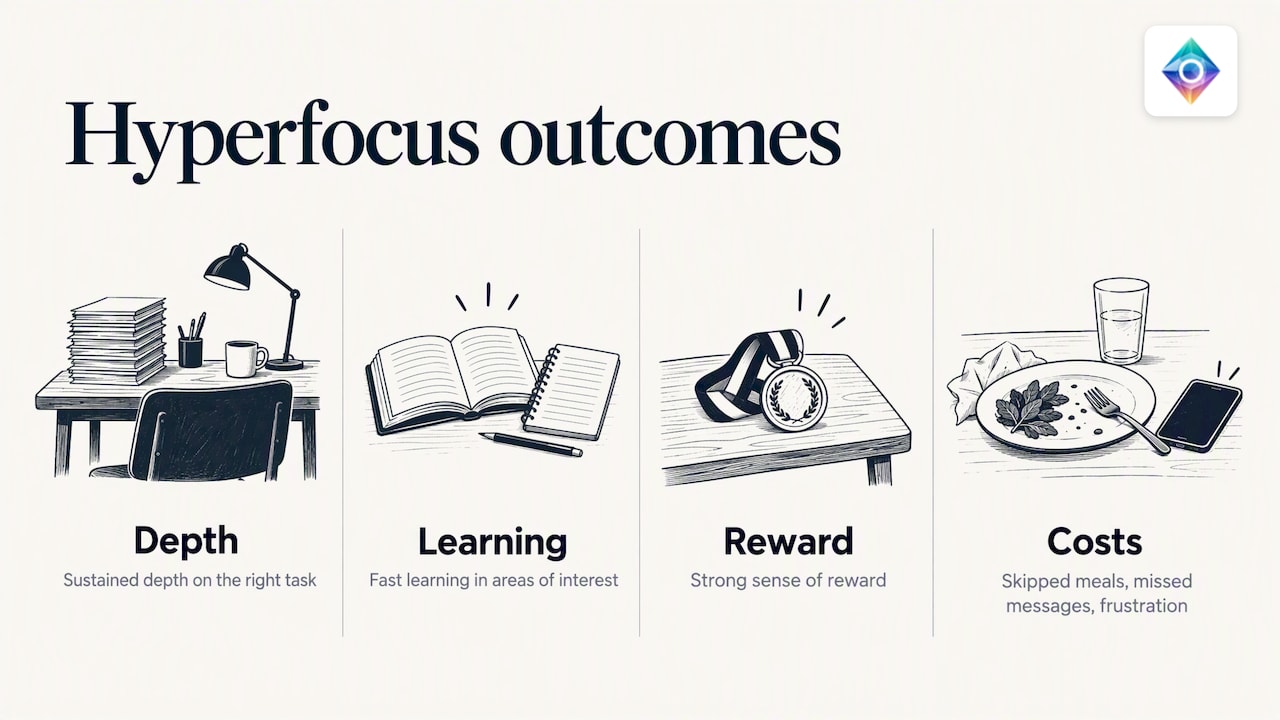
The benefits people commonly name are sustained depth, fast learning in an area of interest and a strong sense of reward. The costs are physical (skipped meals, poor sleep), social (missed messages and commitments) and emotional (frustration when pulled out). Clinicians quoted in the Glasgow work emphasise that hyperfocus needs tailored support so that it stays a tool for flourishing rather than a source of exhaustion.
An integrative review also links hyperfocus with internet addiction and emotional dysregulation, so what you are absorbed in matters. Deep work on a craft and an eight-hour scroll can feel identical from inside.
Our own guide to clinician-backed ways to harness hyperfocus in ADHD goes through the practical side in more detail.
How do you manage hyperfocus and get into flow on purpose?
No technique has been proven to switch hyperfocus on or off for everyone, so treat these as experiments rather than treatments. They are drawn from the patterns the research describes: triggers, missing control and difficult exits.
- Pick the target before you start. Because interest and deadlines trigger hyperfocus, decide which task gets your best attention and remove the more tempting ones from view.
- Match challenge to skill. Flow is usually described as a task slightly stretching your ability. If it is too easy you drift, and if it is too hard you stall.
- Set an exit before you enter. The transition out is where neurodivergent people most often need an explicit strategy. Use an alarm across the room, a calendar event or a person who will knock.
- Anchor the body. Put water and food next to you before you begin, so that meeting needs does not depend on noticing them.
- Write a one-line note on where you stopped. This makes leaving less costly, because the thread is saved.
- Use shorter blocks for obligations. If you are studying alongside work, 15-minute micro sessions can fit around a job and give you natural stopping points.
Pro Tip: Put the alarm for leaving the task on the same device you will need next, such as the kettle timer or the phone you must use to join a call. A cue that forces a physical move is harder to dismiss than a beep.
For children, teachers and parents often meet hyperfocus as a transition problem: a child who cannot move from one activity to the next. Our piece on classroom adjustments that help ADHD in UK schools covers how schools can give warnings and stepped changes between tasks.
What does Omniprism think about hyperfocus?
We do not treat hyperfocus as a superpower or as a symptom to eliminate. It is a pattern with a cost and a benefit, and what a person needs depends on which of the two they are experiencing at the time.
I was diagnosed with ADHD at 42, and that late timing is part of why I built Omniprism: many adults arrive at an assessment with a lifetime of patterns they have never had words for. Absorption is one of the most commonly misunderstood, because from outside it can look like focus, and from inside it can feel like losing the steering wheel.
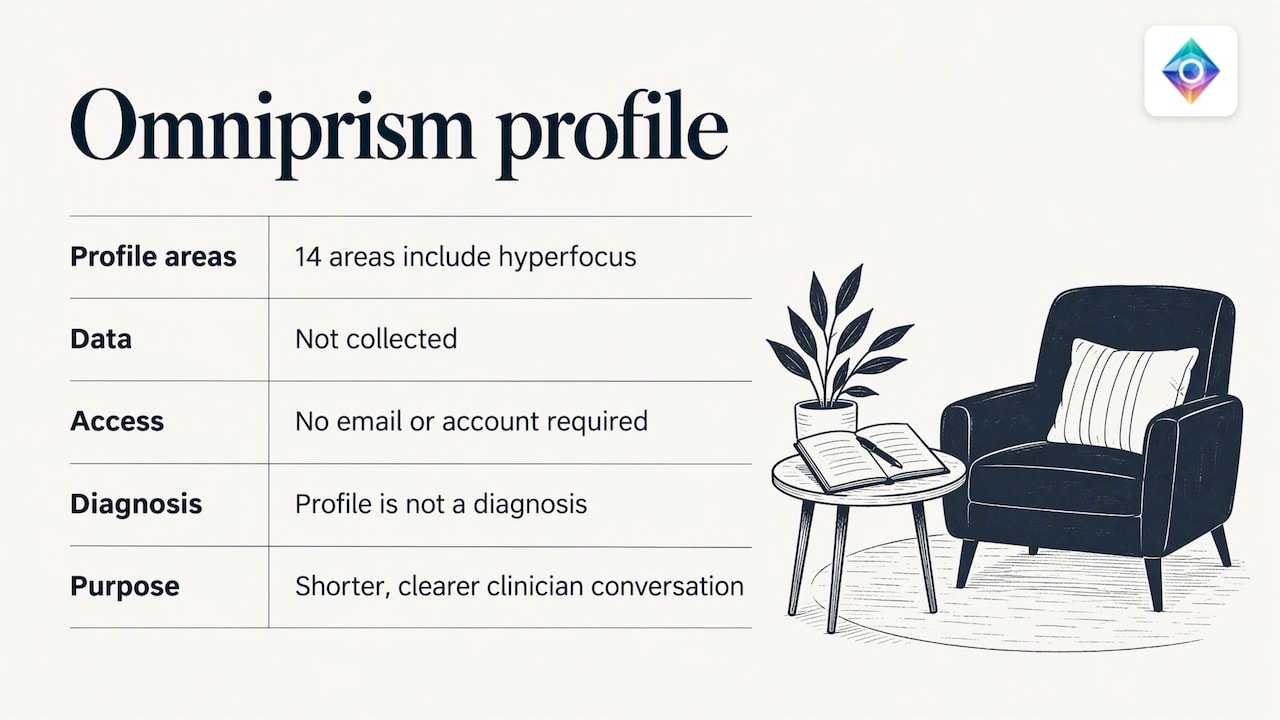
Our approach is to describe that experience in plain language rather than label it. Hyperfocus, masking, sensory processing and the rest sit among 14 areas in our profile, so that you can see how absorption sits alongside your other traits. We do not collect your data, and we do not ask for an email or account, because reflection works better when you are not being tracked. A profile is not a diagnosis, and its main job is to make a conversation with a clinician shorter and clearer.
If you want to see where your strengths sit without a diagnosis, our guide to mapping neurodivergent strengths across 14 domains shows how.
— Valerio Cozzi
Can I check my own attention patterns before seeing a clinician?
Yes. The Omniprism self-assessment gives you an instant profile across 14 areas, including ADHD, autism, dyslexia, masking, dyspraxia, dyscalculia, sensory processing and high sensitivity, in plain language. There is a guided version for children and teens too.
If you decide to take your results to a GP or specialist, the Specialist Briefing summarises them for a clinician. It is a one-off €9.99. Parents can start from the pages for children and young people.
A profile cannot diagnose you. If your difficulties show up in more than one area of life, our page on when to seek an ADHD diagnosis in the UK explains what to raise with your GP. For autism, NICE guidance on adult diagnosis describes the core features clinicians look for, including restricted interests and resistance to change that have been present since childhood.
FAQ
Is hyperfocus the same as flow?
Not necessarily. A 2019 review found no consensus, and some later studies find the two only weakly related. In daily life, flow is usually chosen and balanced, while hyperfocus can feel involuntary and costly.
Do you need ADHD to experience hyperfocus?
No. Many people become deeply absorbed in tasks they find interesting. Hyperfocus is studied mostly in ADHD and autism, but absorption on its own does not indicate either condition. Persistent difficulties across several areas of life are the thing to discuss with a GP.
How long can hyperfocus last?
There is no standard duration in the sources we reviewed. People describe anything from a long evening to a whole day. The practical limit is your body’s needs, so set a food, water and sleep cue before you begin.
Is hyperfocus harmful?
It can be, mostly through its side effects. The Glasgow study of adults with ADHD describes ignored basic needs and exhaustion, and the integrative review links hyperfocus with internet addiction and emotional dysregulation. If it is regularly leaving you unwell or unable to meet commitments, speak to your GP.
Sources
- Hyperfocus: the forgotten frontier of attention (PMC)
- Hyperfocus or flow? Attentional strengths in autism spectrum disorder (PMC)
- Experiences of deep concentration in ADHD: an integrative review (PMC)
- Absorbed, trapped, or lost? Hyperfocus experiences in ADHD adults (University of Glasgow)
- “In a State of Flow”: Autistic adults’ experiences of task immersion (PMC)
- Towards autistic flow theory: a non-pathologising conceptual approach (Swansea University)
- A storm of post-it notes: perceptual capacity in autism and ADHD (UCL)
- ADHD in adults (NHS)
- Autism spectrum disorder in adults: diagnosis and management (NICE)
- Flow State vs. Hyperfocus (ADDitude)
- Hyperfocus at Work: How It Differs From Flow (Science Works Health)
- Study While Working: 15 Minute Micro Sessions (Lift College)
Recommended
- 5 Clinician Backed Ways to Harness Hyperfocus in ADHD
- ADHD vs. OCD: Key Differences, Overlap, and Next Steps
- 50–70% Overlap in Autism and ADHD: What Families and Clinicians Need
- Autism vs. ADHD: Comparing Symptoms, Overlap, and Diagnosis
Written and edited by Valerio Cozzi, founder of Omniprism. Omniprism began after my own ADHD diagnosis at 42.
This article is educational. It is not medical advice, not a diagnosis, and not a substitute for assessment by a qualified clinician. The Omniprism self-assessment is free, needs no account and no email address, and runs entirely in your browser — your answers are never sent to a server. The optional Specialist Briefing report is a paid add-on.