Handwriting Help for Dyspraxia: What Works in the UK
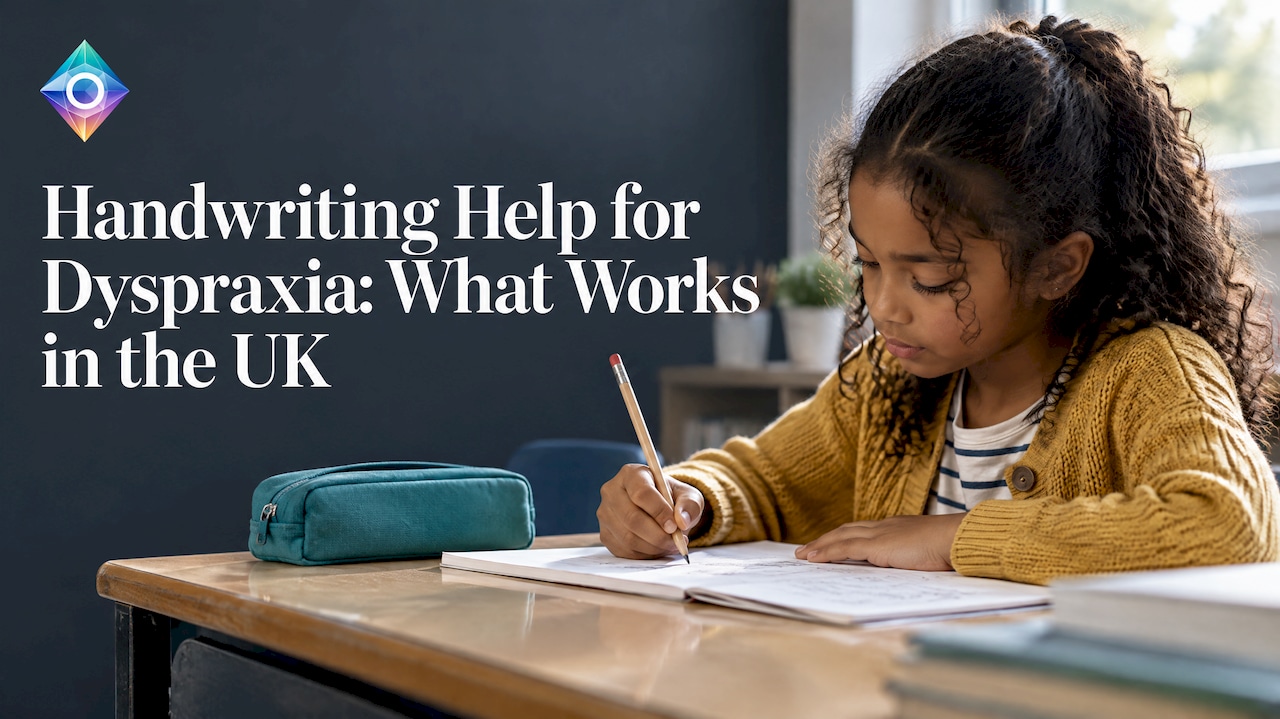
The most effective handwriting help for dyspraxia combines the right seated position, task-based practice with an occupational therapist (OT), and a fair way to record work when writing is too slow, such as a keyboard. Pen grips and special paper can help, but they sit on top of posture and practice rather than replacing them.
This guide is for parents, teachers and adults with dyspraxia (also called developmental coordination disorder, or DCD) who want specific things to try, and who want to know what the evidence and UK guidance say about each.
Key takeaways
- Poor handwriting is one of the most common signs of dyspraxia, and it comes from coordination, not from lack of effort (Dyspraxia Foundation).
- Sort out posture first: feet flat, shoulders relaxed, forearms supported. Pen grips and programmes work badly without it (Devon County Council).
- Task-focused, activity-oriented training has the strongest evidence for improving motor performance in DCD (2018 meta-analysis).
- For exams, a laptop or extra time must reflect a pupil’s normal way of working, so start using it in lessons early (GOV.UK).
- You do not need a formal diagnosis to ask for occupational therapy support (RCOT).
Does dyspraxia affect handwriting?
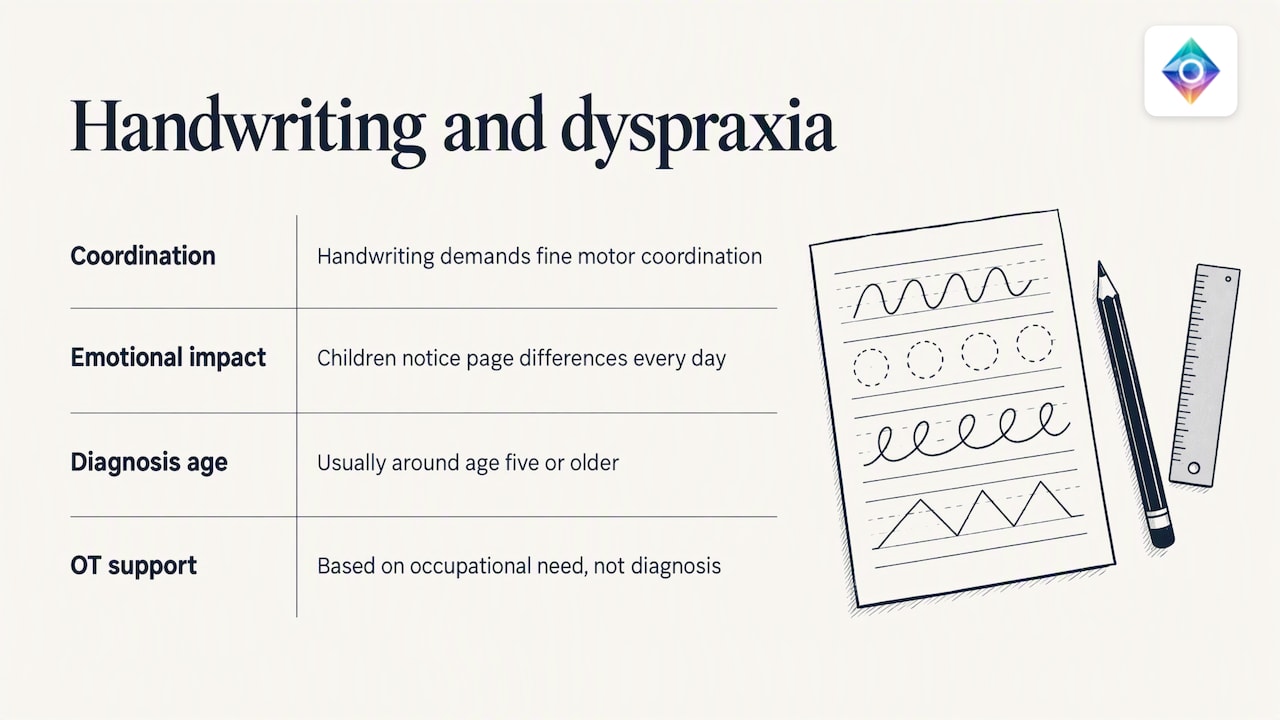
Yes. DCD affects physical coordination, and handwriting is a fine motor task that demands a lot of it. The NHS lists problems with movement and co-ordination as the main symptoms of DCD, and handwriting difficulties sit within that picture alongside trouble with everyday tasks that need precise movement.
The Dyspraxia Foundation points out something parents will recognise: children with poor handwriting do not need anyone to tell them. Every time they write, they can see the gap between their page and their friends’ pages. That daily comparison is a large part of the emotional cost, which is why the support below puts confidence alongside technique.
The NHS also notes that a diagnosis generally does not happen until a child is around five or older, because early development varies so much. Handwriting support does not have to wait for that. RCOT guidance says occupational therapy should be available according to occupational need and should not depend on a diagnosis.
What does dyspraxia handwriting look like?
There is no single look. Common patterns include:
- slow, laboured writing that tires the hand quickly;
- letters of uneven size, with inconsistent spacing between letters and words;
- an awkward or unusually tight pencil grip;
- scribbled or hard-to-read work compared with what is expected for the child’s age.
These match what the NHS describes for children with DCD. Some people with dyspraxia write neatly, and some write neatly only by spending far more effort than their peers. Neat handwriting does not rule out dyspraxia, and a messy page does not prove it. Look at the effort and the speed as well as the result.
How do you help a child with dyspraxia improve handwriting?
This is the practical core. Work through these steps in order, because each one depends on the one before it.
- Fix the seating. Feet flat on the floor, shoulders relaxed, forearms supported on the desk. Practitioners cited by Devon County Council stress that a child must be properly positioned before any grip change or handwriting programme can be effective, and that without this, efforts often lead to more fatigue and anxiety. Check the chair height and the desk height before buying anything.
- Look at the whole task, not only the pen. Writing draws on motor skills, core strength and awareness of letter-sound relationships, according to Hertfordshire’s guidance on writing difficulties. If a child is working hard on spelling or composing, there is less capacity left for forming letters.
- Practise in short, specific bursts. Pick one skill, such as starting letters from the correct point, and practise it for a few minutes. Activity-oriented, task-specific approaches produced the largest effects in a systematic review and meta-analysis of motor interventions for DCD (Cohen’s d of 1.06 overall), though the review notes the range between studies was wide.
- Try tools one at a time. Add a different grip, a chunkier pencil or a sloped board separately, so you can see which one helps. Keep what reduces fatigue and drop what does not.
- Measure against the child’s own earlier work. The Dyspraxia Foundation describes Dr Rosemary Sassoon’s view that handwriting should be judged against the person’s own previous efforts, not against classmates (Dyspraxia Foundation). Keep dated samples in a folder so progress is visible.
- Ask for an OT referral if progress stalls. Local authorities such as Solihull Council prefer to refer to occupational therapy for specific motor and coordination needs, whatever label is used.
Pro Tip: Date every handwriting sample and write the same sentence each month. A short, repeatable task makes small gains easy to see, and gives a school or OT clear evidence when you ask for support.
What are the best writing aids for dyspraxia?
Writing aids are worth trying once posture is sorted. The usual options are:
| Aid | What it is for | Worth knowing |
|---|---|---|
| Chunky or triangular pencils | Easier hold for a weak or tense grip | Cheap, so safe to trial |
| Pen grips | Guide finger position | Test several shapes; fit is personal |
| Sloped writing board | Supports wrist and forearm, improves line of sight | Often used alongside correct seating |
| Wide-lined or raised-line paper | Gives clearer size and spacing cues | Helps with letter size rather than speed |
| Keyboard, laptop or tablet | Bypasses handwriting for longer tasks | Needs its own practice; start early |
I have deliberately named no product brands. Fit varies from child to child, and a classroom trial tells you more than a review does. I could not find controlled research showing that any single grip or pen cures dyspraxic handwriting, so treat aids as comfort and fatigue tools, with the training above doing the main work.
Typing deserves a proper place in the plan. A keyboard does not remove the need for coordination, but it changes the demand from forming shapes to finding keys, which many people with dyspraxia find easier to learn with practice. Introduce it alongside handwriting, not as the point where handwriting support stops.
What does an occupational therapist do for handwriting?
An OT looks at why writing is hard and builds a plan around the person. RCOT describes the approach as strengths-based and holistic, focused on the whole person rather than only the motor difficulty. It also says that while coordination may stay below average, building coping strategies is the main aim for long-term success.
In practice, that can mean assessing posture and core stability, choosing a few targeted activities, advising on equipment, and writing recommendations the school can follow. If your child is waiting for a diagnostic assessment, remember that RCOT’s position is that support can start before a diagnosis. Ask your GP, the school SENCo or your local authority’s local offer about how to access OT in your area.
Is dysgraphia the same as dyspraxia?
They overlap but are not the same. Dyspraxia is a broader coordination condition. Dysgraphia is a learning difficulty centred on writing. Some local authorities, including Solihull, do not diagnose dysgraphia as a separate entity and instead send people to occupational therapy to address the specific motor challenges. In everyday terms, the label matters less than finding what is getting in the way: motor control, spelling, organisation of ideas, or a mix.
If the classroom picture is unclear, our guide on telling dysgraphia from dyslexia lists the signs teachers tend to see. For the DCD side, we have written about five adjustments parents and teachers can use.
Is dyspraxia a form of autism?
No. Dyspraxia and autism are separate conditions that often occur together. The NICE guideline on autism in children and young people reports that around 70% of autistic people meet criteria for at least one other mental or behavioural disorder, and cautions clinicians not to delay an autism assessment because a child already has another diagnosis such as ADHD (NICE CG170). I have not found a source that gives a precise figure for how often autism and dyspraxia specifically coincide, so I will not offer one.
What this means for handwriting: if a child has several difficulties at once, support needs to cover all of them. For families weighing up dyspraxia and ADHD, this comparison for families explains how to gather evidence a clinician can use.
How do you get exam adjustments for dyspraxia in the UK?
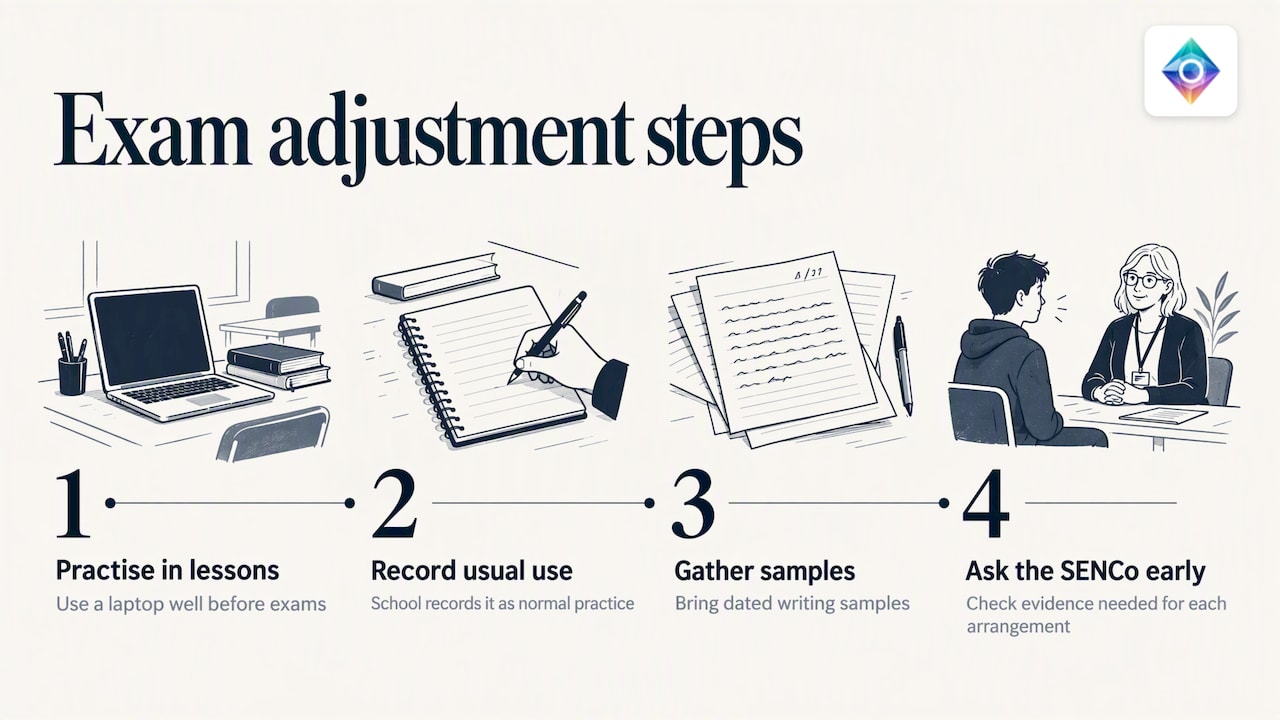
Exam arrangements such as extra time or a word processor are not an automatic response to a diagnosis. Ofqual’s regulatory report on access arrangements explains that they must reflect a student’s normal way of working, and schools need to hold evidence of that before applying to the Joint Council for Qualifications. The adjustment should remove a substantial disadvantage without giving an unfair advantage.
The practical consequence is timing. If a pupil will want a laptop in GCSEs, they should be using it in lessons well before the exam period, and the school should be recording that use. Raise it with the SENCo early, bring your dated writing samples, and ask what evidence the school needs for each arrangement. The same report notes that arrangements, once granted for a disabled student, can stay valid for up to 26 months, so check the current rules with the school’s exams officer.
For older teenagers planning further study, early academic planning matters too, and there are guides to support for students with disabilities that cover how needs can shape the application journey.
Why we think understanding comes before technique
I was diagnosed with ADHD at 42, and I know how much easier conversations with professionals become once you can describe your patterns in plain words.
That is why we built Omniprism the way we did. Handwriting trouble rarely travels alone: dyspraxia can sit next to ADHD, autism, dyslexia or sensory differences, and each shapes what helps. A child who is slow to write because of coordination needs different support from one who is slow because they are overwhelmed by the noise of the classroom. Our self-assessment covers 14 areas, including dyspraxia, dysgraphia-related patterns, sensory processing and ADHD, and gives a plain-language profile with no email, account or data collection.
We do not claim it diagnoses anything. It gives you vocabulary and a structured picture to bring to a GP, SENCo or OT, which is where handwriting support actually gets arranged.
— Valerio Cozzi
Where can I start with a self-assessment for my child or myself?
If you suspect handwriting difficulties are part of a wider profile, the free Omniprism self-assessment gives an instant profile across 14 areas. There are guided versions for children aged 7 to 10 and young people aged 11 to 13, so a parent can answer in a way that suits the child’s age.
After completing it, you can buy an optional Specialist Briefing for €9.99, a one-off payment, which summarises your results for a clinician. Many families find a short, organised summary helps a GP appointment or school meeting stay focused. If you want to understand the strengths in a profile as well as the difficulties, our piece on mapping neurodivergent strengths is a good next read.
Frequently asked questions
Can adults with dyspraxia improve their handwriting?
Often they can make useful changes, though the aim is usually comfort and legibility rather than perfection. RCOT’s adult neurodiversity guidance says that coping strategies are the primary goal even where coordination stays below average (RCOT). Check your seating, try one or two aids, and use a keyboard for long tasks.
At what age is dyspraxia usually diagnosed?
The NHS says diagnosis generally does not happen until a child is five or older, because young children develop at such different rates (NHS). If you are worried earlier, you can still ask for advice and support, since occupational therapy should be based on need rather than a diagnosis.
Should my child use a laptop instead of handwriting?
A laptop is a legitimate tool, and it is worth introducing early, especially if GCSE arrangements may be needed later. Exam boards expect it to reflect the pupil’s normal way of working, so it has to be in regular use at school. Keep handwriting practice going in short sessions, so the child keeps both skills.
Is poor handwriting always a sign of dyspraxia?
No. Poor handwriting is one of the most common symptoms of dyspraxia, according to the Dyspraxia Foundation, but other things can cause it, including other learning differences. A clinician or OT can look at the full picture, and a structured summary of what you have observed will help them.
Sources
- NHS: Developmental co-ordination disorder (dyspraxia) in children, symptoms
- Evaluating the evidence for motor-based interventions in DCD: systematic review and meta-analysis (PubMed)
- Ofqual regulatory report: access arrangements, including 25% extra time (GOV.UK)
- NICE CG170: autism in children and young people, full guideline
- RCOT: Adult neurodiversity
- RCOT: Diagnosis of developmental coordination disorder in children
- Dyspraxia Foundation: Handwriting
- Devon County Council: Handwriting, support for schools and settings
- Hertfordshire: Guidance on identifying writing difficulties
- Solihull Council: SpLD guidance
Recommended
- Families and Adults: Make Online Dyspraxia Tests Clinician Ready
- Dysgraphia vs Dyslexia: Spot Classroom Signs With a 14 Domain Self Check
- Bring Clinician Ready Evidence: Dyspraxia vs ADHD for Families
- Sensory Processing Checklist for UK Children: Prepare for NHS Meetings
Written and edited by Valerio Cozzi, founder of Omniprism. Omniprism began after my own ADHD diagnosis at 42.
This article is educational. It is not medical advice, not a diagnosis, and not a substitute for assessment by a qualified clinician. The Omniprism self-assessment is free, needs no account and no email address, and runs entirely in your browser — your answers are never sent to a server. The optional Specialist Briefing report is a paid add-on.