Bring Clinician Ready Evidence: Dyspraxia vs ADHD for Families

ADHD mainly disrupts attention and executive control, while dyspraxia (developmental coordination disorder, or DCD) mainly disrupts motor planning and coordination. That overlap means most families need a multidisciplinary assessment rather than a single diagnosis, so treat the sections below as a map for whichever path fits.
TL;DR:
- Most children with ADHD show symptoms early across multiple settings, but motor difficulties in dyspraxia often remain specific to physical tasks.
- A high proportion of individuals with ADHD also meet criteria for dyspraxia, and their combination results in more severe impairments across multiple domains.
- Effective assessment requires screening both attention and motor skills through standardized tests, samples, and joint evaluations by pediatricians and occupational therapists.
- Structured support varies: ADHD management prioritizes behavioral and environmental strategies, while dyspraxia relies on occupational therapy and skill-building interventions.
- Families should prepare specific, dated examples of motor and attention difficulties before appointments to improve diagnostic clarity and treatment planning.
What is ADHD?
ADHD is a neurodevelopmental condition built around three core features: inattention, hyperactivity, and impulsivity. NICE guidance describes it as heterogeneous, meaning presentations vary widely from person to person, and recommends clinicians assess how symptoms affect personal, educational, and social functioning rather than relying on a checklist alone.
A child with the inattentive pattern might drift off mid-instruction, lose homework sheets, or start three tasks and finish none. A child with more hyperactive-impulsive traits might blurt out answers, struggle to queue, or fidget through assembly. Diagnostic criteria require symptoms to appear before age 12 and to show up in at least two settings. So, a child who is fine at home but chaotic at school still meets that bar.
In adults, ADHD rarely looks like constant fidgeting. It shows up as chronic lateness, unfinished projects, missed deadlines, and a habit of losing track of conversations mid sentence. Many adults compensate for years before symptoms cause enough disruption at work or in relationships to prompt an assessment, which is why diagnosis in adulthood so often follows a difficult year rather than a dramatic single event.
The practical thread running through both age groups is functional impact. NICE is clear that ADHD assessment should look beyond symptoms themselves and weigh how much they interfere with daily life, because two people with an identical symptom list can have very different levels of impairment.
What is dyspraxia (developmental coordination disorder)?
Dyspraxia, more formally DCD, is a motor disorder that affects the planning, sequencing, and execution of movement. It is not a muscle weakness or an intelligence issue. The brain struggles to translate an intention into a coordinated physical action, whether that is catching a ball, tying a shoelace, or forming letters at a consistent size.
“Dyspraxia” and “DCD” are used interchangeably in most clinical writing, though DCD is the term you will see in formal diagnostic documents. Both describe the same underlying picture: difficulty with gross motor skills (running, jumping, riding a bike), fine motor skills (buttons, cutlery, pencil grip), or both.
At school, DCD often surfaces first through handwriting. Letters may be inconsistently sized, pencil pressure uneven, and the physical act of writing so effortful that written output lags well behind a child’s spoken vocabulary and ideas. PE can be a source of quiet dread, since sequencing a movement like a star jump or a throw takes deliberate mental effort that classmates perform almost automatically.

At home, dyspraxia tends to show up in self-care: struggling with buttons and zips years after peers manage them, spilling drinks, bumping into furniture, or taking far longer than expected to get dressed. In adulthood, those same coordination difficulties persist for many people. Review evidence on adult presentations notes that motor coordination problems do not simply disappear with age; they show up instead as poor handwriting, driving difficulties, or clumsiness that colleagues sometimes read as carelessness.
Symptoms compared: ADHD, dyspraxia, and where they overlap
Separating the two conditions gets easier once you group behaviours by their likely root cause rather than by how they look on the surface.
Hallmark ADHD signs:
- Difficulty sustaining attention on tasks that are not inherently interesting
- Impulsive comments, interruptions, or decisions made without pausing to think
- Restlessness, fidgeting, or a constant need to be moving or talking
- Losing possessions, forgetting instructions, or leaving tasks half finished
- Poor time awareness and chronic underestimation of how long things take
Hallmark dyspraxia (DCD) signs:
- Poor balance, frequent trips, or bumping into objects and people
- Handwriting that is slow, effortful, or inconsistent regardless of practice
- Difficulty with sequenced physical actions like tying laces or using cutlery
- Trouble judging distance or force, leading to spilled drinks or heavy-handed touch
- Avoidance of sport or physical play, often mistaken for laziness
Where the two genuinely overlap:
- Poor organisation, both physical (messy bags, lost kit) and mental (planning a project)
- Weak time management, though the ADHD version stems from attention drift and the DCD version from slow, effortful task execution
- Trouble starting tasks, whether from distraction (ADHD) or dread of a physically demanding step (DCD)
- Low self-esteem after years of being labelled “lazy” or “careless” rather than understood
The overlap column is where most confusion starts. A child who takes forever to get changed for PE might be daydreaming, or might be physically struggling to sequence the movements. Same behaviour, different mechanism, different support plan.
How common is the overlap, and why does it matter?
A significant proportion of people diagnosed with ADHD also meet criteria for DCD, and the combination is not simply additive. A systematic review of behavioural and neurobiological profiles found that comorbid ADHD and DCD often produces a distinct, more severe phenotype, with its own neurocognitive fingerprint rather than a straightforward mix of both conditions’ symptoms.
That matters practically because a child (or adult) with both conditions tends to struggle more across more domains than either condition alone would predict. Motor difficulties make attention lapses harder to compensate for, and attention difficulties make it harder to consistently practise the motor skills that occupational therapy relies on to build improvement. One problem feeds the other.
Narrative review evidence on DCD comorbidities describes genuinely blurred boundaries between these diagnostic categories, and argues that a multidisciplinary approach, rather than a single specialist working in isolation, gives the most accurate picture. In practice, that means a good assessment for suspected ADHD should routinely screen motor skills, and a motor assessment for suspected DCD should routinely screen attention and impulse control. Treating either condition as the whole story risks missing the other.
How to know if it’s ADHD, dyspraxia, or both
A few practical checks separate the two conditions well, and clinicians typically look at all of them together rather than any single one in isolation.
- Check the timing. ADHD symptoms are usually visible from early childhood across multiple settings; motor difficulties in DCD are also present early but tend to be specific to physical tasks rather than attention-dependent ones.
- Watch the response to structure. Give a task more scaffolding (step-by-step instructions, reminders, a quiet space). If performance improves sharply, attention is likely the bigger driver. If the physical execution stays clumsy regardless of support, motor planning is more likely at fault.
- Look at motor test findings. Standardised motor assessments, run by an occupational therapist, will flag genuine coordination deficits that attention problems alone would not produce.
- Gather real evidence, not memory. Bring school reports, handwriting samples from different points in the year, and short videos of the child attempting a physical task like catching a ball or writing a sentence.
- Ask for a joint assessment when signs of both appear. A single specialist rarely covers both domains well; a paediatrician or psychiatrist assessing attention and an occupational therapist assessing motor skills together give a far more complete picture than either working alone.
Assessment and diagnosis: what to expect from professionals
Most families start with a GP or school referral, which then typically leads to a paediatrician, child psychiatrist, or clinical psychologist for the attention and behaviour side, and an occupational therapist for motor testing. NICE recommends assessing ADHD symptoms against DSM-5 criteria alongside a review of coexisting neurodevelopmental conditions, including DCD, during the diagnostic process.
Expect structured interviews, standardised ADHD rating scales completed by parents and teachers, and, where motor concerns are flagged, tools like the DCD Questionnaire (DCD-Q) alongside a standardised motor skills assessment. Clinicians rely heavily on symptom pervasiveness (does it show up everywhere, or only during physically demanding tasks?) and on concrete evidence like handwriting samples to separate the two, according to reviews on adult presentations of both conditions.
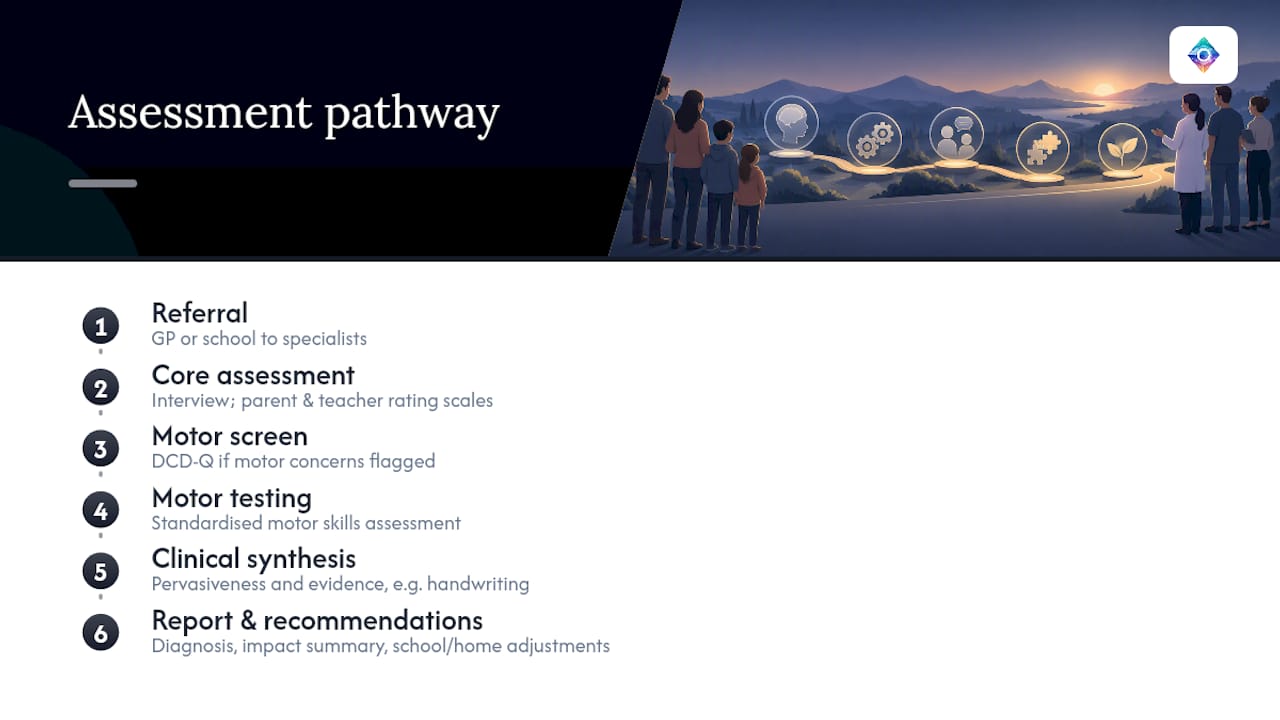
A finished assessment usually produces a written report with a formal diagnosis (or diagnoses), a functional impact summary, and specific recommendations for school, home, or workplace adjustments. Ask for a copy in plain language if the version you receive is heavy on clinical shorthand.
Support and management: what actually helps
For ADHD, NICE’s management guidance sets out environmental adjustments, educational support, and psychological interventions as first steps, with medication considered where impairment is more significant. None of these are mutually exclusive; most treatment plans combine several.
For dyspraxia, occupational therapy is the backbone of support, and incorporating music activities that support executive function and motor skills can be particularly beneficial. Rather than aiming for a cure, DCD-focused reviews describe intervention as skill building, compensatory strategy, and environmental adjustment working together: adapted pencil grips, extra time for written work, and structured motor programmes that build specific skills through repetition.
When both conditions are present, sequencing matters. A child who cannot sit still long enough to benefit from a motor programme may need attention support first, while a child overwhelmed by physical tasks may need those broken into smaller steps before any attention-based strategy can take hold. Practical classroom strategies for combined ADHD and DCD tend to work best when school, occupational therapist, and family agree on one plan rather than three separate ones.
What co-occurrence means for families, and how to prepare
The neurocognitive profile of comorbid ADHD and DCD is distinct enough that treating it as “ADHD, plus a bit of clumsiness” understates the picture. The systematic review already cited found the combination carries its own severity pattern, which is part of why proactive screening matters so much.
That proactive screening has a real gap to close. A study of parents of children with ADHD found many were unaware their child might also have DCD, even when screening questionnaires suggested a high probability. Motor difficulties get missed simply because nobody thought to ask about them during an ADHD-focused assessment.
Pro Tip: Before any appointment, write down specific examples rather than general impressions: “struggles to tie shoelaces at age nine” carries more diagnostic weight than “a bit clumsy”. Specific, dated observations are exactly what clinicians ask for and rarely get.
A structured self-assessment profile, completed at home before an appointment, gives families a clearer, organised starting point for that conversation, and can highlight motor concerns a parent might not otherwise mention.
A founder’s perspective on getting a clearer picture
I was diagnosed with ADHD at 42, after two decades of assuming my scattered focus was just a personality quirk. What struck me most was how much clarity mattered once I finally had it, and how differently that conversation with clinicians might have gone with a structured profile in hand rather than a vague sense that something was “off”. That gap is exactly what a well-built self-assessment tool should close.
— Valerio Cozzi
Get clinician-ready clarity before your next appointment
A structured starting point can provide an instant profile across multiple domains, including ADHD and dyspraxia traits, often without requiring an account, email, or data collection. That matters most right before an assessment, when families need organised, specific observations rather than a vague sense that something needs looking into.
The free self-assessment works for adults and, through guided assessments for children and teens, for families trying to make sense of overlapping traits at home or school. Once you have your results, the optional Specialist Briefing report turns them into a plain-language summary designed for easy use by a GP, paediatrician, or psychologist, priced at €9.99 as a one-off purchase. None of this replaces a clinical diagnosis. It exists to make the conversation with the professionals who provide that diagnosis faster and better informed. Start with the free assessment, and decide afterwards whether the briefing is worth adding to your next appointment.
This article is general information, not a substitute for advice from a qualified doctor. Consult a qualified healthcare professional about your own circumstances before acting on anything here.
Sources
- Attention deficit hyperactivity disorder: diagnosis and management | NICE
- A systematic review of behavioural and neurobiological profiles associated with coexisting attention-deficit/hyperactivity disorder and developmental coordination disorder
- Narrative review: relationships between Developmental Coordination Disorder (DCD) and comorbidities
- Motor skills in children with ADHD: overlap with developmental coordination disorder - PubMed
- Dyslexia, dyspraxia, and ADHD in adults: what you need to know
- Management | Attention deficit hyperactivity disorder | CKS | NICE
FAQ
Can ADHD be mistaken for dyspraxia?
Yes, particularly when a child struggles to start or finish physical tasks, since that can look like inattention or genuine motor difficulty from the outside. The clearest way to tell them apart is checking whether performance improves with extra structure (pointing to ADHD) or stays clumsy regardless of support (pointing to DCD), and a proper assessment tests both.
How does dyspraxia affect handwriting?
Dyspraxia typically produces handwriting that is slow, physically effortful, and inconsistent in letter size and spacing, even after significant practice. This happens because forming letters requires precise motor sequencing, which is exactly the skill DCD disrupts, and written output often lags well behind a person’s actual vocabulary and ideas.
How common is dyspraxia, and how often does it occur with ADHD?
Dyspraxia affects a meaningful minority of children, and among those already diagnosed with ADHD, research shows a high rate of co-occurrence. That high rate is a major reason clinicians now recommend checking motor skills during any ADHD assessment, rather than treating the two as unrelated.
How is dyspraxia diagnosed in children?
Diagnosis usually involves a paediatrician or clinical team review alongside an occupational therapist, who runs standardised motor assessments and structured task observation rather than relying on parent report alone. Evidence like handwriting samples and videos of physical tasks, along with questionnaires such as the DCD-Q, help build a complete picture before a formal diagnosis is given.
Recommended
- Parents: 14 Domain Self Check to Uncover Autism Misdiagnosed as ADHD
- DSM-5 ADHD Criteria: A Clear Guide for Parents and Clinicians
- 50–70% Overlap in Autism and ADHD: What Families and Clinicians Need
- Autism vs. ADHD: Comparing Symptoms, Overlap, and Diagnosis
Written and edited by Valerio Cozzi, founder of Omniprism. Omniprism began after my own ADHD diagnosis at 42.
This article is educational. It is not medical advice, not a diagnosis, and not a substitute for assessment by a qualified clinician. The Omniprism self-assessment is free, needs no account and no email address, and runs entirely in your browser — your answers are never sent to a server. The optional Specialist Briefing report is a paid add-on.