Dyslexia Self-Assessment Guide: Steps, Checklist and Next Steps
A dyslexia self-assessment is a structured way to check your own reading, spelling, memory and organisation against known signs of dyslexia, and it can show you whether a formal assessment is worth pursuing. It cannot diagnose dyslexia, because dyslexia remains a clinical diagnosis with no single test that confirms it. What it can do is turn a vague feeling of “reading is harder for me” into a clear, written pattern that a professional can work with.
This guide is for adults, parents, young people preparing for an assessment, and educators who want to understand what a screening result does and does not mean. It starts with the steps, then explains the checklist, how screening differs from diagnosis, and what to do with the result.
Key Takeaways
- A self-assessment screens for signs of dyslexia and estimates likelihood. A diagnosis needs a qualified assessor, who looks at history, observation and testing.
- Look for a pattern across reading, spelling, memory, organisation and effort, not a single sign. Many people have one or two of these without being dyslexic.
- Write down specific examples with dates and situations. Specific examples are what make a later conversation with a GP, school or assessor productive.
- Omniprism’s free self-assessment gives an instant plain-language profile across 14 areas, including dyslexia, with no email, account or data collection.
- Parents can use the children’s assessment and bring the result to the school’s special educational needs coordinator (SENCO) or a GP.
How do I do a dyslexia self-assessment step by step?
Follow these six steps in one sitting of about 20 to 30 minutes, in a quiet place and on a normal day rather than after a bad night’s sleep.
- Choose the right version. Use an adult checklist for yourself, or a child or teen version if you are answering for a young person. Questions written for adults ask about work and paperwork. Questions for children ask about letters, sounds and homework.
- Answer from your usual pattern. Think about the last six months, not your best or worst day. If you rely on spellcheck, text-to-speech or a partner to proofread, answer as you would without them, because those supports hide the underlying difficulty.
- Note an example for each sign you tick. “I reread emails three times before sending” is useful. “I am slow” is not. Add where it happens: work, study, home.
- Look at the pattern, not the count. Several signs clustering around reading, spelling and working memory point in one direction. Scattered signs across many areas may point elsewhere, such as attention or coordination.
- Check the neighbouring traits. Dyslexia often sits alongside other differences. Our Free Adult Self-Assessment covers 14 areas in one go, so the same sitting also shows whether dyspraxia, ADHD or dyscalculia traits appear.
- Decide on a next step. If the pattern is clear and affects work, study or confidence, plan a conversation with a professional (covered below). If it is mild, keep your notes and revisit if difficulties grow.
The common failure points are answering for the “coping” version of yourself, ticking signs without examples, and treating a high score as a verdict. A result is a prompt for a conversation, nothing more.
What are the signs of dyslexia in adults?
The NHS lists adult signs that include frequent spelling mistakes, confusing words that look similar, needing to reread text, tiring when reading or writing, difficulty telling left from right, trouble planning and managing time, forgetting dates or names, getting confused by several instructions at once, and being skilled in some areas while struggling with tasks others find easy.
Understood groups the signs in a way that makes a checklist easier to use:
| Area | What it can look like |
|---|---|
| Decoding | Guessing unfamiliar words, misreading similar words, skipping lines, slow reading |
| Fluency | Reading aloud flatly, feeling exhausted after reading, little interest in reading for pleasure |
| Spelling | Inconsistent spelling, mixing up similar-sounding letters, heavy reliance on spellcheck |
| Executive function | Difficulty with planning, organisation, attention and working memory |
The last row matters because many adults notice the organisation problems first and never connect them to reading. If your difficulties show up mainly there, the profile across all 14 areas is more informative than a dyslexia-only list.
Is there a dyslexia self-assessment checklist I can use?
Yes, and you can build a reliable one from the table above. Turn each row into three questions and answer “rarely”, “sometimes” or “often”:
- Do I need to reread a paragraph to take it in, even when the subject is familiar?
- Do I avoid writing by hand or spelling aloud in front of other people?
- Do I lose track of multi-step instructions, dates or names more than the people around me?
- Do I feel tired out by reading or writing that others find routine?
- Have I avoided jobs, courses or tasks mainly because of reading and writing demands?
Several “often” answers on reading and spelling questions are worth following up. Our free assessment does this work for you and returns an instant plain-language profile, so you do not have to score a checklist yourself. It collects no email address, account or personal data, which suits people who want to look at the result privately first.
Pro Tip: Print or save your result and add three real examples from work or study before any appointment. Assessors work from history, and examples give them something concrete to ask about.
What is the difference between a dyslexia screening and a diagnosis?
A screening estimates the likelihood of dyslexia. A diagnosis explains what is happening and why, and it is made by a qualified professional.
The Specialist Teachers Assessment of… is not needed here, but the UK professional guidance is worth knowing. The SASC guidance on the Tests of Dyslexia, published in October 2024, says a comprehensive assessment measures three domains: reading and spelling, linguistic processing, and vocabulary and reasoning. The same guidance says the TOD-Screener produces a Dyslexia Risk Index but, as a screener, does not provide enough information to diagnose dyslexia.
A peer-reviewed review in the medical literature agrees on the principle: diagnosis rests on history, observation and psychological assessment, and a parent or caregiver checklist of developmental skills forms part of the initial history. A well-kept self-assessment fits into that history directly.
What are the best dyslexia tests?
The best test depends on what you need it to do. There are three kinds, and each answers a different question.
| Type | Question it answers | Who it suits |
|---|---|---|
| Self-assessment profile | Do my traits fit a dyslexia pattern, and what else shows up? | Anyone starting out, adults and parents |
| Professional screener | What is my estimated risk, measured against a norm? | Used by a teacher or assessor |
| Full diagnostic assessment | Do I have dyslexia, and what support fits? | Anyone who needs a formal report |
For a first step, we recommend the Free Adult Self-Assessment. It is instant, free, and shows your dyslexia traits next to 13 other areas, including ADHD, autism, dyspraxia, dyscalculia and sensory processing. That wider view is useful because traits overlap: handwriting difficulty, for example, can come from dyslexia or from dyspraxia. Our guide to the signs of dyspraxia in adults helps you tell them apart.
For a formal report, a qualified assessor carries out the standardised testing. That is a step for a professional, and the self-assessment is how you arrive prepared.
What are the best dyslexia tests for children?
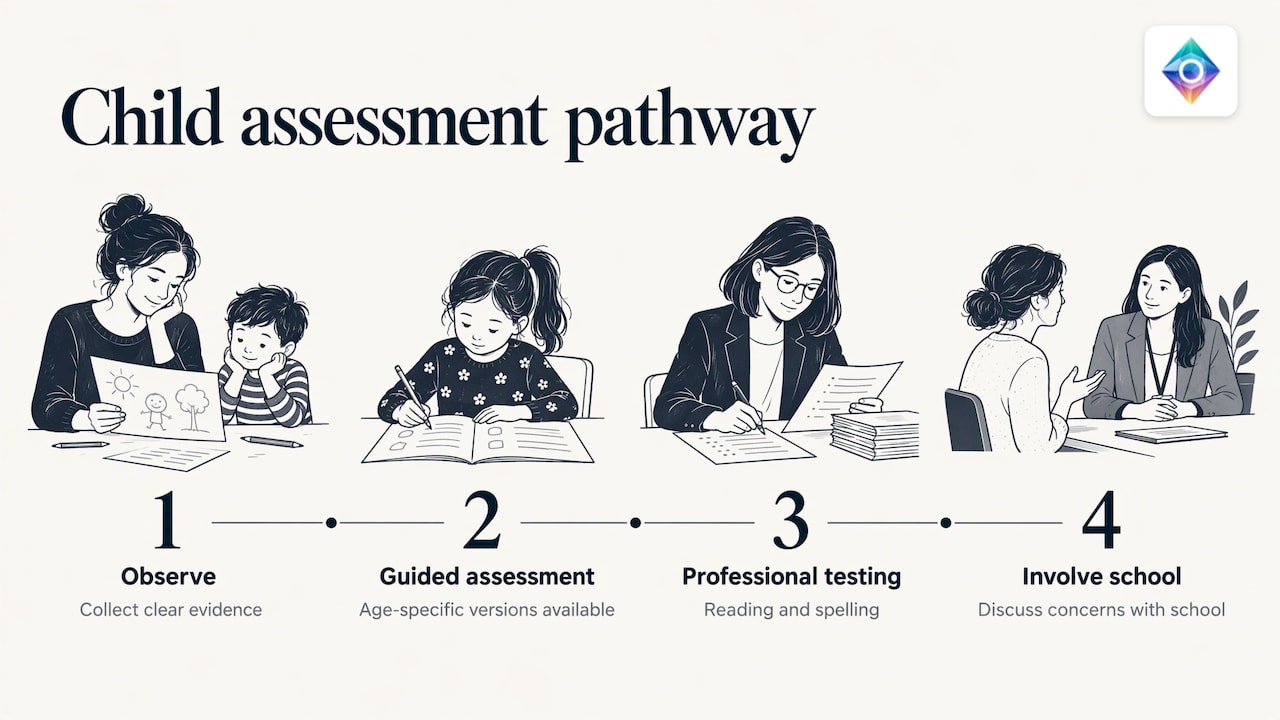
For children, start with observation and a guided assessment, then involve the school. Standardised testing of reading and spelling is done by a professional, so a parent’s job is to collect clear evidence.
Our Children & Young People Free Assessment offers guided assessments for children and teens, with age-specific versions for the 7 to 10 age group and for 11 to 13 year olds. Results come in plain language and need no email or account.
Signs worth noting at different ages are covered in our guides to dyslexia signs in kindergarten and signs of dyslexia in a child. If your concern started with late or unclear speech, a speech delay checklist for parents helps you describe what you have seen. In the classroom, it helps to know how dysgraphia differs from dyslexia and how to tell dyscalculia from dyslexia, because the writing and number difficulties can look similar from the outside.
What should I do after a dyslexia self-assessment?
Treat the result as the start of a conversation and take it to the right person.
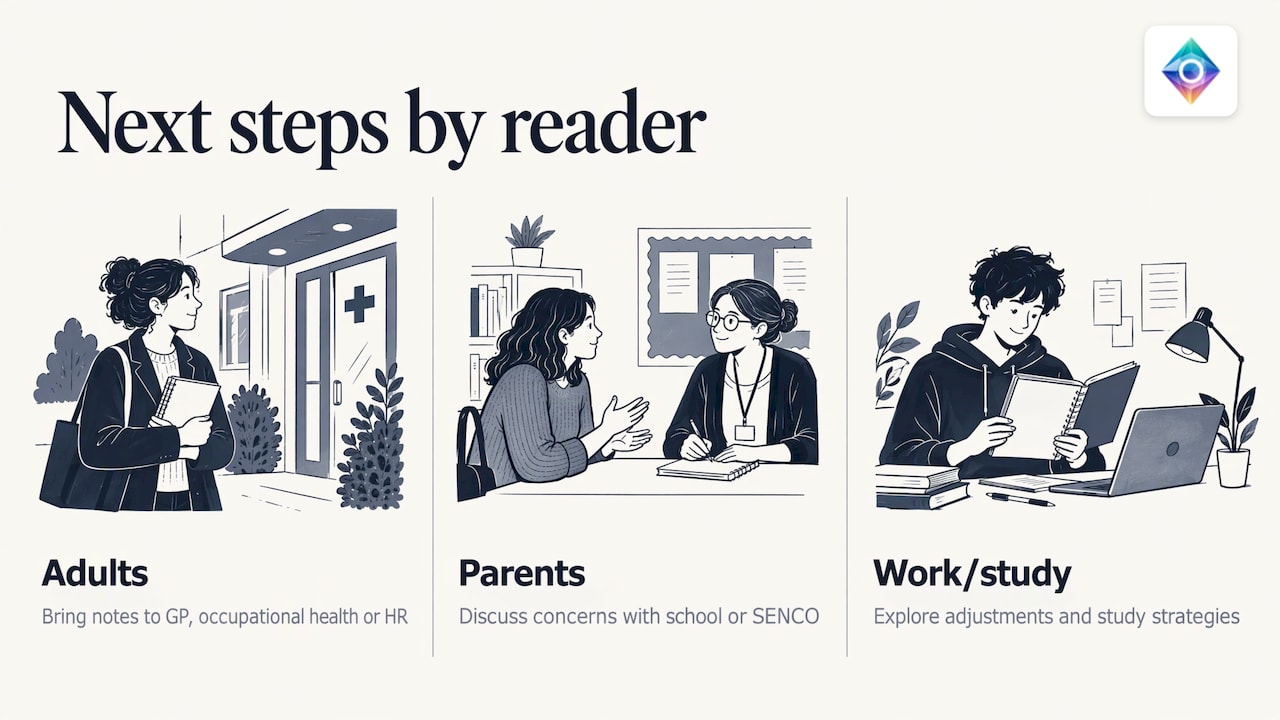
Adults. Book a GP appointment or speak to your employer’s occupational health or HR team, and bring your notes. If you want a formal diagnosis, ask a qualified assessor, such as an educational psychologist or a specialist teacher with an assessment practising certificate. Our Specialist Briefing costs €20 one-off and summarises your results for clinicians, so you do not need to explain everything from scratch in a short appointment.
Parents. The NHS advises speaking with your child’s school, which usually means the SENCO, about concerns. The Youth Briefing costs €20 one-off and gives that conversation a clear written summary.
Workplace and study. Under the Equality Act 2010, employers must consider reasonable adjustments for disabled workers, and dyslexia can fall within that definition. A professional can advise whether your situation does. Our guide to study strategies for dyslexic students offers practical techniques while you wait.
How can parents, educators and professionals support someone during assessment?
The waiting period is where a lot of confidence is lost, and a few habits make it easier.
- Keep a shared log. Short, dated notes of what happened, in which task and how much support was needed.
- Ask about effort, not only results. A child who reads accurately but is exhausted afterwards still has a story to tell, as the Understood list of fluency signs suggests.
- Protect strengths. The NHS notes that people with dyslexia are often skilled in some areas, so name and use those strengths in lessons and at work.
- Use plain-language summaries. Clinicians and teachers can read a one-page profile quickly, which is why we built the briefings for easy use by healthcare professionals.
Why we built Omniprism this way
Most people who suspect dyslexia are not asking for a label. They want to know whether what they feel is real, and what to say when they finally speak to someone.
I was diagnosed with ADHD at 42, so I know how long a person can carry unanswered questions about their own mind. A self-assessment will not replace a clinician, and we never present it that way. What it can do is give you a clear, private starting point.
That is why our assessment covers 14 areas rather than one, returns results instantly in plain language, and asks for no email, account or personal data. The Specialist Briefing exists so a clinician receives your information in a form that is easy to use.
Valerio Cozzi
Frequently asked questions
Can an online dyslexia test diagnose me?
No. A clinical review states that no single test can diagnose dyslexia, and that diagnosis draws on history, observation and psychological assessment. An online result shows whether your traits fit the pattern and helps you prepare for that assessment.
How accurate is a dyslexia self-assessment?
It is a guide to likelihood and not a measurement of ability. Its value depends on honest answers and on the examples you record. Professional screeners such as the TOD-Screener also estimate risk only, according to the SASC guidance.
At what age can I use a dyslexia checklist for my child?
Parents can note early signs from kindergarten age, and our guided assessments cover children aged 7 to 10 and young people aged 11 to 13. Share the result with the school, and ask a GP if you also have health concerns.
Does Omniprism store my answers?
No. The assessment asks for no email, account or data collection, so you can complete it and read the result privately. If you want a summary for a clinician, the optional Specialist Briefing costs €20 one-off.
Sources
- Dyslexia in adults, NHS
- Dyslexia, NHS
- Tests of Dyslexia guidance, SASC, October 2024
- Dyslexia: neurobiology, clinical features, evaluation and management, PMC
- Dyslexia signs in adults, Understood
- Equality Act 2010 guidance, GOV.UK
Recommended
- Dysgraphia vs Dyslexia: Spot Classroom Signs With a 14 Domain Self Check
- Dyslexia Signs in Kindergarten: 5 Clues to Bring to School
- 6 Evidence Backed Study Strategies Dyslexic Students Can Try This Week
- Parents & Teachers: Four Steps to Tell Dyscalculia From Dyslexia
Written and edited by Valerio Cozzi, founder of Omniprism. Omniprism began after my own ADHD diagnosis at 42.
This article is educational. It is not medical advice, not a diagnosis, and not a substitute for assessment by a qualified clinician. The Omniprism self-assessment is free, needs no account and no email address, and runs entirely in your browser — your answers are never sent to a server. The optional Specialist Briefing report is a paid add-on.