Dyscalculia Self-Assessment Guide: Steps, Signs and Next Moves
You can assess yourself for dyscalculia by working through a structured checklist of everyday number difficulties, then noting how often each one affects you and since when. The result is a set of signs to take to a specialist, because a self-assessment cannot diagnose dyscalculia, and the free Omniprism adult self-assessment gives you a plain-language profile across 14 areas, dyscalculia among them, in a single sitting with no account or email.
This guide covers the steps, the signs worth looking for, how dyscalculia differs from dyslexia, how to read what you find, and what to do next for an adult, a child or a teenager.
Key Takeaways
- A self-assessment shows patterns in how you handle numbers, time and money. Only a qualified assessor can diagnose dyscalculia.
- Look at everyday tasks (PINs, change, clocks, directions) and at how long the difficulty has been there, not at one test score.
- Dyscalculia and dyslexia are separate conditions with different cognitive profiles, so a dyslexia test will not answer a number question.
- UK guidance on assessment asks for history-taking and several kinds of testing, so go to an appointment with written examples.
- Parents and educators can use the same approach with age-appropriate tools and bring the notes to school or a clinician.
How do you do a dyscalculia self-assessment?
Work through these six steps in order. They take roughly an hour in total if you write things down as you go.
- Write down the situations, not the label. List the places numbers cause you trouble: paying, timetables, recipes, budgets, directions, deadlines. Concrete examples are what a clinician can use later, and a vague sense of being “bad at maths” is not.
- Check the signs against a reliable list. Use the everyday signs in the next section, which come from a UK charity and a US professional body. Mark each as never, sometimes or often.
- Trace the history. Note when each difficulty began. UK assessment guidance asks for thorough history-taking covering maths, literacy, attitudes, motivation and maths anxiety, according to the SASC guidance on assessing dyscalculia, so your school memories matter as much as today’s habits.
- Separate anxiety and lack of practice from number sense. Ask yourself whether you struggle even when calm and unhurried, and whether the difficulty extends to simple things such as comparing two amounts. The same SASC guidance names maths anxiety, attitudes and motivation as factors an assessor weighs, so record them honestly.
- Run a structured profile. A tool that covers several areas at once shows whether numbers are the only pattern or one of several. Our free adult assessment covers 14 domains, including dyscalculia, dyslexia, ADHD, autism, dyspraxia and sensory processing, and gives you results immediately in plain language.
- Decide what to do with the result. If the signs are frequent and began in childhood, book a formal assessment and take your notes. If they are occasional, the notes still help you ask for practical adjustments at work or in study.
The order matters: examples first, label last. People who begin with a score tend to remember only the score, while an assessor wants the stories behind it.
What are the signs of dyscalculia in adults?
Dyscalculia is a specific and lasting difficulty with numbers. The most useful checklist is made of daily tasks. National Numeracy lists these effects:
- trouble recalling PINs or telephone numbers
- difficulty managing time and planning journeys
- uncertainty when choosing notes or coins
- trouble following directions or reading a clockface
- problems with multiplication, division and comparing amounts
- difficulty counting backwards and estimating
- trouble with place value, such as the difference between £500 and £5.00
The Learning Disabilities Association of America adds adult examples: copying phone numbers, logins and dates wrongly, struggling to estimate shopping totals, tips or bill shares, scaling recipes with fractions, understanding APR, and keeping track of appointments and deadlines. The same page notes that the DSM-5, the US psychiatric manual, refers to difficulties with number sense, memorising basic maths facts, and accurate, fluent calculation. It estimates that 4 to 7% of students have dyscalculia.
A practical way to use these lists is to score yourself on the cluster rather than on any single item. Mixing up one phone digit means little. Regularly misjudging change, losing track of time and avoiding anything involving distances points to a pattern worth recording.
What is the difference between dyscalculia and dyslexia?
Dyslexia affects reading through phonological processing, decoding, fluency and spelling, whereas dyscalculia affects maths through working memory, number sense, computation and the use of symbols, as the New York State Education Department sets out. A 2009 study of children aged 8 to 10 found separable profiles: a phonological deficit in dyslexia and deficits in processing symbolic and nonsymbolic magnitudes in dyscalculia.
This answers a question behind the search for the top free dyslexia tests: a dyslexia screener looks at reading and spelling, so it will not tell you whether number processing is the issue. The two can occur in the same person, which is why a multi-area profile is useful. Our guide for parents and teachers on telling dyscalculia from dyslexia goes through four steps for children.
Which dyscalculia tests are worth knowing about?
There are two kinds of tool, and they do different jobs.
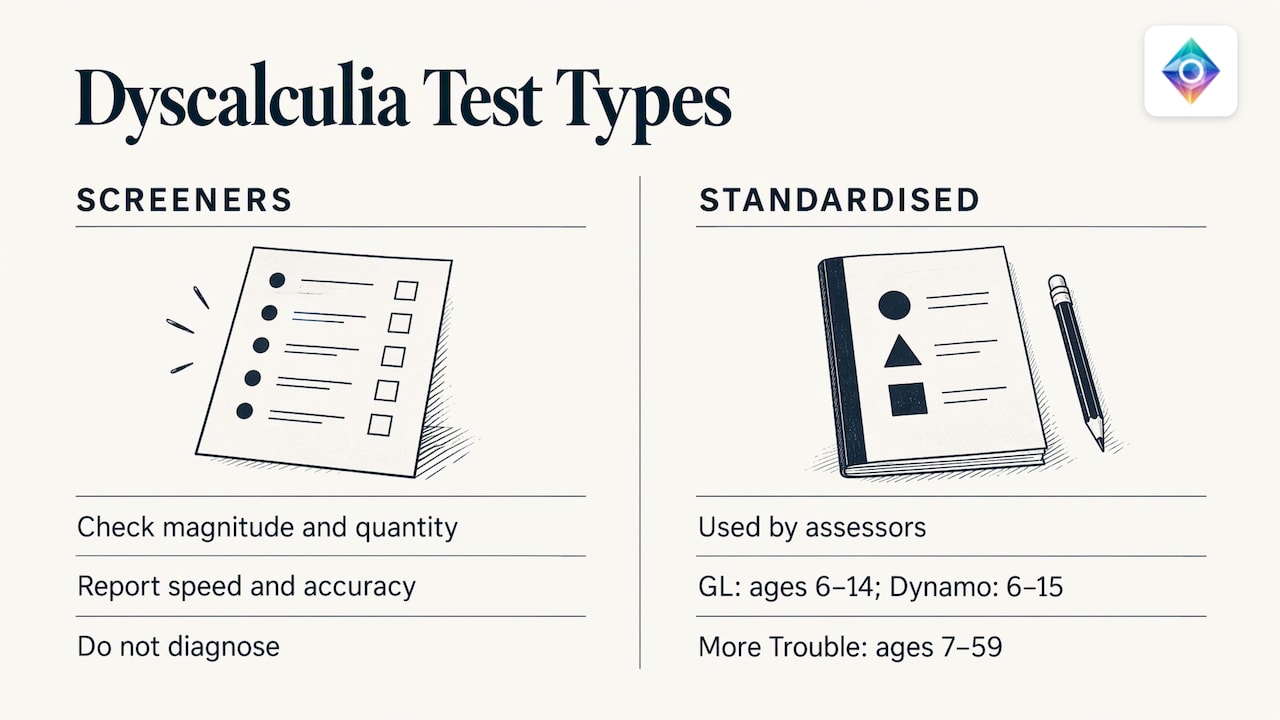
Screeners are informal tools that look for early signs. New Jersey’s education department says a good one should assess magnitude and quantity, computation and mathematical reasoning, reporting both speed and accuracy, and that screeners do not diagnose. UCL’s ADD UP resource makes the same point and notes that some free tools cover narrow ground: the Panamath test of number sense assesses dot comparison only.
Standardised tests are used by assessors. The SASC list of suitable tests from June 2024 names options with age ranges, such as the Dyscalculia Screener from GL Assessment (ages 6 to 14), the Dynamo Maths assessment (6 to 15) and More Trouble with Maths, which covers ages 7 to 59. These are administered by trained people, so they are not something to take at home.
If you are comparing what is available online, our overview of privacy-first dyscalculia tests explains what each kind can and cannot show.
Can an online dyscalculia test diagnose you?
No. A screener can suggest areas of strength and difficulty, but UCL states that screeners are not diagnostic tools and cannot tell whether someone has developmental dyscalculia (UCL ADD UP). SASC adds that maths difficulties should not be judged on a single arithmetic score.
What a self-assessment does well is organise your experience so you can describe it clearly. If you are curious how the same logic applies to other conditions, self-assessment versus diagnosis sets it out for ADHD and autism quizzes.
How do you read your results?
Treat the result as a map with three layers.
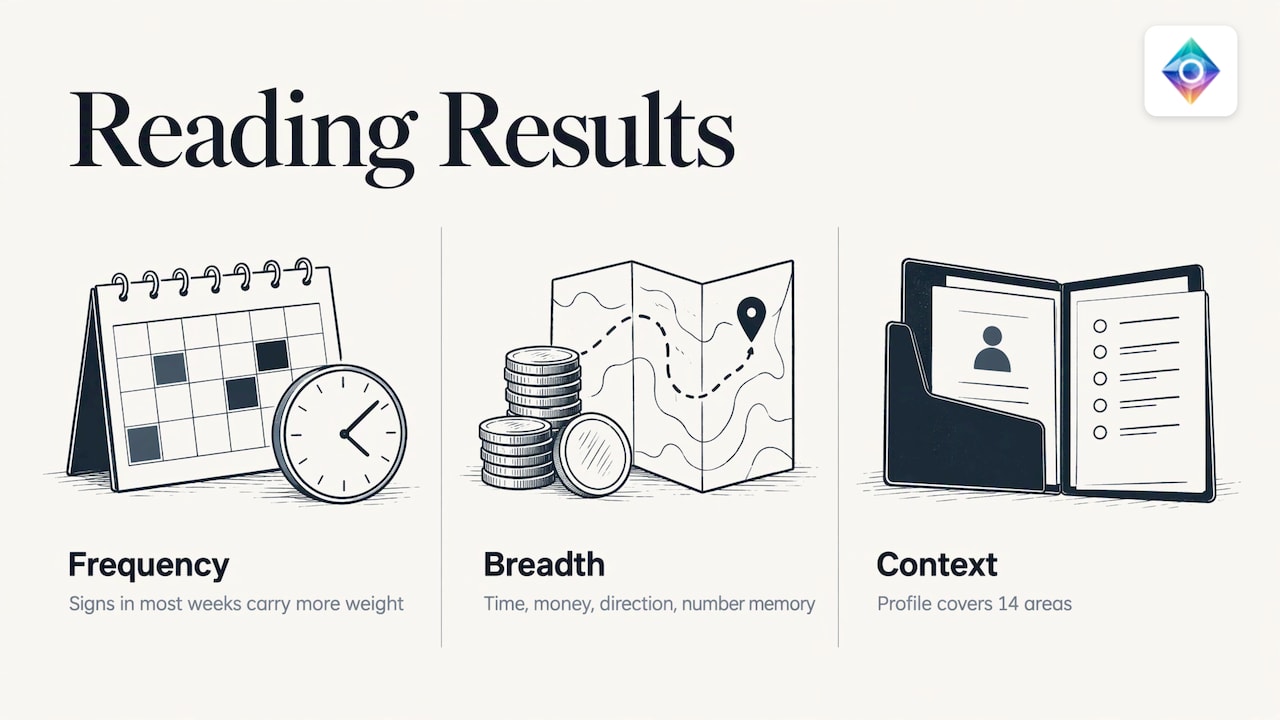
Frequency. Signs that appear in most weeks carry more weight than signs that appear under pressure only.
Breadth. Difficulties across time, money, direction and memory for numbers suggest something wider than a bad experience with one subject.
Context. A profile that also flags other areas is common, and it is useful for the assessor. Our profile covers 14 areas, so you can see dyscalculia next to dyslexia, dyspraxia, ADHD and sensory processing rather than in isolation.
Worked example: an adult notes that they cannot hold a PIN in mind, always round up bills because splitting them feels risky, and have misread analogue clocks since primary school. Those three items are frequent, broad and long-standing, so they go into a written summary. Another adult notices they dislike maths and freeze in exams, but handle money easily day to day. That pattern points more towards anxiety, which an assessor will also explore.
What should you do after a dyscalculia screener flags something?
Take your notes to someone qualified. According to the SASC guidance, a diagnostic assessment should be holistic and include:
- thorough history-taking
- cognitive and processing tests
- literacy and maths attainment tests
- informal number-sense tasks, such as subitising (seeing a small quantity at a glance) and comparing quantities
- timed and untimed arithmetic and reasoning measures
- analysis of the kinds of errors made
Prepare for that by bringing three things: your examples from step 1, your history from step 3, and your profile. For clinicians, the optional Specialist Briefing at €20, one-off, summarises your results in a form made for them to read. It is one way to turn the self-assessment into a page that supports the conversation.
Support does not have to wait for a diagnosis. SASC recommends linking adjustments to reported difficulties and test-evidenced needs, and notes that a calculator or rest breaks can sometimes address a need better than extra time. For classroom ideas, see our three classroom maths strategies for dyscalculia.
How do you check a child or teenager for dyscalculia?
The steps are the same, with an adult doing the noting. A parent or teacher writes down what they see: counting that stays effortful, difficulty with clocks, trouble linking numbers to quantities, and avoidance of maths tasks. Dates and examples matter here too, because assessors look for a history rather than a single bad week.
Our free children and young people assessment offers guided versions for ages 7 to 10 and ages 11 to 13, and a Youth Briefing for €20, one-off, summarises results for professionals. For older pupils, our six-step evidence path for teen dyscalculia lists everyday red flags.
Parents who are also tracking other early milestones can use a checklist for recognising speech delays alongside, since the same habit of dated, specific observations helps with any formal evaluation.
Where can you take a free dyscalculia self-assessment?
The Free Adult Self-Assessment costs nothing and needs no email or account. It collects no data, and the result is an instant profile in plain language across 14 areas that include dyscalculia, dyslexia, ADHD, autism, masking, dyspraxia, sensory processing, high sensitivity, OCD traits and synesthesia. If you want a clinician-ready summary afterwards, the Specialist Briefing is available as a one-off purchase at €20.
Why use a privacy-first dyscalculia self-assessment?
Many people hesitate to explore a number difficulty because it feels like admitting a weakness in front of a system that records everything. We built Omniprism so that nobody has to give an email, create an account or have their answers collected before seeing their profile.
I was diagnosed with ADHD at 42, and I know how much easier it is to start a conversation with a clinician when you can already describe your patterns clearly.
That is why we pair a free, instant profile across 14 areas with an optional Specialist Briefing: the first helps you understand yourself, and the second gives the person assessing you a clear summary. Dyscalculia rarely appears alone, so seeing it next to dyslexia, dyspraxia or ADHD saves time at every later step.
Valerio Cozzi
FAQ
Is there a dyscalculia self-assessment checklist I can use?
Yes. Use the everyday signs from National Numeracy and the Learning Disabilities Association of America above: PINs, change, time, directions, estimating and place value. Rate each as never, sometimes or often and note when it began. The checklist describes patterns, and only a qualified assessor can confirm dyscalculia.
What are the best dyscalculia tests?
For professionals, SASC’s June 2024 list names standardised tests by age range. For individuals, the sensible first step is a structured self-assessment that covers several areas, then a formal assessment if signs are frequent. Our free adult assessment is built for that first step.
Are free dyslexia tests useful for dyscalculia?
Only in part. Dyslexia tests look at reading, spelling and phonological processing, while dyscalculia involves number sense, working memory and calculation. A profile that covers both, such as a multi-area self-assessment, shows whether one or both patterns appear.
Can a child do a dyscalculia self-assessment?
Children and teenagers can complete guided versions with an adult. Our children’s assessments are split by age band, and the adult’s job is to note examples and history to share with school or a clinician.
Sources
- National Numeracy: What is dyscalculia?
- SASC: Guidance on assessment of dyscalculia, November 2019
- SASC: List of suitable tests, June 2024
- UCL ADD UP: Dyscalculia screeners and checklists
- PubMed: Dyslexia and dyscalculia, two learning disorders with different cognitive profiles (2009)
- New York State Education Department: Questions and answers on dyslexia, dysgraphia and dyscalculia
- New Jersey Department of Education: Key components of effective dyscalculia screeners
- Baby Bare Essentials: How to recognise speech delays
Recommended
- 3 Classroom Math Strategies for Dyscalculia You Can Start This Week
- Parents & Teachers: Four Steps to Tell Dyscalculia From Dyslexia
- Privacy first dyscalculia tests: 14 domain checks and €20 report
- Six Step Evidence Path and Everyday Red Flags for Teen Dyscalculia
Written and edited by Valerio Cozzi, founder of Omniprism. Omniprism began after my own ADHD diagnosis at 42.
This article is educational. It is not medical advice, not a diagnosis, and not a substitute for assessment by a qualified clinician. The Omniprism self-assessment is free, needs no account and no email address, and runs entirely in your browser — your answers are never sent to a server. The optional Specialist Briefing report is a paid add-on.