Privacy first dyscalculia tests: 14 domain checks and €20 report

The best consumer dyscalculia test is not a test at all in the clinical sense. It is a private, non-diagnostic online questionnaire that produces a plain-language profile of your number-related strengths and difficulties, plus concrete next steps. This kind of self-assessment, in line with UCL’s ADD UP guidance, cannot diagnose anything, but it can help you spot patterns and prepare specific examples for a professional conversation.
TL;DR:
A good online dyscalculia self-assessment should evaluate broad everyday numeracy skills across multiple domains, not just basic arithmetic.
Results should provide a clear profile of strengths and difficulties, highlighting patterns that can be shared with professionals for further evaluation.
It is essential to distinguish between persistent processing errors characteristic of dyscalculia and situational maths anxiety, as the next steps differ.
Reputable tools are free, do not require accounts, and include privacy protections; avoid ones claiming to diagnose or only testing memorized facts.
Using self-assessment examples rather than claims of diagnosis helps facilitate professional conversations and appropriate adjustments.
What should a good online dyscalculia self-assessment cover?
A short arithmetic quiz tells you almost nothing useful. UCL’s guidance on dyscalculia screening favours broad, everyday-life questions over narrow sums, because number difficulties in adults and teens usually show up away from the classroom, in the supermarket, the kitchen or a spreadsheet, not only on a worksheet.
A screen worth your time should ask about:
-
Number sense and estimation, such as guessing quantities or judging whether a bill looks roughly right.
-
Basic facts and mental arithmetic, including recalling times tables or adding without a calculator.
-
Place value and multi-step procedures, like following a multi-part recipe or budget.
-
Working memory for numbers, such as holding a phone number or a running total in your head.
-
Sequencing and directions, including reading timetables or following turn-by-turn instructions.
-
Money handling, particularly counting change or splitting a bill.
-
Time management, such as estimating how long a task will take.
-
Interpreting graphs and charts, a skill UCL’s red flags list specifically calls out as an indicator across school and adult life.
This breadth matters because the same list of red flags spans persistent inability to memorise number facts, place value confusion, weak mental arithmetic, and difficulty calculating change or reading a chart. A tool that only checks whether you can do long division misses most of that picture. If a self-assessment asks only about sums on paper, it is measuring school maths, not the everyday numeracy that actually affects your work, budgeting and daily decisions.
How to interpret a self-assessment result and what to do next
A well-built profile tells you where your strengths sit alongside where the difficulties cluster. It is a pattern, not a verdict. The Just One Norfolk guidance on specific learning difficulties is direct about this: self-assessments cannot replace a professional evaluation, and formal diagnosis is usually carried out by a specialist assessor or educational psychologist, often at private cost, with the exact pathway and fees varying by country.
Once you have a result, a few practical moves turn it into something useful:
-
Save the specific examples the assessment flagged, not just the overall pattern.
-
Write down two or three real situations where the difficulty shows up, such as struggling to work out change or misreading a bus timetable.
-
Decide who needs to see this: a GP for a referral, a school’s learning support team, or a line manager for workplace adjustments.
-
Ask for adjustments that match your profile rather than a generic list.
Adjustments drawn from NHS-linked hidden impairments guidance and the Civil Service line manager toolkit include extra time for tasks involving numbers, figures given in writing rather than spoken aloud, permission to use a calculator, and a short review conversation after meetings where numbers were discussed.
Pro Tip: Bring your self-assessment result to a professional as a list of examples, not a diagnosis claim: “I misread the bill three times this month” is more useful to a clinician than “I think I have dyscalculia”.
Dyscalculia vs maths anxiety
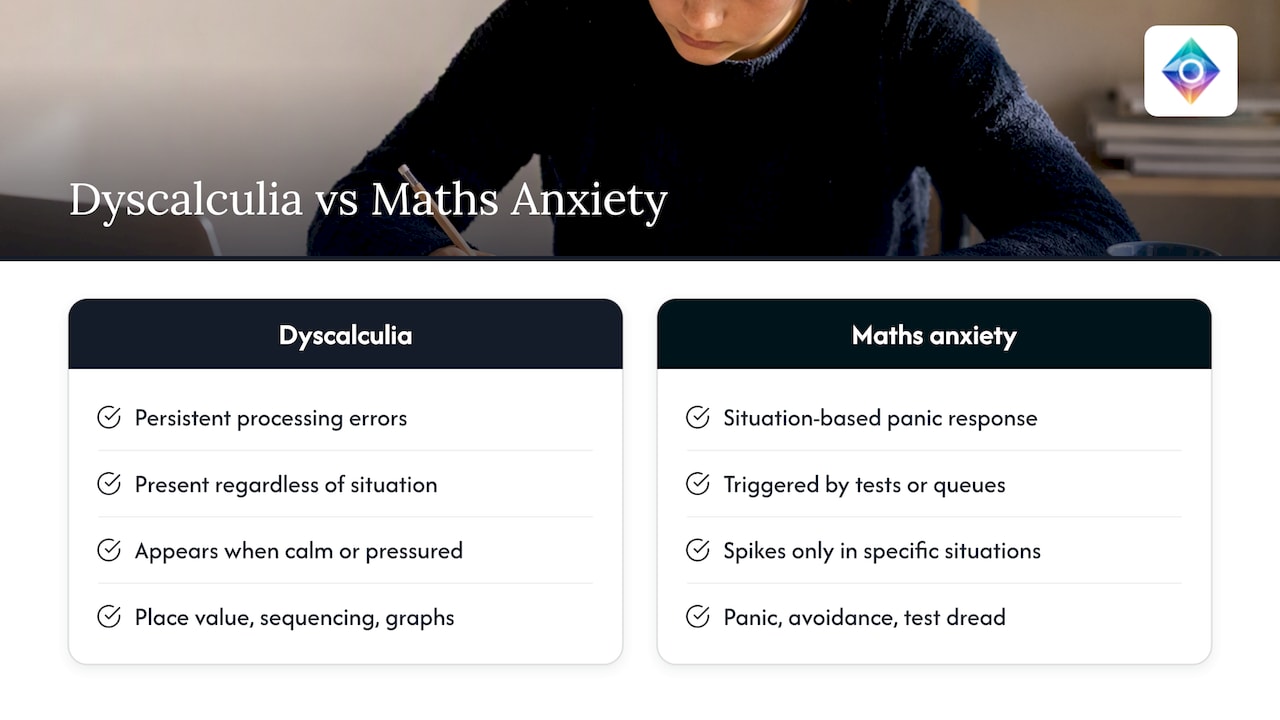
These two overlap heavily but are not the same thing, and a good self-assessment should try to tell them apart. The Mathematics Anxiety Scale-UK study defines maths anxiety as a situation-based response, panic before a test, dread when handling change in public, avoidance of anything number-related, and validates a scale for measuring it reliably in British samples.
Dyscalculia tends to show up as persistent processing errors regardless of pressure: consistent difficulty with place value, sequencing or graphs even when calm and unhurried. Maths anxiety instead spikes around specific situations, a till queue, an exam, a spreadsheet with someone watching, and can affect people whose underlying number processing is otherwise fine.
If your results point mostly to anxiety rather than processing difficulty, the next step looks different: breathing and pacing strategies, gradual exposure to the situations that trigger panic, and a conversation with a GP or counsellor rather than an educational psychologist. Practical strategies for calming maths anxiety can help before you decide whether a fuller assessment is worth pursuing.
How to choose a private online dyscalculia self-assessment
Not every online quiz is worth fifteen minutes of your time. A handful of checks will tell you quickly whether a tool is worth trusting with something personal.
-
Coverage across number sense, memory, sequencing, money, time and graphs, not just arithmetic.
-
A plain-language profile of strengths and difficulties rather than a pass or fail score.
-
A separate check for maths anxiety, since conflating the two skews results.
-
No account or email required, and a clear statement of what happens to your answers.
-
A guided version for children and teens with age-appropriate wording.
-
An option to generate a report written for a clinician if you decide to pursue formal assessment.
Walk away from any tool that claims to diagnose you outright, since UCL’s own screening guidance is explicit that consumer checklists inform next steps rather than produce a diagnosis. Be equally wary of anything that asks only arithmetic questions, since that misses the everyday numeracy difficulties that matter most, and of anything vague about your data or silent on what to do with your result. A reputable provider typically offers the self-check free and charges only if you want a longer report formatted for a professional.
Why I built a screen that stays out of your way
I am Valerio Cozzi, founder of Omniprism. I was diagnosed with ADHD at 42, long after most of the difficulties I now recognise had already shaped how I worked and studied. That gap between noticing a pattern and getting a name for it is what Omniprism’s self-assessments are built to shorten: a private, plain-language profile you can use to start a conversation, not a label handed down without one.
— Valerio Cozzi
Omniprism: privacy-first self-assessment and Specialist Briefing
Omniprism runs a free 14-domain self-assessment covering dyscalculia alongside ADHD, autism, dyslexia, dyspraxia, sensory processing and other traits, with no account or email required and no data collection. That matters if you would rather explore a suspicion privately before telling anyone, whether you are an adult weighing up a workplace conversation, a teen preparing for a school meeting, or a parent trying to understand a child’s numeracy struggles.
-
Take the free self-assessment and get an instant plain-language profile across all 14 areas.
-
Use the guided child and teen versions if you are assessing a young person rather than yourself.
-
Buy the optional Specialist Briefing for 20 EUR one-off if you want a report formatted for a clinician.
-
Return to the free self-assessment any time your profile needs revisiting.
Start with the self-assessment, and if the result is worth taking further, purchase the Specialist Briefing before your next appointment.
Sources
UCL’s ADD UP toolkit and red flags list define screening indicators; NHS-linked pages explain assessment pathways; MAS-UK validates anxiety measurement; Civil Service and Nottinghamshire NHS toolkits list workplace adjustments.
This article is general information, not a substitute for advice from a qualified doctor. Consult a qualified healthcare professional about your own circumstances before acting on anything here.
-
Mathematics Anxiety Scale‑UK (MAS‑UK) — development and validation
-
Hidden impairments and disabilities guidance — Nottinghamshire Healthcare NHS
-
Dyscalculia and related conditions — line manager toolkit (Civil Service)
FAQ
How much does a dyscalculia assessment cost?
Formal diagnostic assessment costs vary by country and are often carried out privately by a specialist assessor or educational psychologist, as NHS-linked guidance notes. A free online self-assessment costs nothing, while a clinician-ready summary report such as Omniprism’s Specialist Briefing is a 9.99 EUR one-off.
Are online dyscalculia tests accurate?
Online self-assessments are not diagnostic tools and cannot confirm dyscalculia on their own, according to UCL’s screening guidance. Their value lies in identifying patterns worth discussing with a professional, not in producing a final answer.
Is my data private when I take a dyscalculia test online?
Privacy practices differ widely between providers, so check whether an account or email is required before you start. Omniprism’s self-assessment collects no data and requires no account, which is worth comparing against any tool that asks for personal details upfront.
What is the difference between dysgraphia and dyspraxia?
Dysgraphia affects writing, particularly handwriting and putting thoughts onto paper, while dyspraxia affects motor coordination and planning physical movement. They can overlap with dyscalculia but describe distinct sets of difficulties, and a broader comparison of related conditions explains how to tell them apart.
How often should I repeat a dyscalculia self-assessment?
There is no fixed schedule, but repeating a self-assessment after a few months can help if your circumstances change, such as starting a new job or noticing new difficulties. If results stay consistent over time, that consistency itself is useful information to bring to a professional.
Recommended
-
Parents & Teachers: Four Steps to Tell Dyscalculia From Dyslexia
-
Spot Twice Exceptional Autism: Use a 14 Domain Self Check to Build Evidence
-
Parents: 14 Domain Self Check to Uncover Autism Misdiagnosed as ADHD
Written and edited by Valerio Cozzi, founder of Omniprism. Omniprism began after my own ADHD diagnosis at 42.
This article is educational. It is not medical advice, not a diagnosis, and not a substitute for assessment by a qualified clinician. The Omniprism self-assessment is free, needs no account and no email address, and runs entirely in your browser — your answers are never sent to a server. The optional Specialist Briefing report is a paid add-on.