3 Classroom Math Strategies for Dyscalculia You Can Start This Week
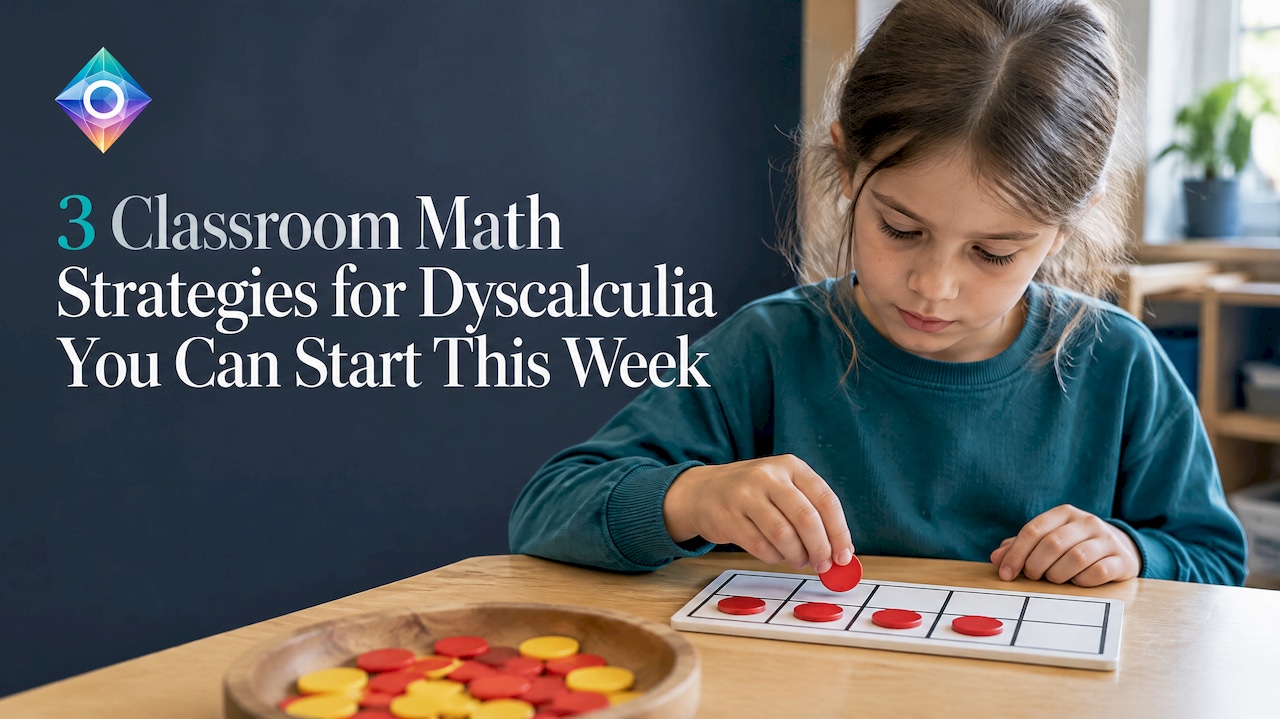
The single most effective early step is concrete, multisensory teaching that reduces working memory load, paired with targeted assessment and short, frequent practice. This combination, concrete→pictorial→abstract (CPA) teaching built on assessment-led targeting, is the approach with the strongest backing. Start this week with three actions: bring in manipulatives, cut each task into smaller steps with prompt sheets, and run brief daily retrieval practice on number facts.
Key Takeaways
Concrete multisensory teaching that reduces working memory load, combined with targeted assessment and regular practice, is the most effective strategy for supporting learners with dyscalculia.
| Point | Details |
|---|---|
| Use manipulatives | Incorporate physical tools like Numicon or Cuisenaire rods to help students see and feel number concepts. |
| Break tasks into steps | Divide multi-step problems into smaller parts with prompt sheets to lessen working memory demands. |
| Practice retrieval regularly | Run short daily sessions on number facts to help students build automatic recall over time. |
| Employ classroom adjustments | Offer extra processing time, prompt sheets, and a quiet space to reduce anxiety and support understanding. |
| Utilize multisensory apps carefully | Select apps that reflect concrete methods, like virtual manipulatives, to reinforce skills without overloading learners. |
1. How do you recognise dyscalculia in a student?
Dyscalculia shows up as a persistent pattern, not a bad week. Watch for weak number sense, trouble subitising (recognising small quantities at a glance without counting), slow or inconsistent recall of basic facts, and sequencing errors when following a multi-step procedure such as long division. A child might solve a problem correctly on Monday and lose the method entirely by Thursday.
Developmental dyscalculia affects a small percentage of children and the profile varies considerably from one learner to the next, which is why two dyscalculic pupils can struggle with completely different parts of a lesson. The same review notes that dyscalculia often overlaps with dyslexia and ADHD, so a student’s difficulties with maths rarely sit in isolation. Our guide to telling dyscalculia from dyslexia walks through the practical checks that help separate the two.
Signs worth tracking over several weeks include:
- Difficulty judging which of two groups has more without counting each one.
- Slow, effortful recall of facts that peers answer automatically.
- Errors that follow no clear pattern, suggesting the method itself has not stuck.
- Strong verbal reasoning alongside weak performance on written calculation.
Because the picture is so individual, a single test rarely tells the full story: build a profile across several sessions before drawing conclusions.
2. Why is maths so hard for some learners?
Three cognitive factors drive most of the difficulty: working memory, language, and abstraction. A pupil juggling several steps of a calculation needs to hold numbers, a method and an interim answer in mind at once, and when working memory capacity is limited, something drops.
Maths language compounds this. Words like “difference”, “product” and “of” carry specific mathematical meaning that differs from everyday use, so weak reading comprehension can block access to a problem before the maths even starts. The Hampshire headteachers’ briefing on special school mathematics names working memory limits, language demands and the abstract nature of maths as the three central barriers, and recommends dialogic teaching and explicit vocabulary instruction to narrow the gap.
Anxiety sits on top of all this. Research from the University of Cambridge describes how maths anxiety interacts directly with working memory, so a pupil who feels threatened by a task has even less cognitive capacity left to do the maths itself.
Working memory in numbers: one review found that developmental dyscalculia affects a small percentage of children, meaning most classrooms contain at least one or two learners whose working memory load needs active management.
Barriers that compound each other:
- Multi-step procedures overload working memory before the answer is reached.
- Maths-specific vocabulary blocks comprehension of otherwise simple questions.
- Anxiety narrows the cognitive resources available for the task at hand.
3. Which concrete multisensory techniques build number sense?
CPA teaching moves a learner from touching objects, to drawing or viewing pictures, to working with symbols alone, and each stage should be mastered before moving on. EEF guidance on manipulatives recommends tools such as Numicon, ten-frames and Cuisenaire rods precisely because they let a child see and feel a quantity rather than just name it, and the guidance stresses that materials only work when explicitly linked to the written method alongside them.
Pro Tip: Say the written step out loud as you move the manipulative, so the physical action, the spoken language and the symbol land together rather than as three separate experiences.
Try these activities, roughly in order of use:
- Ten-frame dot patterns: place counters on a ten-frame and ask the child to say the number without counting every dot, building instant recognition of small quantities.
- Numicon shape matching: match number shapes to written numerals, then to addition sentences, so the physical gap between pieces mirrors the gap between digits.
- Cuisenaire rod trains: build two rods end to end and compare the length to a third rod, introducing addition and subtraction as physical comparison.
- Bar model drawing: once rods feel secure, ask the child to draw a bar instead of building one, moving from concrete to pictorial.
- Array building: arrange counters in rows and columns to show multiplication as repeated groups rather than an abstract fact to memorise.
- Number line jumps: use a physical number line and counters to practise jumps of varying size before attempting jumps mentally.
- Place value counters: swap ten units counters for one tens counter to make exchange and carrying visible rather than procedural.
- Estimation jars: fill a jar with objects and ask for a sensible guess before counting, reinforcing that maths includes approximation, not only exact answers.
Fade the concrete support gradually: once a child draws the pictorial version correctly and unprompted across three or four sessions, test the same problem with numbers alone. If errors return, step back a stage rather than pushing forward. Further EEF guidance notes that manipulatives stay useful well into key stage two and should not be withdrawn purely because a child has got older.
4. What classroom adjustments and assessment checkpoints help?
Assessment works best as an ongoing process rather than a single diagnostic moment. Devon’s educational psychology guidance recommends building a profile across repeated checks and monitoring how a child responds to teaching, rather than relying on one test to label a learner. A single low score can reflect anxiety, a bad day or a genuine gap, and only repeated observation tells you which.
Everyday adjustments that reduce pressure without lowering expectations:
- Give extra processing time before expecting an answer, spoken or written.
- Avoid timed tests where speed is not the skill being assessed.
- Provide prompt sheets and worked examples the child can refer back to independently.
- Offer a quiet space for assessment tasks, away from classroom noise and movement.
- Pre-teach key vocabulary before a new topic so language does not block the maths itself.
Same-day, light-touch intervention after a lesson, five or ten minutes revisiting a sticking point before it compounds, tends to work better than waiting for a weekly catch-up session. Build in short progress checkpoints every two or three weeks rather than relying on end-of-term tests to reveal whether an approach is working.
5. What intervention routines and practice schedules work best?
A systematic review of intervention characteristics for maths difficulties found that multi-component, strategy-based training produces measurable gains in calculation fluency and problem solving, and that focused, small-step instruction outperforms broader, less targeted teaching. The same review points to overlearning and retrieval practice, distributed and cumulative review rather than a single cram session, as key to building automatic recall in learners with reduced working memory capacity.
A workable weekly structure:
- Daily micro-session (10 to 15 minutes): focus on one narrow skill, such as number bonds to ten, using a ten-frame or counters.
- Three short retrieval bursts a week: quick recall of previously taught facts, mixed with the current focus, to keep older learning active.
- One weekly review (15 minutes): ask the child to demonstrate the week’s skill using a pictorial representation rather than concrete materials, checking the bridge has held.
- Fortnightly checkpoint: compare performance against the previous checkpoint and adjust the next fortnight’s focus accordingly.
If progress stalls across two or three checkpoints despite consistent practice, that is the point to bring in a specialist assessment rather than extending the same routine indefinitely.
6. Which apps and technology support dyscalculic learners?
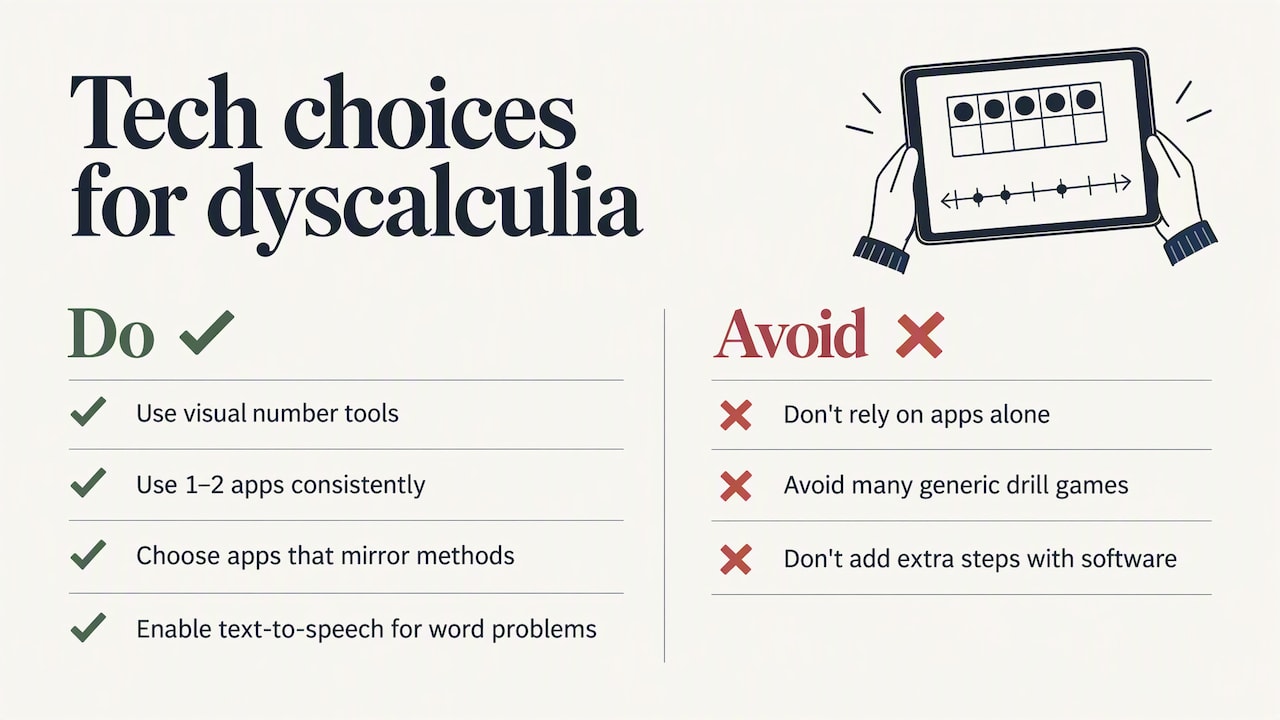
Assistive technology works best as a supplement to concrete teaching, not a replacement for it. Apps built around visual number representations, such as on-screen ten-frames, number lines and virtual manipulatives, extend the same CPA principles into independent practice time, letting a child repeat a skill at home without needing physical resources to hand.
Text-to-speech and read-aloud tools matter for maths specifically because word problems carry a language load separate from the calculation itself. A pupil who can have a question read aloud is freed to focus working memory on the maths rather than decoding. Our piece on cutting decision fatigue through better-matched tactics covers related ground on reducing cognitive load through the right tools, which applies directly to choosing software that simplifies rather than adds steps.
Be selective rather than exhaustive: one or two apps used consistently, chosen because they mirror the concrete methods already taught in class, tend to outperform a scattered collection of generic “maths games” apps that drill answers without reinforcing understanding. Screen-free practice still has a place too. Our partner Team Genius Squad’s age-ramped maths games offers hands-on alternatives that fit the same multisensory principle without a device involved, useful for evenings when screen time is already stretched.
7. How do you teach estimation and approximation skills?
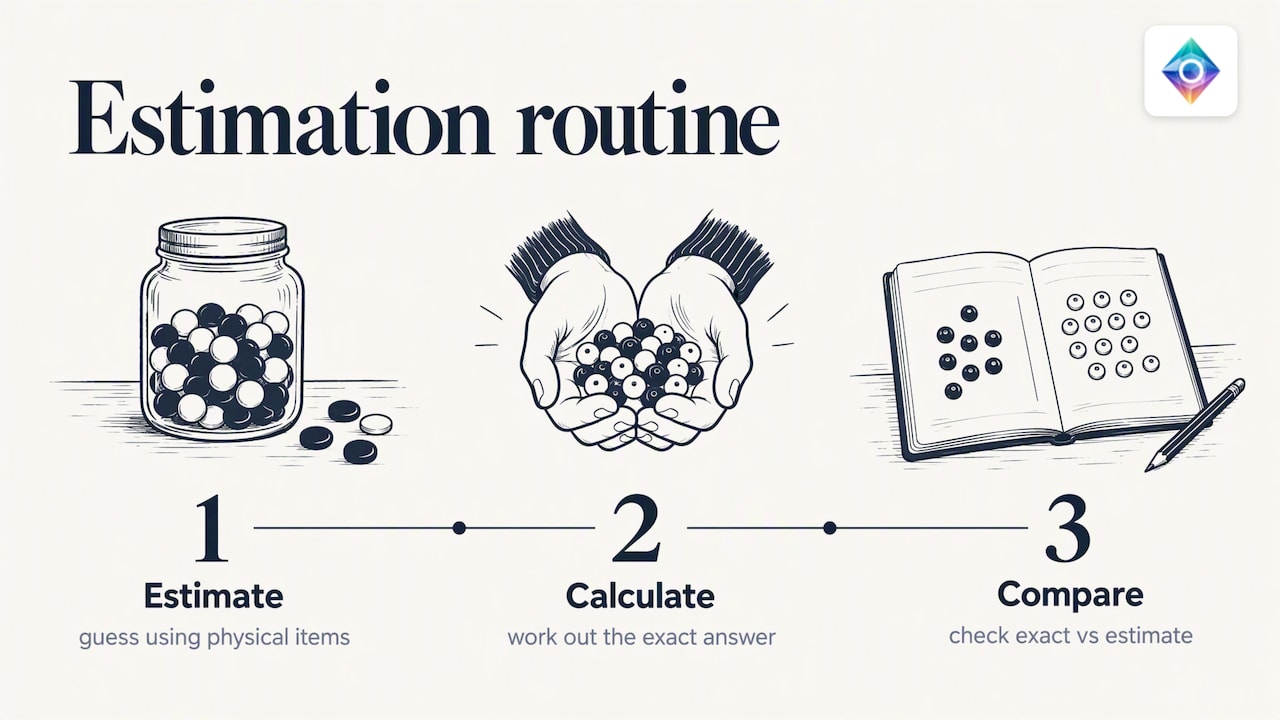
Estimation gets skipped surprisingly often, yet it is one of the most useful skills for a dyscalculic learner because it does not demand exact recall under pressure. Teaching a child to judge “about how many” before calculating gives them a built-in check: if the exact answer lands nowhere near the estimate, something has gone wrong in the method, and they can catch it themselves rather than relying on a teacher to spot the error.
Start with physical quantities: a jar of counters, a handful of beads, a row of books on a shelf. Ask for a sensible guess before counting, and talk through the reasoning aloud, “that looks like roughly four rows of five, so somewhere near twenty.” This builds a feel for magnitude that pure calculation practice does not.
Move into rounding once physical estimation feels secure: rounding numbers to the nearest ten before adding gives a quick sanity check on the final answer. Practise this as a habit attached to every calculation, not as a separate topic taught once and forgotten. Over time, the estimate-then-calculate-then-compare sequence becomes a self-correcting routine a child can run independently, which matters more for dyscalculic learners than for most, since it catches errors that slow fact recall would otherwise let slip through unnoticed.
8. How does maths anxiety affect learning, and how do you manage it?
Maths anxiety and dyscalculia feed each other. A child who has repeatedly struggled with number work starts to dread it, and that dread then eats into the working memory capacity needed to do the maths, creating a cycle that gets harder to break the longer it runs. Research on working memory, maths anxiety and dyscalculia describes exactly this interaction and recommends low-stakes practice and open “maths talk” as ways to reduce both the anxiety and the cognitive load it creates.
Low-stakes practice means removing the sting of being wrong in front of others: private retrieval practice, non-graded warm-ups, and plenty of “let’s see what we notice” framing rather than “get this right” framing. Maths talk, encouraging a child to describe their reasoning aloud without immediate correction, helps surface where the thinking breaks down and signals that mistakes are part of the process rather than a failure to hide.
Celebrate method over outcome where possible: praising a correctly applied strategy, even with an arithmetic slip, reinforces that the thinking was sound. For a child whose confidence has taken repeated hits, this distinction between “you did the maths right” and “you got the right number” can rebuild willingness to try before it rebuilds raw skill.
9. How should parents and specialists work together on support?
Consistency between home and school multiplies the effect of any single strategy, and dyscalculia support works best when it is a shared effort rather than something that stops at the classroom door. A prompt sheet used in class loses its value if the same scaffolding disappears during homework, so sharing the specific methods and materials in use, not just the general topic, lets a parent reinforce rather than accidentally contradict what a teacher is building.
Educational psychologists and specialist teachers bring assessment expertise that a classroom teacher or parent typically cannot replicate alone, particularly around distinguishing dyscalculia from general maths difficulty or anxiety-driven underperformance. Devon’s educational psychology resources frame this as an ongoing, profile-based process involving school staff and specialists together rather than a one-off referral that hands the problem to someone else entirely.
Regular, specific communication works better than vague check-ins: a short note on which strategy worked this week, which one did not, and what the next focus is, keeps everyone working from the same plan. When a child’s profile is unclear, a shared written summary of observed patterns, built up by parents and teachers together, gives a specialist something concrete to assess rather than a general impression of struggle.
10. A founder’s note on getting this right
I was diagnosed with ADHD at 42, and that late diagnosis shaped why I founded Omniprism: understanding your own cognitive profile earlier changes how you approach learning, not just as a child but for life.
Three takeaways to act on this week:
- Bring in one manipulative, a ten-frame or Numicon set, before the next maths session.
- Cut the next multi-step task into smaller steps with a visible prompt sheet.
- Run five minutes of daily retrieval practice on number facts, not a single weekly block.
— Valerio Cozzi
Where a self-assessment can help clarify the picture
When a child’s maths struggles sit alongside other traits, attention difficulties, sensory sensitivities, or patterns that look like more than one thing at once, a clearer picture of the full cognitive profile helps before anyone sits down with a clinician. We built the Omniprism self-assessment to give parents and adults an instant, plain-language profile across 14 domains, including dyscalculia, without needing an account, an email address, or any data collection.
For families preparing for a formal evaluation, our Specialist Briefing turns those results into a summary designed for easy use by healthcare professionals, at 9.99 EUR one-off. It is not a diagnosis, and we are clear about that limit: it is a structured starting point for the conversation that follows. Our children’s and young people’s assessments extend the same approach to younger learners, giving parents a grounded first step before pursuing a full educational psychology assessment.
FAQ
How can you be good at maths with dyscalculia?
Progress comes from consistent, short, concrete practice rather than talent or long study sessions. Multisensory tools like Numicon and ten-frames, paired with regular retrieval practice on number facts, build the number sense that dyscalculia research shows is typically underdeveloped, and that sense improves with targeted repetition over time.
Can you pass GCSE maths with dyscalculia?
Yes, with the right adjustments and sustained support many dyscalculic students do pass GCSE maths. Reasonable classroom adjustments such as extra processing time, reduced reliance on timed tests, and consistent use of prompt sheets, alongside the targeted interventions reviews of maths difficulty interventions describe, give students a realistic route to a pass grade.
Is dyscalculia a form of ADHD?
No, dyscalculia and ADHD are separate conditions, though they frequently occur together. Research on developmental dyscalculia notes it commonly overlaps with ADHD and dyslexia, but each reflects a distinct cognitive profile that needs its own assessment.
Which strategy best helps a student with dyscalculia?
Concrete, multisensory teaching using manipulatives such as Numicon, Cuisenaire rods or ten-frames, moved deliberately through concrete, pictorial and then abstract stages, has the strongest backing. EEF guidance on manipulatives recommends this approach specifically because it reduces working memory load while building lasting understanding.
Sources
- Developmental dyscalculia
- Systematic review of intervention characteristics for maths difficulties
- Use manipulatives and representations to develop understanding (EEF)
- Briefing for Headteachers of Special School Mathematics
- A Devon approach to understanding children and young people with mathematical difficulties
- Exploring working memory, maths anxiety and dyscalculia
Recommended
Written and edited by Valerio Cozzi, founder of Omniprism. Omniprism began after my own ADHD diagnosis at 42.
This article is educational. It is not medical advice, not a diagnosis, and not a substitute for assessment by a qualified clinician. The Omniprism self-assessment is free, needs no account and no email address, and runs entirely in your browser — your answers are never sent to a server. The optional Specialist Briefing report is a paid add-on.