Six Step Evidence Path and Everyday Red Flags for Teen Dyscalculia

The clearest teen dyscalculia signs include persistent difficulty understanding numerical magnitude and place value, challenges recalling arithmetic facts like times tables, trouble solving multi-step problems, and difficulty reading graphs or estimating quantities. These patterns show up consistently across school subjects, not just in maths class, and they tend to persist despite normal teaching. Dyscalculia frequently co-occurs with ADHD or dyslexia, while maths anxiety alone is not sufficient for diagnosis.
TL;DR:
- Most teens with dyscalculia struggle with understanding place value, recalling arithmetic facts, and reading graphs, which persist across various contexts over time.
- Difficulties with multi-step problems, estimating change, and following directions often lead to low confidence and anxiety in both academic and real-life situations.
- Identification involves documenting repeated patterns of errors, consulting teachers, collecting school reports, and potentially using screeners before pursuing a full assessment.
- Practical supports like visual tools, step-by-step checklists, and exam arrangements can improve independence, but emotional support is equally crucial for long-term success.
- Dyscalculia often co-occurs with ADHD, dyslexia, or language issues, requiring a broad assessment approach to address multiple learning difficulties effectively.
What are the signs of dyscalculia in teenagers?
Secondary school raises the stakes on numeracy: teens are expected to interpret graphs, calculate percentages, and follow multi-step reasoning without much scaffolding. The UCL ADD UP toolkit sets out red-flag patterns specific to this age group, and they cluster around a few recognisable behaviours.
- Place value and magnitude errors: a teen might read 4,062 as “four hundred and sixty-two” or struggle to say which of two decimals is larger.
- Weak arithmetic fact recall: times tables never became automatic, so simple multiplication still needs counting on fingers or scrap paper.
- Inefficient alternative strategies: instead of using a taught method, the teen invents laborious workarounds that take far longer than a classmate’s.
- Trouble with graphs and charts: reading a bar chart or interpreting a scale on an axis takes noticeably longer or produces wrong answers.
- Estimating and calculating change: rounding a bill or working out change from a purchase feels effortful rather than automatic.
- Multi-step problem difficulty: a word problem with two or three operations causes the teen to lose track of what step comes next.
- Trouble with directions, maps and recipes: following a recipe’s quantities or reading a map’s scale produces consistent, repeated errors.
A single wrong answer on a difficult test proves nothing; what indicates dyscalculia is a repeating pattern of difficulties across weeks and contexts, distinguishing persistent processing difficulty from ordinary gaps in practice or teaching.
Pro Tip: Keep dated samples of the teen’s maths work, noting whether a calculator was allowed and whether the task was timed. This turns vague worry into evidence a school or specialist can actually use.
How dyscalculia shows up in everyday life for teens
Dyscalculia rarely stays inside the classroom. It follows a teen into situations where numbers matter for independence and confidence.
- Money: working out change, splitting a bill, or judging whether a purchase is affordable can trigger real anxiety.
- Time: reading a timetable, estimating how long a journey takes, or judging when to leave the house often goes wrong.
- Navigation: map scales and directions (“second left, then 200 metres”) are easy to misjudge.
- Cooking: halving or doubling a recipe’s quantities produces inconsistent results.
- Exams: time pressure amplifies every one of the difficulties above, since there is no time to fall back on slow workaround strategies.
The emotional toll is just as real as the practical one. Devon’s local-authority guidance on supporting mathematical difficulties notes that repeated public errors and exam pressure erode confidence and can lead teens to avoid maths altogether, which then delays the adjustments that would actually help (Devon guidance). Short-term supports, including calculators for money tasks, visual timers for exams, and written step-by-step checklists for multi-step problems, can support independence while longer-term teaching targets underlying skills.
How is dyscalculia identified in teenagers?
Identification is a staged process, not a single test appointment. Guidance from Solihull’s parents’ guide to assessment and Devon’s local authority guidance both describe a similar pathway.
- Log specific examples at home, noting the date, the task, and whether a calculator was used.
- Speak to the maths teacher and SENCO to compare classroom observations with what you are seeing at home.
- Request classroom adjustments and monitoring so the school can track whether targeted teaching changes the pattern.
- Gather school reports and any prior interventions, since assessors need a history, not a snapshot.
- Consider a screener if difficulties persist despite good teaching. UCL’s overview of dyscalculia screeners explains that these tools map magnitude processing and number sense quickly, and that symbolic measures often predict difficulties better than non-symbolic ones, but screeners are not diagnostic on their own.
- Pursue a full specialist assessment if the screener and school evidence point that way. According to guidance on assessment pathways, a proper assessment looks at developmental and health history, vision and hearing, language history, current and past maths attainment, confidence, family history, and previous interventions, not just a timed maths test.
Routes, eligibility and costs vary by country and by school system, so families should check what applies locally before assuming a particular process or price.
Practical strategies and school or home support for teenagers with dyscalculia
There is no single dyscalculia package that fits every teen. Devon’s guidance recommends assessing component skills first, then targeting the specific weakness rather than applying a generic intervention.
- Multisensory representations: concrete materials such as base-ten blocks help make abstract place value visible again.
- Scaffolded multi-step problems: breaking a word problem into numbered steps reduces the load on working memory.
- Visual supports for graphs: colour coding axes or highlighting the scale before reading data points.
- Exam access arrangements: extra time or a calculator where school policy allows it, agreed in advance rather than negotiated on the day.
- Low-stress functional practice: everyday tasks like shopping or cooking give repeated, low-pressure practice with real numbers.
- Avoiding punitive language: framing errors as information rather than failure protects the confidence that avoidance otherwise erodes.
For emotional effects specific to exams, a practical resource on maths anxiety at GCSE covers calming techniques and grade-focused strategies that pair well with the adjustments above. Where a teen’s needs go beyond what a classroom teacher can address, targeted tutoring or specialist teaching becomes worth exploring, and Devon’s guidance is explicit that emotional support should run alongside any teaching intervention, not follow it as an afterthought.
How Omniprism and evidence can help with assessment conversations
Omniprism offers a free self-assessment covering 14 domains, including dyscalculia traits, with instant plain-language results and no account or email required. For families preparing for a school meeting or clinical referral, the results can be mapped directly onto the red-flag checklist above, giving specific examples to bring to a SENCO or assessor. An optional Specialist Briefing report structures those results for a clinician or educational psychologist. Self-assessment results inform next steps; they do not replace a specialist diagnosis. For distinguishing dyscalculia from a related learning difference, see four steps to tell dyscalculia from dyslexia.
What early signs, before the teen years, point towards this diagnosis?
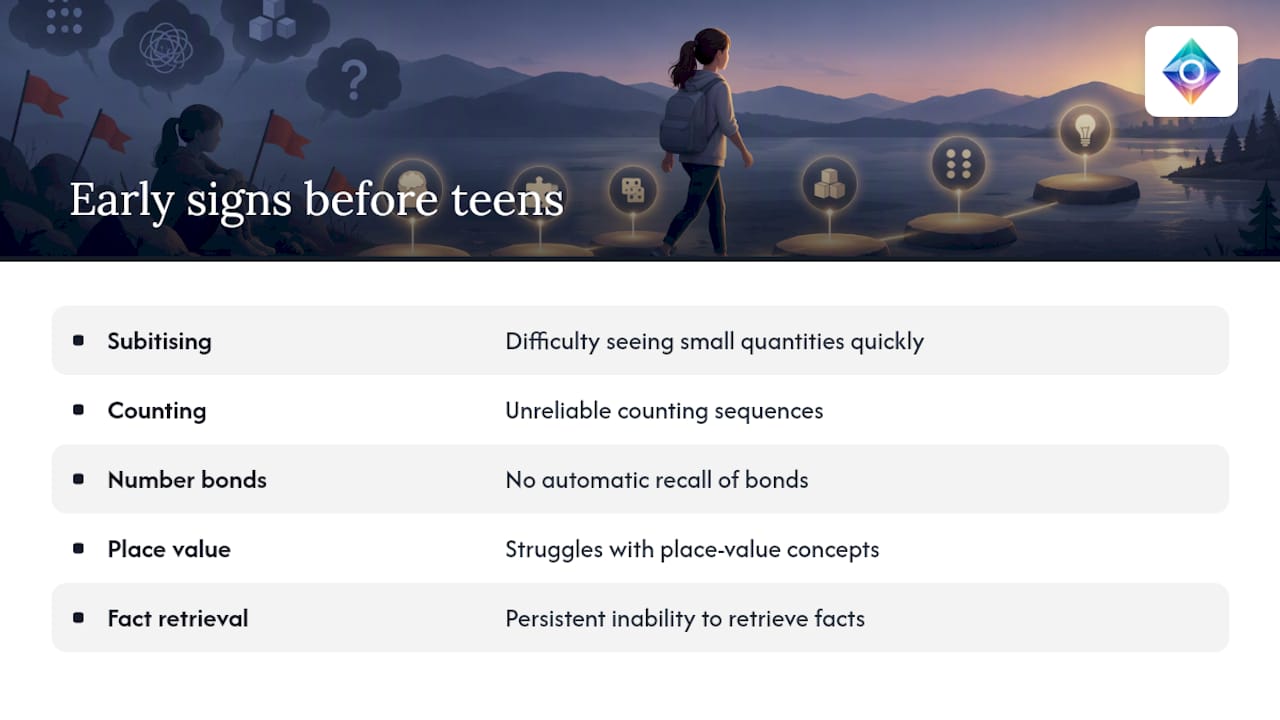
Dyscalculia rarely appears out of nowhere at secondary school. Many of the same difficulties were present earlier but read differently at a younger age: a primary-aged child who struggled to subitise small quantities, who found counting sequences unreliable, or who never settled into automatic recall of number bonds often carries the same core weaknesses into the teenage years, just applied to harder material.
The SASC definition of a specific learning difficulty in mathematics frames these difficulties around numerical magnitude processing, naming, ordering and comparing quantities, estimating, place value, and arithmetic fluency and flexibility. Those are the same domains that show up in the teen checklist above, just tested against age-appropriate content. This continuity matters for families: a teen struggling now was often struggling quietly for years, with the difficulty masked by extra effort, parental help with homework, or a curriculum that had not yet demanded fluent recall.
Peer-reviewed research on dyscalculia notes there is no single agreed test for the condition, and difficulties can be domain-specific rather than a uniform deficit across all mathematics (research syntheses on dyscalculia markers). A persistent inability to retrieve arithmetic facts stands out as one of the more consistent markers across studies, which is why it appears on nearly every checklist, from early years through to secondary school.
When should you suspect more than one learning difference?
Dyscalculia is heterogeneous, and the UCL ADD UP toolkit notes it frequently co-occurs with ADHD, dyslexia, developmental language disorder, or developmental coordination disorder. Attention difficulties can make multi-step problems harder simply because the teen loses track of which step they are on, independent of any core numerical weakness. Language difficulties can turn a maths word problem into a reading comprehension task first and a maths task second.
This overlap means a teen’s difficulties are worth investigating broadly rather than assuming maths is the whole story. A teen who struggles with graphs and also shows classic attention difficulties, such as losing focus mid-task or missing instructions, may be dealing with both dyscalculia and ADHD traits at once. Similarly, weak arithmetic fact recall alongside slow, effortful reading points towards checking for dyslexia rather than treating the maths difficulty in isolation. For a structured look at ADHD-specific behaviours worth documenting, see teen ADHD signs and how to turn them into evidence for clinicians.
The SASC definition also flags that maths anxiety commonly co-occurs with dyscalculia but is not, by itself, diagnostic. A teen can be anxious about maths for reasons unrelated to a processing difficulty, such as a difficult teacher relationship or a gap caused by absence, so anxiety alone should never be read as confirmation of dyscalculia.
What does the long-term outlook look like, including further study and work?
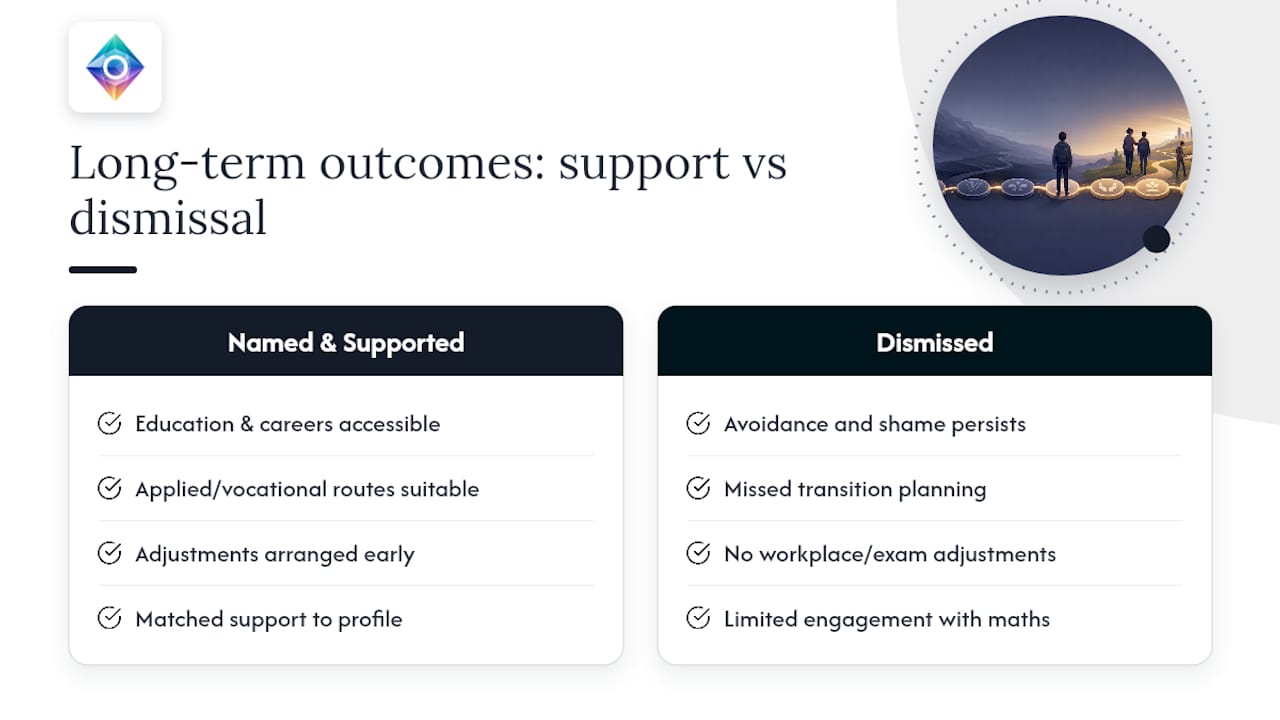
A dyscalculia diagnosis in the teenage years is not a ceiling on what someone can achieve. Many teens with dyscalculia go on to further education, apprenticeships, or careers that involve numbers in a supported, applied way rather than under timed exam pressure. The key shift, according to local-authority guidance, is matching support to the specific profile of strengths and weaknesses rather than assuming a blanket deficit in all things mathematical.
Transition planning benefits from starting early. A teen heading towards college, university, or an apprenticeship should know what exam access arrangements or workplace adjustments exist before they need them under pressure, not after a difficult first term. Vocational routes that emphasise applied, hands-on numeracy, such as trades that use measurement and estimation in context rather than abstract calculation, often suit dyscalculic strengths better than routes built entirely around timed written maths tests.
Confidence carries into adulthood in both directions. A teen whose difficulties were named, explained and accommodated tends to develop practical workarounds and self-advocacy skills that serve them well in work and study. One whose struggles were dismissed as laziness or carelessness often carries the avoidance and shame into adult life, which is precisely why local-authority guidance treats emotional support as inseparable from teaching intervention.
What can parents and teachers do outside the classroom?
Support does not have to wait for a formal diagnosis or a school meeting. Everyday life offers low-pressure practice that a worksheet cannot replicate. Involving a teen in genuine shopping decisions, working out a fair split of a takeaway bill, or planning a journey using a real timetable gives repeated, functional practice with numbers that matter to them personally.
Language matters as much as the activity itself. Framing a miscalculation as useful information rather than a mistake to be corrected reduces the shame response that drives avoidance. Devon’s guidance is explicit that emotional support needs to run alongside any teaching intervention, and that principle applies just as much at home as in the classroom.
Practical tools help bridge the gap between support and independence: a visual timer for homework sessions, a written checklist for multi-step tasks, or a calculator reserved for real-world money decisions rather than schoolwork. Teachers can extend the same logic into group work, pairing a dyscalculic teen with a peer for graph-reading tasks rather than isolating them, and building in extra time for tasks that involve reading scales or charts. For classrooms managing several kinds of learning differences at once, three fixes for a sensory-friendly classroom offers adjustments that often help teens with co-occurring attentional or sensory needs alongside dyscalculia.
A note from Omniprism’s founder
I was diagnosed with ADHD at 42, long after I would have benefited from someone naming what was happening to me. That gap is why I built Omniprism around clear, practical information families can act on immediately, rather than vague reassurance.
— Valerio Cozzi
How Omniprism supports families gathering evidence
Omniprism’s free self-assessment gives instant, plain-language results across 14 domains, including traits linked to dyscalculia, with no account, email, or data collection required. That privacy-first design means a parent or teen can complete it at home and bring the results straight into a conversation with a teacher or GP.
- Free self-assessment: complete it privately, get results instantly, no sign-up needed.
- Specialist Briefing: a one-off £9.99 report that structures your results for a clinician or educational psychologist.
- Children and young people: guided versions of the assessment designed for younger users, available from the Omniprism homepage.
Start with the free self-assessment and decide from there whether a Specialist Briefing would help move a school or clinical conversation forward.
Sources
- UCL ADD UP: awareness and developmental dyscalculia toolkit
- A Devon approach to supporting children and young people with mathematical difficulties
- ADD UP: dyscalculia screeners and checklists — UCL
- Peer-reviewed summary of dyscalculia research (PMC)
FAQ
What do people with dyscalculia excel at?
Strengths vary by individual, since dyscalculia affects specific components of mathematics rather than general intelligence or ability. Many people with dyscalculia do well in verbal reasoning, creative fields, or practical hands-on work where numbers are applied in context rather than tested through timed abstract calculation.
How to combat dyscalculia?
There is no single fix, because effective support targets the specific component skills a person struggles with, such as place value or fact recall, rather than treating dyscalculia as one uniform problem. Devon’s local-authority guidance recommends profile-based teaching combined with emotional support, alongside practical tools like calculators for functional tasks.
What does dyscalculia look like in teens?
In teenagers, dyscalculia typically shows up as persistent trouble with place value and numerical magnitude, poor recall of arithmetic facts, difficulty with multi-step problems, and struggles reading graphs or estimating quantities, as set out in the UCL ADD UP toolkit. These patterns tend to persist across weeks and contexts rather than appearing as occasional errors.
Can you have mild dyscalculia?
Yes, dyscalculia exists on a spectrum of severity, and someone can have a specific learning difficulty in mathematics while remaining strong in other areas of the subject. The SASC definition frames it as a pattern of persistent difficulty in specific components, such as arithmetic fluency or numerical magnitude, rather than a uniform deficit across all mathematics.
Recommended
- Parents & Teachers: Four Steps to Tell Dyscalculia From Dyslexia
- Teen ADHD Signs: Turn Everyday Behaviors Into Evidence for Clinicians
- ADHD Red Flags: What Parents and Adults Should Know
- 25–50% Overlap: Parents & Teachers’ Action Plan for ADHD and Dyslexia
Written and edited by Valerio Cozzi, founder of Omniprism. Omniprism began after my own ADHD diagnosis at 42.
This article is educational. It is not medical advice, not a diagnosis, and not a substitute for assessment by a qualified clinician. The Omniprism self-assessment is free, needs no account and no email address, and runs entirely in your browser — your answers are never sent to a server. The optional Specialist Briefing report is a paid add-on.