What Is a Maths Learning Disability? Signs, Assessment, Support
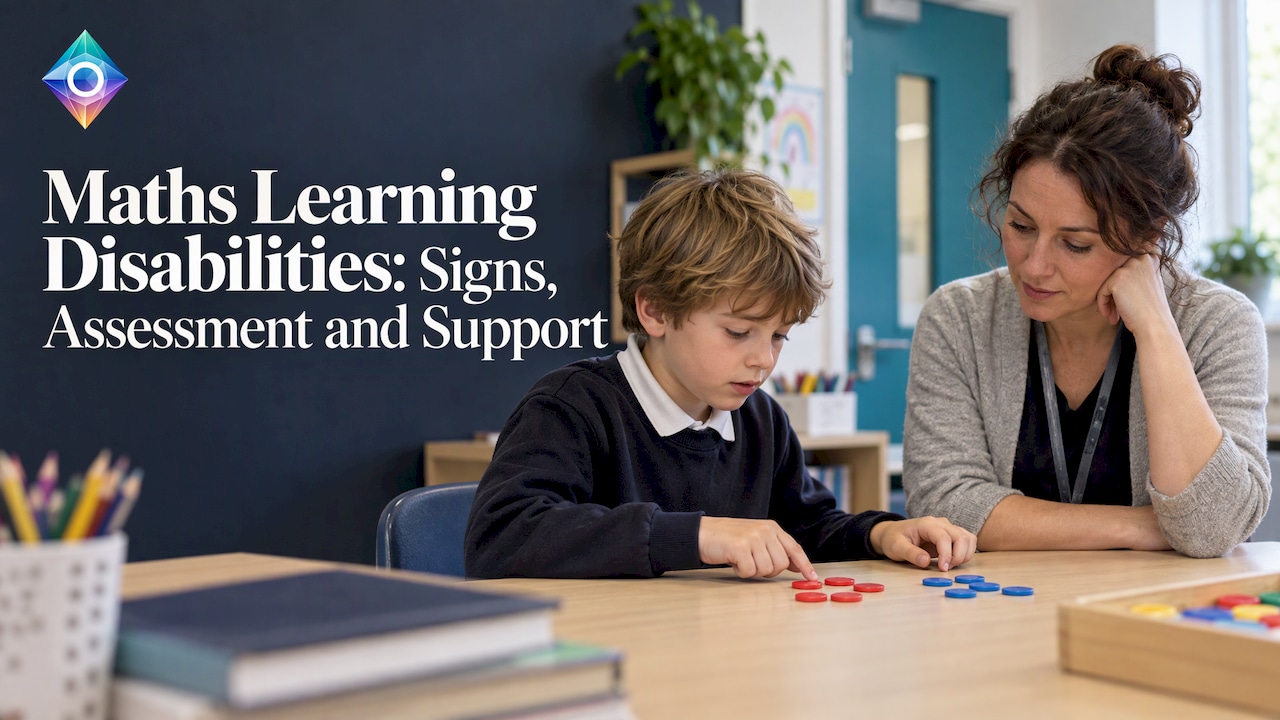
A maths learning disability is a specific, lasting difficulty with understanding numbers and arithmetic that is out of step with a person’s age, schooling and general ability, and its best-known form is dyscalculia. The American Psychiatric Association describes it as Specific Learning Disorder with impairment in mathematics: skills in number sense, memorising arithmetic facts, calculation or maths reasoning sit well below what is expected. If you are trying to work out whether this describes you or your child, our free adult self-assessment gives you a plain-language profile across 14 areas, dyscalculia among them, without an email address or account.
Key Takeaways
- Dyscalculia is a persistent difficulty with number sense, not a lack of effort, intelligence or good teaching.
- Estimates put it at roughly 3 to 7% of people, and it often travels with dyslexia, ADHD and maths anxiety.
- In the UK, dyscalculia is not diagnosed through NHS assessment; schools and qualified specialist assessors carry out formal assessments.
- Early, one-to-one, maths-specific practice has the strongest evidence behind it.
- A written profile of your own patterns makes an assessment conversation faster and clearer.
What is a maths learning disability?
The term covers any specific learning disorder that mainly affects mathematics. Dyscalculia is the label most people use for the sharper end of it: trouble learning number-related concepts, processing numerical information, and learning or recalling arithmetic facts accurately and fluently.
Definitions differ slightly between bodies. The Specialist Assessment Standing Committee (SASC) guidance of November 2019 calls dyscalculia a specific and persistent difficulty in understanding numbers, unexpected for the person’s age, education and experience. Its core feature is weak number sense, which can show up when someone has to see at a glance how many objects there are (subitising), compare two quantities or put them in order.
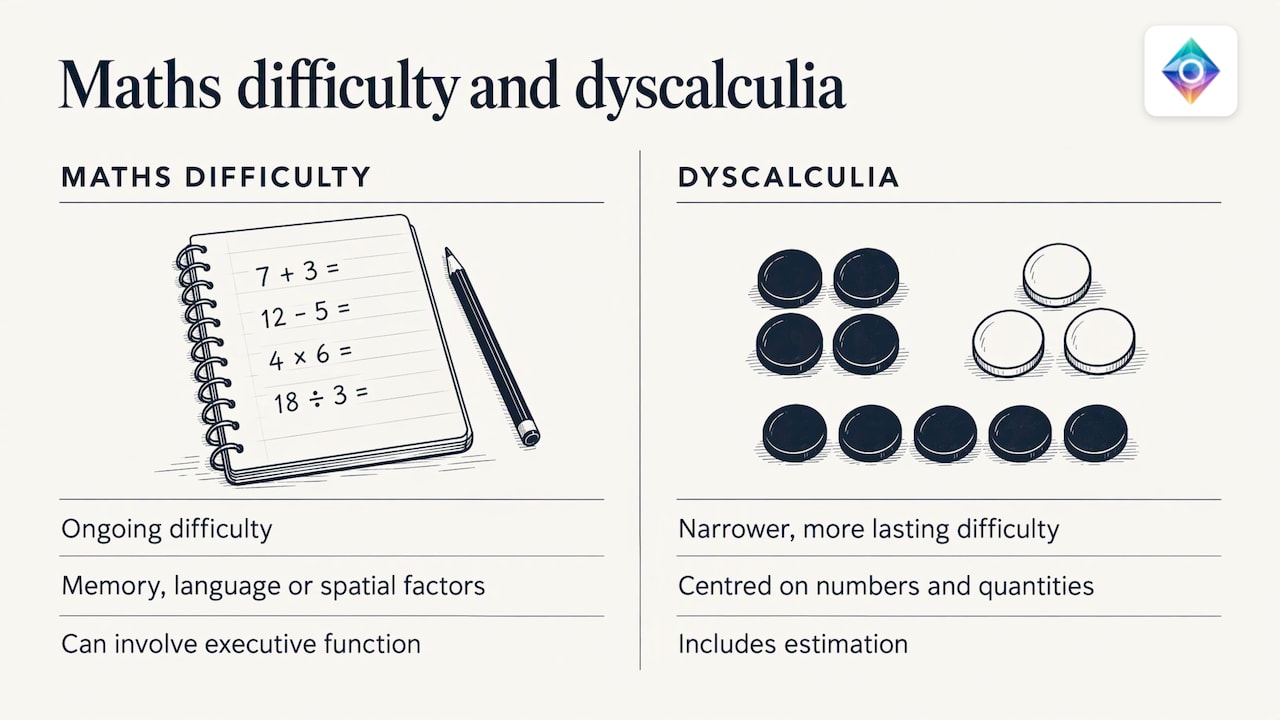
The British Dyslexia Association draws a useful line between two things. A specific learning difficulty in maths is an ongoing difficulty rooted in factors such as working memory, language, spatial skills or executive function. Dyscalculia is narrower and more lasting, centred on numbers, quantities and estimation.
Researchers still debate the cause. The UK Council for Science and Technology’s 2020 report on specific learning difficulties notes competing explanations: a core problem with numerical processing, with visuo-spatial working memory, or with processing speed. It also reports evidence for a significant inherited component. The Cambridge Centre for Neuroscience in Education explains that developmental dyscalculia can cause maths difficulty despite normal intelligence, excellent teaching and no maths anxiety, which separates it from poor performance caused by low motivation or weak instruction.
A separate form, acquired dyscalculia, can appear at any age after an event such as a brain injury, according to the Cleveland Clinic. This article concentrates on the developmental kind, which begins in childhood.
How common is dyscalculia?
The UK Council for Science and Technology report puts prevalence at around 6%, similar to dyslexia. A 2019 international guideline from 20 medical societies gives a range of 3 to 7% of children, adolescents and adults. Bupa adds that as many as 25 in 100 people have general maths difficulties, a much larger group than those with dyscalculia itself.
The same guideline reports that people with dyscalculia have a higher risk of dyslexia (an odds ratio of 12.25) and of ADHD and other mental health conditions. That overlap is why a single-label approach often misses things. If reading or attention is also in the picture, our guide on telling dyscalculia from dyslexia sets out four steps for parents and teachers.
Is dyscalculia a disability?
It depends on the system you are in. In the United States, the APA places it under specific learning disorders, a recognised diagnostic category. In the UK the picture is looser. The House of Lords Library briefing on dyscalculia reports there is no settled definition, that dyscalculia is not diagnosed through NHS assessment, and that it may be diagnosed in schools by specialist assessors.
Scotland takes a practical stance. Education Scotland’s working definition of dyscalculia treats it as a barrier to learning on a continuum from mild to severe and notes that support need not wait for a formal label. For a parent or a student, that means asking the school for help with the specific barriers you can see is a reasonable first move, whatever the paperwork says.
What are the signs of dyscalculia?
Signs change with age, but the thread is the same: numbers do not become automatic. The Cleveland Clinic lists difficulty counting forwards or backwards, linking numbers to objects, recognising number symbols, using money, recalling calculations, solving word problems, measuring for recipes, making change and converting fractions. Anxiety, panic and physical stress around maths can come with it.
In adults the signs often show up in ordinary life. National Numeracy lists trouble remembering PIN or phone numbers, managing time, planning journeys, choosing the right coins or notes, reading a clockface, driving at the right speed and judging which of two amounts is larger. Bupa’s examples include struggling to follow a restaurant bill, budgeting, and not seeing that £14.99 is less than £20.
The British Dyslexia Association adds a few markers: needing to count and recount small quantities, difficulty estimating quantities, measurements, time and money, and not noticing when an answer is unreasonably large or small.
Signs across the school years
In the early years, the building blocks are counting, matching numbers to quantities and putting numbers in order. Playing with sequences at home helps you see where a child is; for example, these number order activities for preschoolers show how adults can watch for hesitation with ordering. In secondary school the signs shift towards fractions, algebra, timetables and money, and our teen dyscalculia signs guide sets out a six-step evidence path for that stage.
Can you have mild dyscalculia?
Yes. Education Scotland describes dyscalculia as a continuum from mild to severe, and the Lords Library briefing quotes the British Dyslexia Association’s 2018 definition placing dyscalculia at the extreme end of a continuum of maths difficulties. A mild profile may mean someone copes with school maths by memorising routines, then struggles with budgeting, timekeeping or estimating as an adult.
Mild does not mean unimportant. The 2020 UK report links specific learning difficulties with long-term negative effects, which is a strong argument for acting on what you notice rather than waiting for it to become severe.
Does reversing numbers mean dyscalculia?
Not by itself. The 2026 Oklahoma state handbook on dyslexia, dysgraphia and dyscalculia says plainly that dyscalculia is not reversing or confusing numbers and is not simply dyslexia with numbers. Reversals are common while children are learning to write digits. What points towards dyscalculia is a persistent struggle with quantity and number sense that continues despite good teaching.
How is dyscalculia assessed?
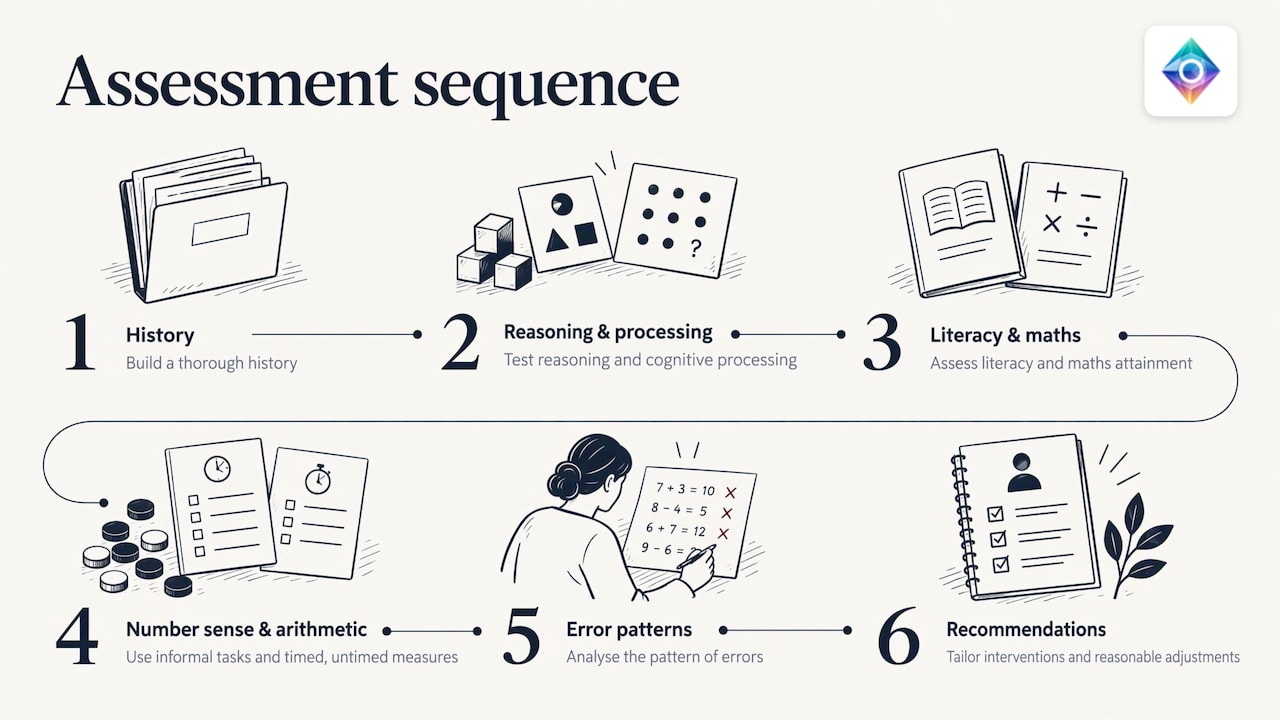
In the UK the route usually runs through school or a qualified specialist assessor, not the NHS. SASC’s guidance says assessment should be holistic. It starts with a thorough history, then tests reasoning, cognitive processing, literacy and maths attainment, using informal number-sense tasks and standardised timed and untimed arithmetic measures. The assessor analyses the pattern of errors and recommends interventions and reasonable adjustments tied to the person’s needs.
The international guideline agrees that a diagnosis needs below-average maths performance judged against history, test results, clinical examination and psychosocial assessment. It is a judgement made across several sources, never a single score.
Adjustments are meant to match the need. SASC advises that they should be targeted without giving an unfair advantage, and that a calculator or rest breaks can sometimes address the need better than extra time.
What to bring to the appointment
Assessors ask about your history, so concrete examples save time: how you handle money, time and directions, what school maths was like, and whether reading, attention or coordination are also hard. A structured written summary makes this easier to deliver. Our Specialist Briefing costs €20 one-off and summarises your results for clinicians, and the Youth Briefing, also €20 one-off, does the same for children and teens.
What helps with dyscalculia?
The strongest evidence is for early, individual, maths-specific practice. The 2019 guideline recommends treatment by a trained specialist, aimed at the specific problem areas. Its meta-analysis found that practising the specific mathematical content beat no intervention or non-specific training, with a mean effect size of 0.52 (95% confidence interval 0.42 to 0.62). Gains were 0.30 for numerical and quantitative processing, 0.44 for basic arithmetic and 0.47 for word problems. Group settings (−0.19) and sessions shorter than 45 minutes (−0.49) fared worse than individual sessions of longer length, so the format matters as much as the content.
The 2020 UK report adds an encouraging point. Genetic effects on learning difficulties tend to be general, while environmental effects are specific, so a child’s learning environment shapes how a difficulty appears and schools can help students overcome it, even if ongoing support is likely.
In the classroom, the Oklahoma handbook lists accommodations that keep expectations high while changing how work is delivered: calculators or graph paper, written or digital notes and formulas, and assignments broken into smaller steps. Teachers who want a starting point can use our three classroom maths strategies this week.
Where can I start with a dyscalculia check?
Before a formal assessment, many people want a clearer picture of their own patterns. Our free adult self-assessment produces an instant profile across 14 areas, including dyscalculia, dyslexia, ADHD, autism, dyspraxia and sensory processing, in plain language. It collects no data and asks for no email or account. For families, the free children and young people assessment offers guided questions, with versions for ages 7 to 10 and ages 11 to 13. If you want to compare how different checks work, see our overview of privacy-first dyscalculia tests.
A self-assessment is a way to understand your patterns and prepare for a conversation with a school or a specialist assessor. It does not replace a formal assessment.
Why do we build a self-check before a formal assessment?
Maths difficulties rarely arrive alone. The research shows dyscalculia sitting alongside dyslexia, ADHD and anxiety, so we built Omniprism to look across 14 areas at once instead of asking about one label in isolation.
I was diagnosed with ADHD at 42, and I know how much easier a conversation with a clinician becomes when you can describe your patterns in your own words. We designed our free assessments to give instant, plain-language results with no email, no account and no data collection, so the first step costs you nothing and exposes nothing.
When you want something to hand to a clinician or school, our Specialist Briefing and Youth Briefing turn those results into a summary built for them. That is the point of the whole tool: clarity first, then a better-prepared appointment.
Valerio Cozzi
FAQ
Is a maths learning disability the same as being bad at maths?
No. General maths difficulty is common, with Bupa citing as many as 25 in 100 people. Dyscalculia is a more specific and persistent difficulty with number sense that remains despite good teaching, according to Cambridge’s Centre for Neuroscience in Education. The difference shows in how automatic numbers feel, not in how hard someone tries.
Can adults have dyscalculia?
Yes. The Cleveland Clinic notes that symptoms usually start in childhood and that many adults have it undiagnosed. In adult life it often appears as trouble with budgeting, time, PINs and estimating costs. A written profile of these everyday examples is useful to bring to an assessor.
Does dyscalculia go away?
The Oklahoma handbook says dyscalculia has no cure but can be remediated using alternative approaches such as multisensory instruction. The 2019 guideline found that early, individual, maths-specific practice gives measurable gains in arithmetic and word problems. Support and the right adjustments are what change day-to-day outcomes.
Does dyscalculia occur with ADHD or dyslexia?
Often. The 2019 international guideline reports a raised risk of dyslexia (odds ratio 12.25) and of ADHD and other mental health conditions among people with dyscalculia. SASC also notes it can co-occur with other specific learning difficulties and maths anxiety. A profile across several areas helps show which of these apply.
Sources
- What Are Specific Learning Disorders? (American Psychiatric Association)
- SASC guidance on assessment of dyscalculia, November 2019
- British Dyslexia Association: how dyscalculia differs from other maths learning difficulties
- Specific Learning Difficulties: current understanding (UK Council for Science and Technology, 2020)
- What is Dyscalculia? (Cambridge Centre for Neuroscience in Education)
- Dyscalculia: What It Is, Causes, Symptoms and Treatment (Cleveland Clinic)
- The Diagnosis and Treatment of Dyscalculia (PMC, 2019 guideline)
- Dyscalculia (Bupa UK)
- Dyscalculia: identifying and supporting students (House of Lords Library)
- Dyscalculia (Education Scotland)
- What is dyscalculia? (National Numeracy)
- 2026 Oklahoma Dyslexia, Dysgraphia, and Dyscalculia Handbook
- Number Order Activities for Toddlers and Preschoolers
Recommended
- 3 Classroom Math Strategies for Dyscalculia You Can Start This Week
- Parents & Teachers: Four Steps to Tell Dyscalculia From Dyslexia
- Privacy first dyscalculia tests: 14 domain checks and €20 report
- Six Step Evidence Path and Everyday Red Flags for Teen Dyscalculia
Written and edited by Valerio Cozzi, founder of Omniprism. Omniprism began after my own ADHD diagnosis at 42.
This article is educational. It is not medical advice, not a diagnosis, and not a substitute for assessment by a qualified clinician. The Omniprism self-assessment is free, needs no account and no email address, and runs entirely in your browser — your answers are never sent to a server. The optional Specialist Briefing report is a paid add-on.