Dyspraxia Self-Assessment Guide: What a Self-Check Can Tell You
A dyspraxia self-assessment can show you whether your coordination, planning and daily-living difficulties follow the pattern clinicians recognise as developmental coordination disorder (DCD, the clinical name for dyspraxia), and it gives you organised evidence to take to a GP. It cannot confirm a diagnosis, because a diagnosis needs a motor assessment carried out by a trained clinician, as UK specialist guidance on DCD sets out. Our free adult self-assessment covers dyspraxia as one of 14 areas and gives you a plain-language profile straight away.
Key Takeaways
- A self-assessment is a structured way to notice and record patterns, and it works best when you answer from real examples rather than first impressions.
- Clinicians diagnose DCD with standardised motor tests and a developmental history, so your self-assessment is preparation for that appointment.
- For adults, UK guidance asks for evidence that motor difficulties have been present since childhood, so memories, school reports and family accounts matter.
- New or worsening coordination problems are a reason to see your GP promptly, before any dyspraxia question.
- Children are assessed by a medical practitioner first, then by a multi-disciplinary team, so parents benefit most from a written record of what they see.
How do you do a dyspraxia self-assessment?
Five steps cover the whole process, whether you are answering for yourself or for your child.
- Choose a quiet, ordinary day. Answer when you are not rushed or unusually tired, so the answers describe your typical functioning rather than a bad week.
- Answer from specific situations. For each question, recall a recent example: the last time you spilled a drink, tied laces, parked the car or copied a diagram. A concrete memory is more reliable than a general feeling, and the same example becomes useful evidence later.
- Consider the whole life span. Ask whether the difficulty has been there since childhood. UK guidance for adults treats a developmental history of motor difficulties persisting into adulthood as essential, so note what you remember of learning to ride a bike, handwriting, games lessons and dressing.
- Look at the other areas too. Coordination difficulties often sit alongside attention, sensory or reading differences. Omniprism’s assessment profiles 14 areas at once, including dyspraxia, ADHD, autism, dyslexia, dyscalculia and sensory processing, so you see the wider picture in one sitting. There is no email, account or data collection.
- Write down what you found. Keep the profile, your examples and any school or work feedback together. If you want a summary a clinician can read quickly, the Specialist Briefing is a one-off €20 report built for that purpose.
Parents answering for a child can use the Children & Young People Free Assessment, which has guided versions for ages 7 to 10 and ages 11 to 13.
What signs does a dyspraxia checklist look for?
The signs fall into movement, planning and everyday function, and they look different at different ages.
Signs in adults
The NHS describes the main symptoms in adults as difficulty with movement, balance and spatial awareness, which can lead to bumping into things, falling over and dropping things. The same NHS page notes that time management and planning can be affected too. In practice, a checklist asks about handwriting, using cutlery and tools, driving and parking, following a recipe, organising a desk and judging distances in crowded spaces. Our guide to the dyspraxia checklist for adults goes through these signs in more detail.
Signs in children
For children, the NHS lists delayed milestones such as crawling, walking, self-feeding and dressing, with drawing, writing and sports performance usually behind what is expected for age. The NHS also notes that children develop at very different rates, so a definite diagnosis does not usually happen until a child is 5 or older. If your worry is mainly about speech rather than movement, a checklist for spotting speech delays helps you decide when to ask for professional input.
In school, parents and teachers often see messy written work, difficulty copying from the board, avoiding PE, and tiredness after tasks that need sustained fine motor effort. Practical classroom adjustments are covered in our article on evidence-based adjustments for DCD and in handwriting help for dyspraxia.
Which dyspraxia tests do professionals use?
The tests clinicians use differ from a self-assessment in one key way: they measure movement directly, while questionnaires record what you or a parent report. Knowing the main ones helps you understand what happens after a referral.
| Tool | Who it is for | What it involves |
|---|---|---|
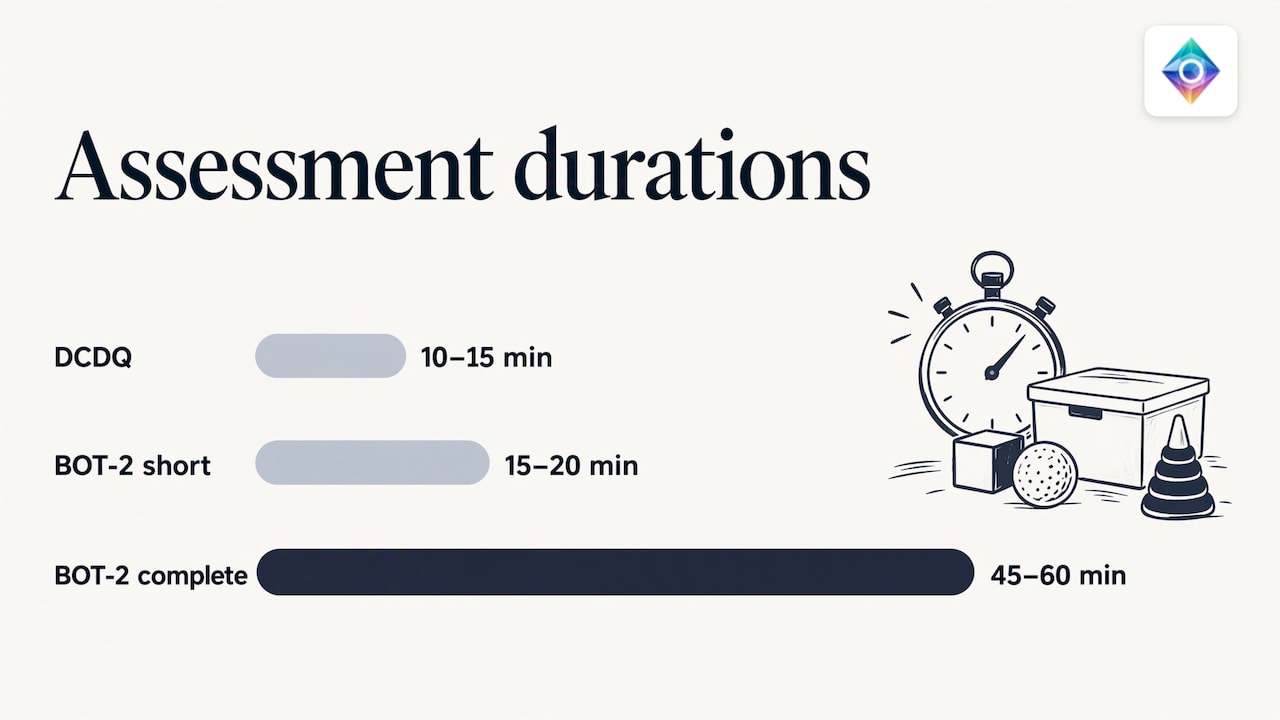
| DCDQ (Developmental Coordination Disorder Questionnaire) | Children aged 5 to 15 | A 15-item parent questionnaire taking 10 to 15 minutes, covering control during movement, fine motor and writing, and general coordination, according to a 2020 review |
| Movement ABC-2 (M-ABC-2) | Ages 3 to 16 | A standardised test of manual dexterity, aiming and catching, and balance, with 24 subtests per the same review |
| BOT-2 (Bruininks-Oseretsky Test of Motor Proficiency) | Children and young people | Assesses fine manual control, manual coordination, body coordination, strength and agility; the short form takes 15 to 20 minutes and the complete form 45 to 60 minutes, per the same review |
| ADC (Adult Developmental Co-ordination Disorders/Dyspraxia Checklist) | Adults aged 16 and over | A questionnaire that UK guidance recommends as a first step, followed by the DIDA (Diagnostic Interview for DCD in Adults) if it indicates possible DCD, per SASC |
The American physical therapy guideline describes the M-ABC-2 as scoring in a traffic-light system: at or below the 5th percentile suggests significant movement difficulty, the 5th to 15th percentile suggests risk, and above the 15th percentile suggests no difficulty. The same guideline reports that the DCDQ’07 has 85% sensitivity and 71% specificity, which is why it is used to support a picture of daily-life difficulty rather than to diagnose alone.
For adults the landscape is less settled. A 2022 review reports no established gold-standard diagnostic procedure for adults, which is one reason a clear developmental history carries so much weight. Our comparison of the best dyspraxia tests explains how to make online results clinician-ready.
Can a self-assessment diagnose dyspraxia?
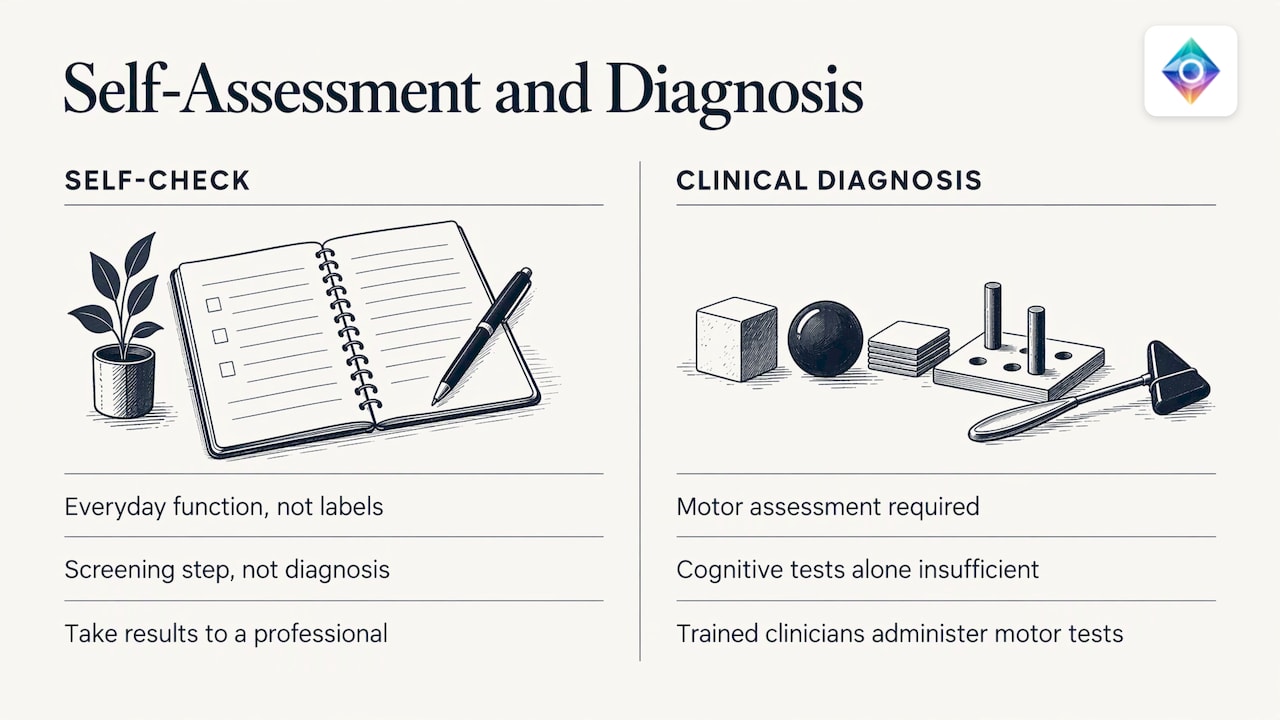
No self-assessment can, and no standalone questionnaire can either. UK guidance states that a diagnosis cannot be made without a motor assessment under the DSM-5 and ICD-11 criteria, and that DCD cannot be established from cognitive test performance alone. Full assessment of children uses standardised motor tests such as the M-ABC-2 and the BOT-2, which require clinical training to administer.
What a good self-assessment does is turn a vague sense of “I have always been clumsy” into a list of specific, dated examples across daily life, which is exactly what the diagnostic criteria ask a clinician to establish. It also helps you notice whether other traits, such as attention differences, may be part of the picture. Our article on dyspraxia and ADHD for families explains how the two overlap and how to describe each clearly.
A credible self-check shares three features: it asks about everyday function rather than offering a label, it is open about being a screening step, and it asks you to take the results to a professional. Omniprism’s profile is built on that footing, and it keeps your answers private by not collecting data.
What should you do after a self-assessment suggests dyspraxia?
The next step depends on your age and on whether anything in your answers looks new rather than lifelong.
Adults
First check for red flags. UK guidance lists worsening or deteriorating coordination, recent functional loss, movement asymmetry, loss of muscle mass, tremor, joint pain, headaches, mood changes and memory loss as signs that need prompt GP referral, so that conditions such as multiple sclerosis, Parkinson’s disease or stroke can be ruled out before any DCD decision. If you have any of these, see your GP before anything else.
If your difficulties are lifelong and stable, book a GP appointment and bring your written evidence. The NHS says the GP may refer you for an assessment, where you will be asked about your symptoms and how they affect your life. Useful items to bring:
- Your self-assessment profile and the examples behind each answer
- Childhood memories, school reports or comments from teachers
- Workplace or study situations where coordination or organisation causes problems
- Anything a relative can confirm about your early development
Children and teenagers
UK guidance says assessors such as SpLD teacher-assessors should not attempt to identify DCD in children under 16. Suspected cases go first to a medical practitioner to rule out other causes, then to a multi-disciplinary motor assessment, with a template referral letter recommended to make it more likely the referral is acted on. A parent’s dated notes on what happens at home and school make that letter concrete. The Youth Briefing, also a one-off €20, summarises a child’s results for the clinician or school.
Why do we build a self-check for dyspraxia?
Many people reach a clinic with years of difficulty and no way of describing it in the few minutes they get. Our assessment exists to fix that: a profile across 14 areas, in plain language, available immediately, with no account and no data collected from you.
I was diagnosed with ADHD at 42, and I know how much easier an appointment becomes when you can show a clinician a clear picture rather than try to recall everything on the spot. We designed the Specialist Briefing for that moment, so a healthcare professional can read your results quickly.
For dyspraxia in particular, the value is in the examples. Clinicians need a developmental history, and a self-assessment completed with real situations in mind gives you and your family a head start on that conversation.
Valerio Cozzi
Where can you take the dyspraxia self-assessment?
The Free Adult Self-Assessment costs €0, takes no email or account, and returns an instant profile across 14 areas that includes dyspraxia. Parents can start with the Children & Young People Free Assessment. If you decide to take your results to a clinician, the Specialist Briefing for adults and the Youth Briefing for children are each a one-off €20.
Dyspraxia self-assessment questions
Is there a reliable dyspraxia test I can do at home?
A home questionnaire can describe your pattern of difficulties and prepare you for a referral. Diagnosis itself rests on a clinical motor assessment and a developmental history, which a clinician carries out.
How is dyspraxia diagnosed in the UK?
In adults, the GP can refer you for an assessment that looks at your symptoms and their effect on daily life, and UK guidance recommends the ADC followed by the DIDA where indicated. In children, a medical practitioner rules out other conditions first, then a multi-disciplinary team uses standardised motor tests.
At what age can dyspraxia be diagnosed?
The NHS says a definite diagnosis does not usually happen until a child is 5 years old or more, because children vary widely in development. Adults can also be assessed, and many people first ask the question later in life.
Does dyspraxia affect more than movement?
The NHS notes that dyspraxia in adults can also affect time management and planning. That is why a profile covering several areas, such as attention, sensory processing and reading, gives a fuller picture than a movement-only checklist.
Sources
- NHS: Dyspraxia in adults (developmental co-ordination disorder)
- NHS: Developmental co-ordination disorder (dyspraxia) in children
- SASC guidance on DCD/dyspraxia, March 2020
- Physical therapy management of children with developmental coordination disorder, clinical practice guideline 2020
- Identifying developmental motor difficulties: a review of tests (PMC, 2020)
- Developmental coordination disorder: relevance for adults (PMC, 2022)
Recommended
- Dyspraxia Checklist for Adults: Signs to Look For
- Families and Adults: Make Online Dyspraxia Tests Clinician Ready
- Handwriting Help for Dyspraxia: What Works in the UK
- Neurodivergence Self-Assessment Guide: What It Can and Can’t Tell You
Written and edited by Valerio Cozzi, founder of Omniprism. Omniprism began after my own ADHD diagnosis at 42.
This article is educational. It is not medical advice, not a diagnosis, and not a substitute for assessment by a qualified clinician. The Omniprism self-assessment is free, needs no account and no email address, and runs entirely in your browser — your answers are never sent to a server. The optional Specialist Briefing report is a paid add-on.