Do Coloured Overlays Help With Dyslexia? UK Options Compared
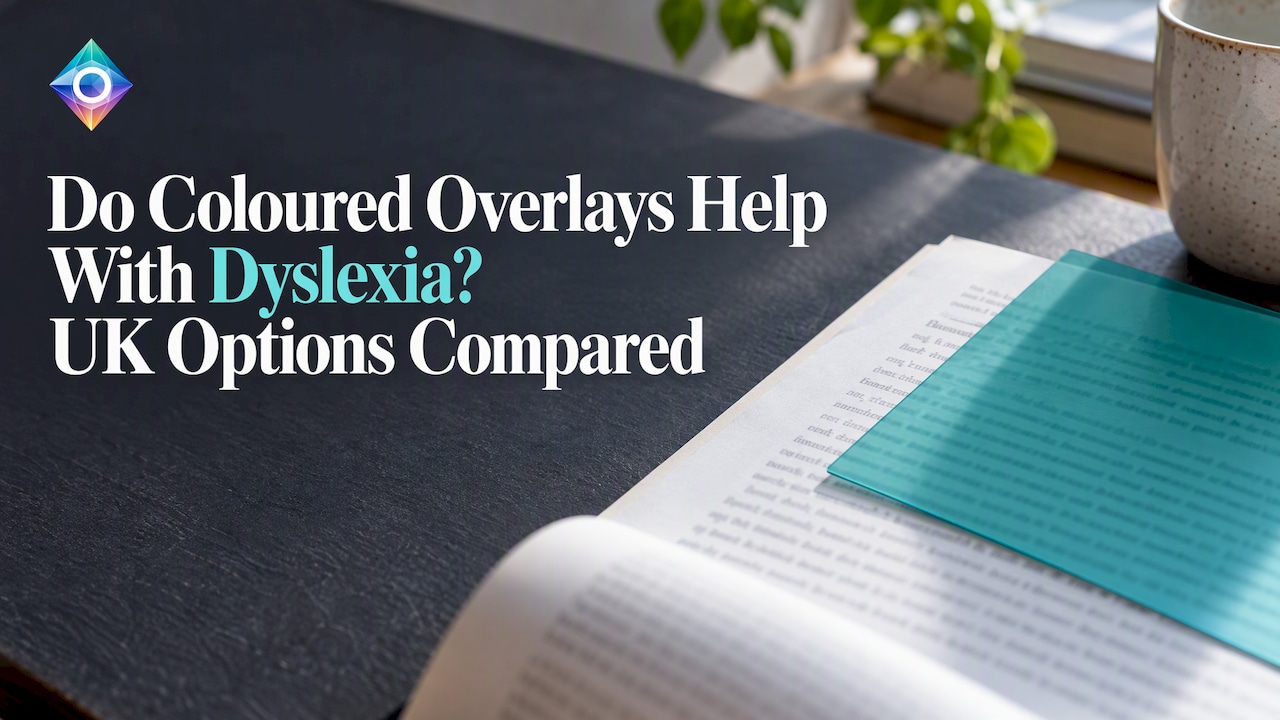
Coloured overlays have not been shown to improve reading in people with dyslexia, and the best systematic evidence says the benefit seen in some studies may come from placebo or practice effects (PubMed review). Some people do report that a tint makes a page more comfortable, which is why overlays are cheap to try, but they belong after an eye test and never in place of one.
Below you will find what overlays are for, how visual stress differs from dyslexia, how to try a tint sensibly, and a price comparison of the main UK options.
Key takeaways
- Dyslexia is a language-based difficulty, while visual stress is a sensory discomfort when viewing text. The two can occur together.
- Systematic reviews find insufficient high-quality evidence that overlays improve reading performance.
- Some people report symptomatic relief, so a low-cost trial can be reasonable once an optometrist has checked their eyes.
- UK paper overlays start from £2.89 and monitor overlays from £5.99, so cost should never be the barrier to a fair trial.
- A free, private self-check can help you decide what to raise with a professional, though it does not diagnose anything.
Do coloured overlays help with dyslexia?
The short answer from the research is that nobody can promise they will. A systematic review of coloured overlays and lenses on reading concluded there is currently insufficient high-quality evidence to endorse them for improving reading performance. Most of the studies carried a high risk of bias, and reported gains were often attributed to placebo or practice effects (PubMed). The same review found the evidence does not support using overlays to treat reading difficulties associated with dyslexia.
Public health bodies have taken the same line. Cheshire and Merseyside Integrated Care Board does not routinely commission coloured filters, lenses or overlays for visual stress or reading difficulties because the published evidence is limited (NHS commissioning policy, June 2024).
Some clinicians still see value for selected patients. One UK optometry practice reports meaningful symptomatic benefit in some cases while advising that practitioners be open about the limits of the evidence and cautious about cost, time and expectations (Brad Abrahams). That seems a fair reading: an overlay may make reading feel easier for one person and do nothing for the next, and none of that changes how well someone decodes words.
What is the difference between visual stress and dyslexia?
Dyslexia is a language-based learning difficulty marked by problems with phonological awareness, spelling and fluent word recognition. Visual stress, also called Meares-Irlen syndrome, is a sensory condition linked to over-stimulation of the visual cortex by repetitive patterns such as lines of text. It can cause discomfort or perceived distortions on the page, and a systematic review of controlled trials describes it as a separate condition that may co-occur with dyslexia (Evans and Allen, 2016).
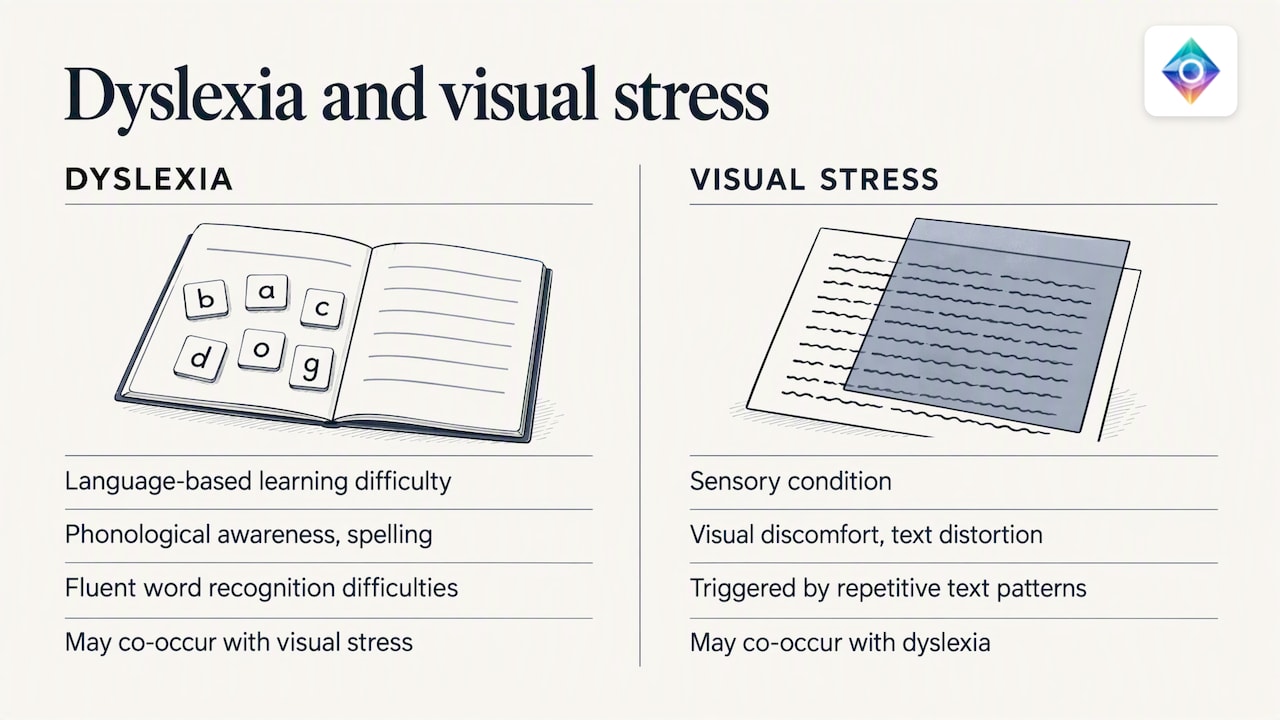
This is where the common assumption goes wrong. Jim Gilchrist, writing in the College of Optometrists’ journal, calls the idea that coloured lenses and dyslexia go together fundamentally flawed, because the lenses are meant to ease visual stress and most dyslexic people do not have it (Acuity, Winter 2020). UK suppliers themselves take care with the wording: The Dyslexia Shop describes overlays as tinted sheets meant to make reading more comfortable for visual stress, which may occur alongside dyslexia but is not dyslexia itself (The Dyslexia Shop).
A child who reads slowly, reverses letters or struggles to sound out words may have dyslexia, visual stress, a standard vision problem, or a combination. Only an assessment can separate them. If you are unsure which signs matter in the early years, our guide to dyslexia signs in kindergarten lists what to bring to school.
What are the best colours for dyslexia?
There is no best colour. Crossbow Education recommends starting with an assessment pack because different readers find different tints most comfortable (Crossbow Education). The standard range covers yellow, pink, green, blue and similar shades, and Niche Healthcare’s Simplex A4 range stretches to twelve, including Apple, Aqua, Lilac, Magenta, Rose and Turquoise (Niche Healthcare).
A sensible way to trial tints:
- Use the reader’s normal material, such as a school book or the document they read for work, rather than a test sheet.
- Try each colour for a few minutes and note comfort, not speed: does the text look steadier, less glaring, less tiring?
- Repeat on another day. A single good impression is the pattern the research warns about, since placebo and practice effects are the usual explanations for early gains.
- Stop if nothing changes. A tint that makes no difference is a result worth having.
For screens, The Dyslexia Shop suggests trialling a screen tint against the person’s usual tasks, and if a paper overlay already works, beginning with the matching screen colour (SEND monitor overlays).
Which coloured overlays can you buy in the UK?
Prices below come from each supplier’s own pages. Stock and prices change, so check the listing before you order.
| Product | What you get | Listed price |
|---|---|---|
| Crossbow Education page overlays | Recyclable, scratch-resistant PET sheets, 216 × 298 mm, gloss and matt sides; single, packs of five or 10, mixed packs | From £2.89 |
| The Dyslexia Shop, pack of 10 reading strips | Ten line-tracking overlays, 209 × 50 mm, two each of yellow, pink, green, dark blue and light blue | £16.99 |
| The Dyslexia Shop, A4 pack of 10 | Ten full A4 sheets, 297 × 210 mm, with a tracking line and bookmark storage | £31.99 |
| Niche Healthcare Simplex A4 | 210 × 297 mm, twelve colours, scratch- and tear-resistant, waterproof, reusable | “Call for pricing” |
| Crossbow Education monitor overlays | Screen filter held in the monitor frame by static; colours can be combined | From £5.99, or £5.49 each for five or more |
| The Dyslexia Shop monitor overlays | Nine tints per size for 17, 19, 21.5 and 24-inch widescreen monitors | £5.99 (17 and 19-inch), from £5.99 (21.5-inch), £8.39 (24-inch) |
| Irlen Store | Five-pack of single-colour overlays | $19.99 |
| World Wide Learning Academy | Pack of 10 Irlen overlays | $79.00 |
A few points help when choosing. Full-page sheets suit readers who find whole pages glaring, while narrow strips work as a line tracker and fit in a pencil case. Gloss and matt sides on the Crossbow sheets let you choose between clarity and reflection control. Monitor overlays cost about the price of a sandwich, so they are the easiest low-risk test for someone who struggles with a work screen. The Irlen prices are in dollars and will include import costs if you buy from outside the UK.
Should you see an optometrist before trying overlays?
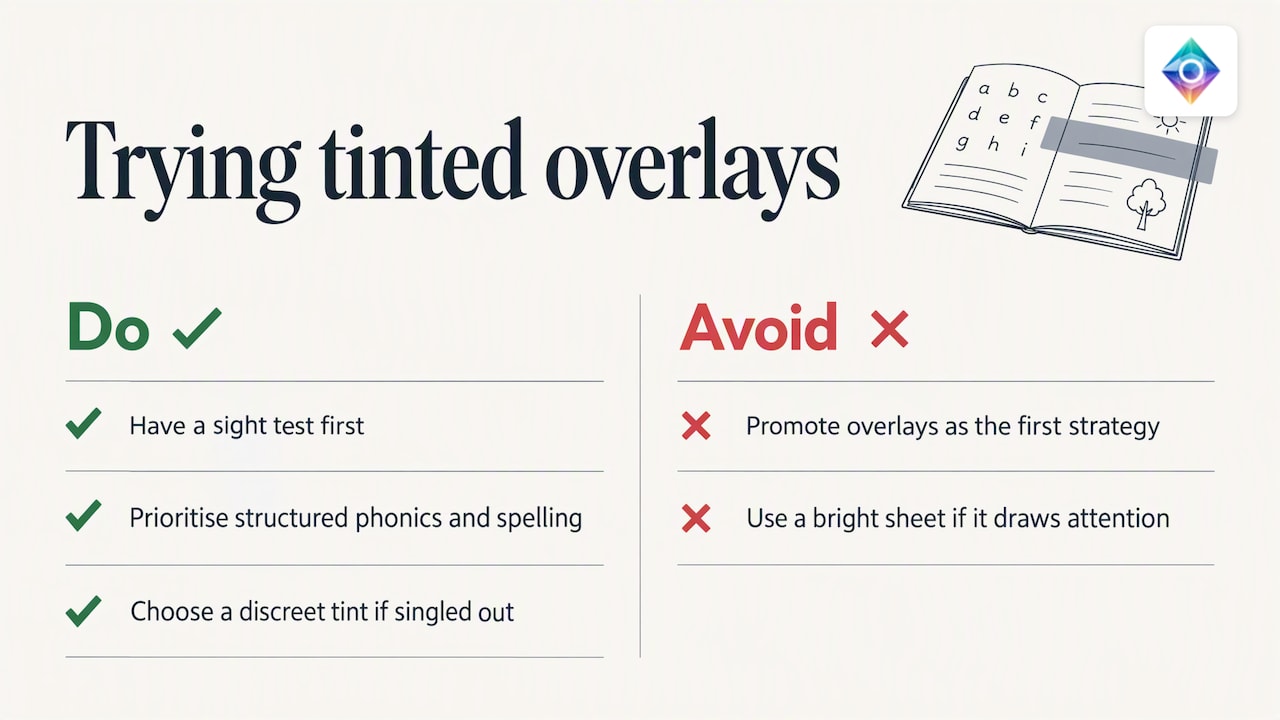
Yes, and the British Dyslexia Association is explicit about it. Anyone with reading-related visual difficulties should have a full assessment of eye health and visual function by a registered optometrist, and coloured aids must not replace or discourage that assessment (BDA). The BDA adds that overlays should not replace a full NHS sight test, which is comprehensive enough to assess eye health and identify likely causes of visual problems affecting reading and near work.
The reasoning is practical. Headaches, blurred print or words that seem to swim can come from an uncorrected prescription, a focusing problem or an eye condition, and a tinted sheet masks none of those. If the optometrist finds a healthy, correctly prescribed eye and the person still reports discomfort with text, a trial of overlays becomes a reasonable next step.
The College of Optometrists also advises its members to take care, since patients and parents can be vulnerable to suggestions that any intervention will help, which may lead to unnecessary expense and raised expectations (College of Optometrists guidance). Treat any supplier that promises a cure with the same caution.
Are tinted overlays worth trying for a child or in the classroom?
They can be, as one adjustment among several, and only after the sight test. The BDA says overlays must not be promoted as the first strategy for children with reading difficulties (BDA). The reading support that carries the strongest case is structured teaching of phonics and spelling, plus the adjustments in our study strategies for dyslexic students.
There is a psychological side too. Evans and Allen note that a coloured filter may help some children by giving them a physical explanation for underachievement instead of a sense of low intelligence, although it may also draw unwelcome attention from classmates (Evans and Allen, 2016). A child who feels singled out may be better served by a discreet strip or a screen tint than by a bright full-page sheet.
Parents and teachers should also keep an eye on other explanations for the same behaviour. Attention differences overlap with dyslexia in a sizeable minority of children, which we cover in our ADHD and dyslexia action plan, and handwriting problems may point somewhere else again, as set out in dysgraphia versus dyslexia. Schools weighing wider inclusion can also look at accessibility planning for school publications, which extends adjustments beyond the classroom.
Our perspective at Omniprism
We built Omniprism around a simple observation: people tend to reach for a product, such as a tint, a lens or an app, before they understand what is actually going on. I was diagnosed with ADHD at 42, and looking back, a clear profile of how my own attention and sensory patterns worked would have saved years of guessing.
That is why we take a cautious view of overlays. They are cheap and sometimes comfortable, but the evidence says they are not a dyslexia treatment, and a family that buys a pack in the hope of fixing reading may delay the steps that matter: a sight test, a conversation with the school and, where warranted, a specialist assessment.
Our self-assessment covers 14 areas, including dyslexia, ADHD, autism, sensory processing and masking, and it needs no email, account or data collection. It will not diagnose anything. What it can do is show which traits are worth describing to an optometrist, a SENCo or a GP, so the appointment starts from specifics.
— Valerio Cozzi
Where Omniprism fits
If you are trying to work out whether reading difficulties, visual discomfort or something else is behind the problem, start with the free Omniprism self-assessment. You get an instant plain-language profile, and parents can use the guided versions for children and young people. When you are ready to take results to a clinician, the optional Specialist Briefing turns them into a summary for professionals, for a one-off €9.99.
FAQ
Can coloured overlays cure dyslexia?
No. Dyslexia is a language-based difficulty, and a review of the evidence found no support for using overlays to treat the reading problems linked to it (PubMed). Overlays may ease visual discomfort for some people, which is a separate matter.
What is the difference between visual processing problems and dyslexia?
Dyslexia affects phonological awareness, spelling and word recognition. Visual stress is a sensory discomfort with repetitive patterns like text, and it can occur alongside dyslexia without causing it (Evans and Allen, 2016). A registered optometrist can assess the visual side, and an educational psychologist or specialist teacher can assess the literacy side.
Does the NHS provide coloured overlays?
Not routinely in at least one area. Cheshire and Merseyside ICB does not routinely commission them because the published evidence is limited (policy document). Policies vary by area, so ask your local ICB or optometrist.
Can I use a tint on my computer screen?
Yes. Screen overlays sit flat against a desktop monitor and start from £5.99 at Crossbow Education (Crossbow). Trial the tint on your usual work for several days before judging it.
Sources
- The effect of coloured overlays and lenses on reading: a systematic review (PubMed)
- A systematic review of controlled trials on visual stress (PMC)
- Cheshire and Merseyside ICB commissioning policy, June 2024
- British Dyslexia Association: Visual difficulties
- College of Optometrists, Acuity: What are coloured lenses and overlays really for?
- College of Optometrists: Examining patients with specific learning difficulties
- Brad Abrahams: coloured filters and overlays
- The Dyslexia Shop: coloured overlays
- The Dyslexia Shop: SEND monitor overlays
- The Dyslexia Shop: pack of 10 reading overlays
- The Dyslexia Shop: A4 pack of 10
- Crossbow Education: coloured overlays
- Crossbow Education: monitor overlays
- Niche Healthcare: Simplex A4 overlay
- Irlen Store
- World Wide Learning Academy: Irlen overlays pack of 10
Recommended
- 6 Evidence Backed Study Strategies Dyslexic Students Can Try This Week
- 25–50% Overlap: Parents & Teachers’ Action Plan for ADHD and Dyslexia
- Dysgraphia vs Dyslexia: Spot Classroom Signs With a 14 Domain Self Check
- Parents & Teachers: Four Steps to Tell Dyscalculia From Dyslexia
Written and edited by Valerio Cozzi, founder of Omniprism. Omniprism began after my own ADHD diagnosis at 42.
This article is educational. It is not medical advice, not a diagnosis, and not a substitute for assessment by a qualified clinician. The Omniprism self-assessment is free, needs no account and no email address, and runs entirely in your browser — your answers are never sent to a server. The optional Specialist Briefing report is a paid add-on.