Carers & Clinicians: NHS Aligned Help for Auditory Processing Disorder
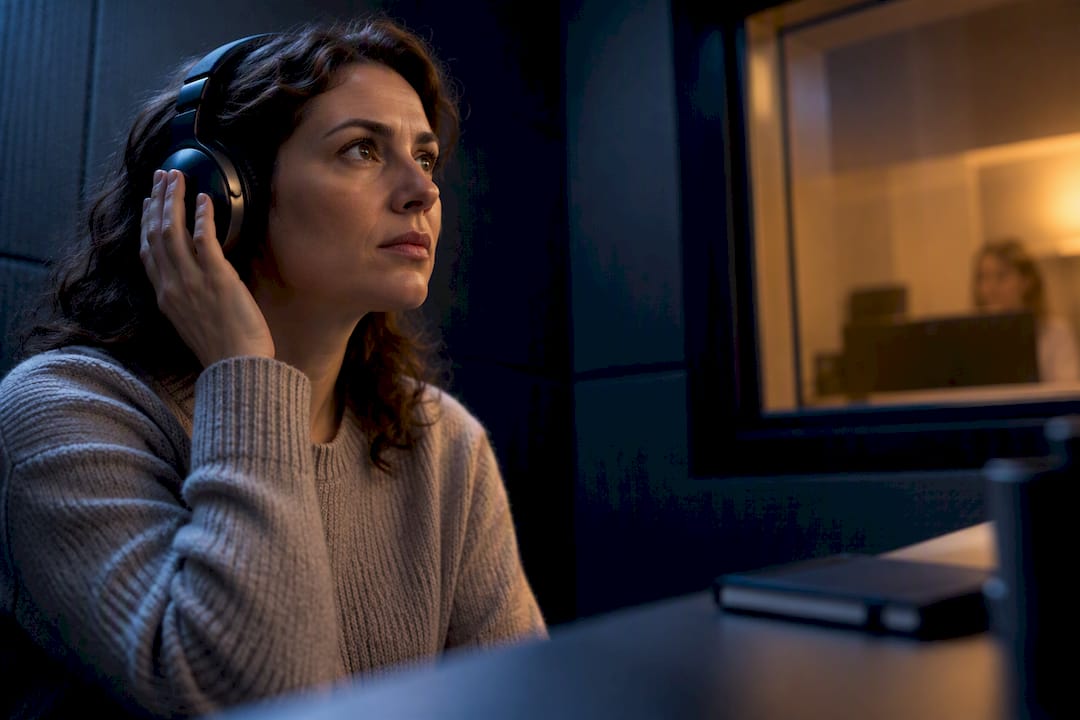
Auditory processing disorder (APD) means the brain struggles to interpret sound accurately even though the ears themselves work normally on a standard hearing test. There is no single cure. Management focuses on practical compensatory strategies, professional support, and realistic expectations, because diagnostic criteria vary between services and evidence for specific treatments remains limited.
TL;DR:
- Most people with APD pass hearing tests but still struggle with speech understanding in noisy environments or during multi-step instructions.
- Diagnosis requires specialized testing, including speech-in-noise and dichotic listening tasks, usually deferred until around age 7 in children.
- Support focuses on reducing background noise, visual aids, and classroom or workplace adjustments rather than attempting a cure, with assistive technology as an adjunct.
- APD often overlaps with attention, language, and developmental disorders, so a functional, interdisciplinary assessment is more useful than a strict label.
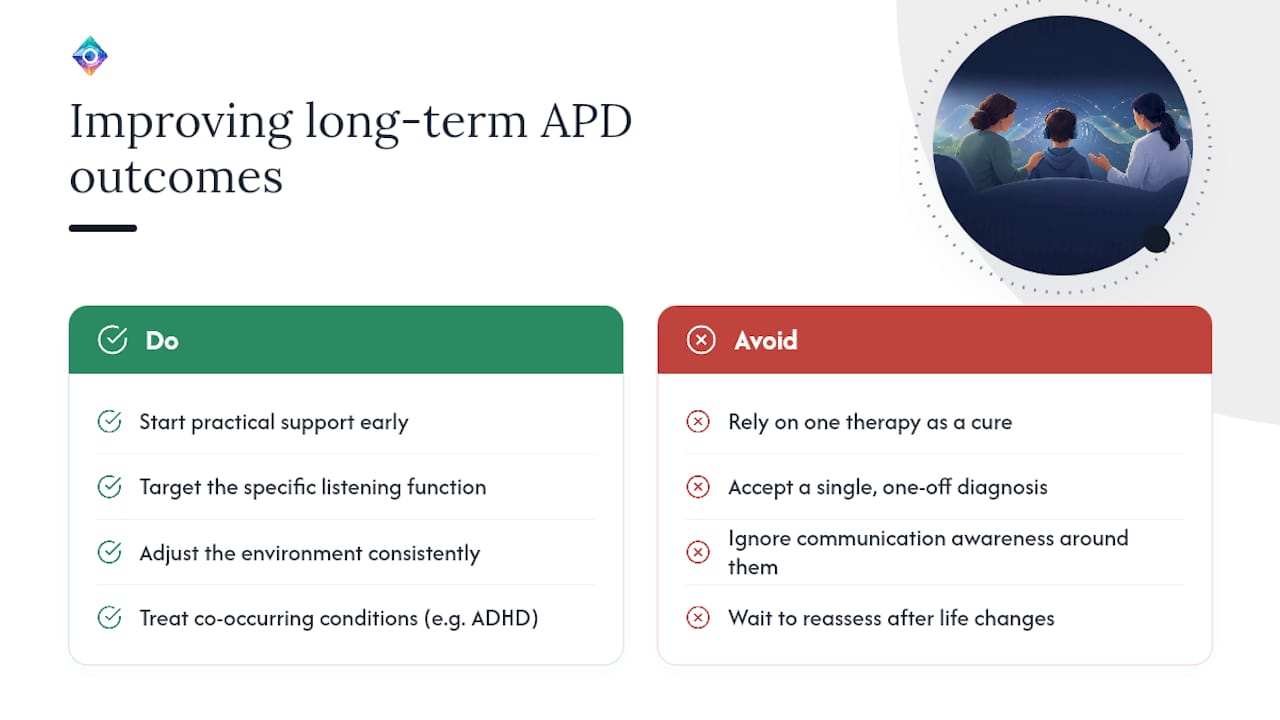
- Long-term outcomes depend heavily on early practical support, environmental adjustments, and management of co-occurring conditions rather than specific therapies.
What are the symptoms of auditory processing disorder?
Someone with APD hears sound perfectly well on a hearing test, yet the brain doesn’t reliably turn that sound into meaning, especially when there’s competing noise. That gap between normal hearing thresholds and real-world listening struggles is the hallmark clinicians look for.
Common auditory processing issues include:
- Frequent requests to repeat what was just said, even in a quiet room
- Confusing similarly sounding words (“fifteen” for “fifty”)
- Struggling to follow multistep instructions without visual backup
- Difficulty on phone calls, video calls, or with unfamiliar accents
- Appearing distracted or slow to respond, particularly in noisy classrooms or open plan offices
In children, the classic picture is a pupil who does well one-to-one but struggles when classrooms become noisy, despite passing standard hearing tests. Teachers sometimes mistake this for inattention or defiance rather than a genuine listening problem. In adults, the same pattern shows up as exhaustion after meetings, avoiding busy restaurants, or leaning heavily on lip-reading and context clues without realising it.
APD is estimated to affect 3% to 5% of school-aged children, though reported rates vary widely between studies and countries, partly because there’s no single agreed test battery. Adults can have APD too, sometimes carried over from childhood and never formally identified, sometimes emerging after a head injury or as part of age-related change.
How is auditory processing disorder diagnosed and when should you see a GP or specialist?
See a GP when listening difficulties persist despite a normal hearing test, especially if they’re affecting school performance, work, or daily conversation. A GP typically starts with a basic hearing check to rule out hearing loss before referring onward, because APD assessment is a specialist process, not something done in a single ten-minute appointment.
The usual pathway looks like this:
- Baseline hearing test to confirm hearing thresholds are within normal range.
- Referral to audiology or a specialist paediatric/adult listening clinic once hearing loss is excluded.
- Speech-in-noise testing, where the person repeats words or sentences against background noise.
- Dichotic listening tasks, presenting different sounds to each ear simultaneously to test how well the brain integrates them.
- Temporal processing tests, checking how accurately tiny differences in timing and pitch are detected.
- Electrophysiological tests such as auditory brainstem response (ABR) in some centres, alongside broader language and attention assessments.
Many services in the UK lack a fully standardised APD pathway, and NHS trust guidance is candid that there’s no UK-wide consensus on which tests to use or how to interpret them. Testing is also usually deferred until a child is developmentally ready, commonly around age 7, because younger children can’t reliably complete the tasks involved.
Before any appointment, gather concrete evidence: teacher observations, specific examples of situations where listening broke down, and copies of any previous hearing test results. Specific detail speeds up the whole process far more than a general “they don’t listen well.”
What causes auditory processing disorder and what are the risk factors?
There’s rarely a single cause. APD tends to arise from a mix of developmental, medical and environmental factors rather than one clear trigger, which is part of why diagnosis is complicated.
Recognised contributors include:
- Genetic and developmental factors affecting how the auditory system matures
- Early, recurrent ear infections or glue ear during key developmental windows
- Complications around birth, including prematurity
- Head injury or concussion, at any age
- Age-related decline in auditory processing speed, distinct from age-related hearing loss
APD overlaps heavily with ADHD, autism, developmental language disorder and dyslexia. This isn’t coincidental. Research indicates that attention and working memory problems, core features of ADHD, often account for a large share of what looks like “auditory processing” difficulty on testing. In practice, this means a child struggling with listening tasks may benefit more from attention-focused support than from auditory-specific training alone. It’s also worth remembering that stress, tiredness and poor room acoustics can temporarily worsen anyone’s listening, APD or not, which is why a bad day at a noisy assessment centre shouldn’t be treated as a permanent verdict.
How is APD managed? Practical strategies, therapies and what the evidence says
Management centres on reducing the acoustic and cognitive load on listening, not on chasing a cure. The NHS is explicit that there’s no single treatment for APD, and that support is built around compensatory strategies tailored to the individual.
Practical, low-risk first steps that NHS trust materials consistently recommend:
- Seat the person near the speaker and away from noise sources (windows, corridors, fans)
- Reduce background noise wherever possible, including carpets, curtains, or closed doors
- Break instructions into short chunks rather than long strings
- Pair spoken information with visual supports: written steps, gestures, slides
- Face the listener directly and check understanding rather than assuming it
Classroom acoustic adjustments and simple teacher training can make a genuine difference, and practical guidance for teachers covers this in more depth for anyone managing a group setting day to day.
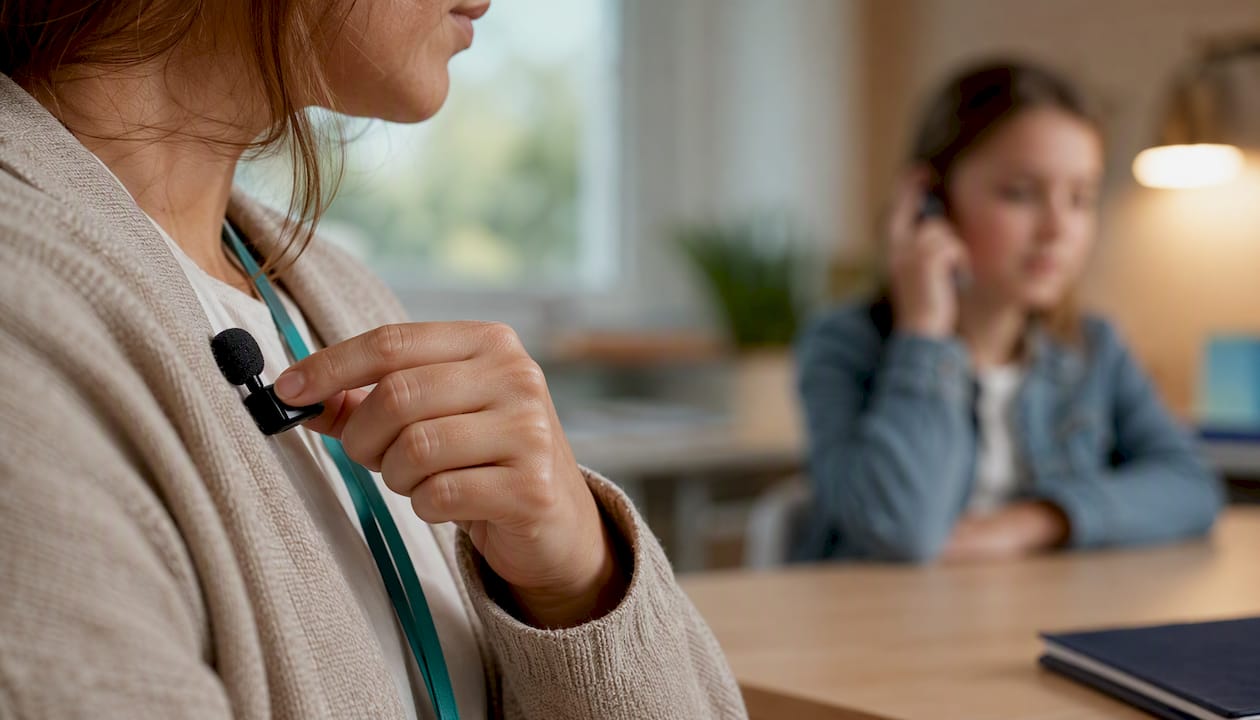
Assistive technology, particularly teacher microphone or FM-style radio systems that transmit a speaker’s voice directly to a receiver, is widely recommended in schools. Evidence reviews are careful to note these systems work best paired with classroom strategies rather than used as a standalone fix.
Computerised auditory training programmes claim to sharpen sound discrimination through repeated practice. The evidence is mixed at best: a systematic review found the research base for auditory and language interventions is thin and methodologically weak, and separate work suggests improvements often reflect gains in sustained attention rather than a genuine change in sensory processing. A broader scoping review of interventions reached a similar conclusion: protocols vary enormously and outcome measures are inconsistent, so treat bold marketing claims for any single programme with caution.
Pro Tip: When agreeing on adjustments at school or work, frame the goal around a specific, observable behaviour rather than a vague label. “Reduces requests for repeated instructions from five per lesson to one” is measurable and reviewable. “Improve listening” is not.
Diagnostic challenges and recent research perspective
A 2026 critical appraisal directly questions whether APD holds up as a discrete diagnostic category in childhood, arguing that test performance overlaps so heavily with attention, memory and language skills that a single “auditory” label can obscure what’s actually going on. The paper recommends functional, interdisciplinary assessment over categorical labelling.
This lines up with older findings that attention and working memory drive much of what gets tested as an auditory deficit. The practical upshot for clinicians and families: a diagnosis of APD shouldn’t be the end of the conversation. What matters more is identifying which specific tasks fail and why, then building support around function rather than around chasing a fixed label. Re-evaluation over time, rather than a single test result, gives a far more useful picture of how someone is actually coping.
Long-term outcomes and prognosis of individuals with APD
Long-term outcomes for APD vary considerably, and there’s no fixed trajectory that applies to everyone. Many children develop effective compensatory habits as they mature, learning to lip-read cues, ask clarifying questions, or position themselves strategically in noisy rooms, sometimes without ever framing it as a “strategy” at all.
For others, particularly where APD sits alongside ADHD, dyslexia or a developmental language disorder, listening difficulties can persist into adulthood and affect career choices, workplace confidence, and social stamina in loud environments. This doesn’t mean the outlook is bleak. It means outcomes depend heavily on how early practical support starts, and on whether that support targets the actual function affected rather than a generic label.
Because the evidence base for specific auditory training programmes remains weak, the most reliable predictor of good long-term outcomes isn’t a particular therapy. It’s consistent environmental adjustment, communication awareness from people around the individual, and, where relevant, treatment of any co-occurring condition like ADHD. Adults diagnosed later in life often report that simply having a framework for their listening struggles, rather than a cure, changes how they manage meetings, relationships and noisy public spaces. Reassessment as circumstances change (new job, new school, ageing) tends to matter more than a one-off diagnosis ever could.
How does APD differ from hearing loss?
Hearing loss is a problem with the ear detecting sound; APD is a problem with the brain making sense of sound the ear has already detected perfectly well. That distinction shows up clearly on testing: someone with APD typically passes a standard audiogram with normal thresholds across all frequencies, yet still struggles to follow speech in noise, on the phone, or across multi-step instructions.
Hearing loss tends to reduce the volume or clarity of sound arriving at the brain, so a hearing aid, which amplifies sound, often helps directly. APD is different because amplifying sound louder doesn’t fix a processing bottleneck further along the auditory pathway. This is why someone can score well on a basic hearing screen at school or work and still be genuinely struggling to listen, and why parents are sometimes told “the hearing test was fine” and left confused about what’s actually happening.
The two conditions can also coexist, particularly in older adults where age-related hearing loss and age-related processing decline often overlap, which is one reason specialist paediatric guidance insists on ruling out hearing loss with a proper audiogram before pursuing any APD-specific testing. Getting the sequence right, hearing test first, processing assessment second, avoids months of misdirected support aimed at the wrong problem.
The role of multidisciplinary teams in managing APD
No single professional can diagnose or manage APD alone, and specialist centres are consistent on this point. Audiologists lead the hearing-based testing: confirming normal thresholds, running speech-in-noise and dichotic listening tasks, and interpreting where performance breaks down.
Speech and language therapists assess how listening difficulties affect language comprehension, vocabulary development and classroom or workplace communication, and they design practical strategies to bridge specific gaps. Educational or clinical psychologists bring in the attention and working memory piece, screening for ADHD, developmental language disorder or other overlapping conditions that might explain, or compound, the listening struggle.
Specialist centres such as GOSH coordinate these roles as standard practice, precisely because APD symptoms rarely map onto one discipline cleanly. A child flagged for “auditory processing” might, after full assessment, turn out to need attention support more than sound-specific training, or a combination of both. Families and adult patients get the most useful outcome when these professionals share findings rather than working in isolation, which is also why bringing organised notes, previous test results and specific examples to each new professional saves everyone time.
A founder’s perspective: why structure matters before the appointment
Valerio Cozzi, founder of Omniprism, was diagnosed with ADHD at 42, well after years of unexplained struggles that никто could quite name. That late diagnosis shaped his conviction that people deserve structured, plain-language information before they ever sit down with a clinician, not instead of clinical assessment, but as preparation for it.
Bringing organised notes, specific examples and clear questions to an appointment, rather than a vague sense that “something’s off,” tends to produce a far more productive conversation. A structured self-assessment can help someone organise their thoughts before that first referral, giving both patient and clinician a clearer starting point.
— Valerio Cozzi
Sources
For further reading, consult the NHS overview of auditory processing disorder, the 2026 critical appraisal of diagnostic validity, and Torbay & South Devon NHS Trust’s practical listening guidance. Families managing a fragmented referral process may also find it useful to see how to prepare evidence for a clinical appointment, and teachers supporting affected pupils can review classroom acoustic fixes. Always discuss individual cases with a qualified audiologist, GP or multidisciplinary team.
If you want a clearer picture of your own cognitive patterns before that conversation, Omniprism’s free self-assessment tool covers 14 domains including ADHD, autism, dyslexia and sensory processing, with no email or account required. Anyone wanting a clinician-ready summary of their results can purchase the Specialist Briefing, a plain-language report designed to make that first specialist conversation faster and more focused. Parents exploring listening or attention concerns in younger family members can also look at the guided assessments for children and young people.
This article is general information, not a substitute for advice from a qualified doctor. Consult a qualified healthcare professional about your own circumstances before acting on anything here.
- Auditory processing disorder (APD) - NHS
- Auditory Processing Disorder in childhood: a critical appraisal of diagnostic validity, functional assessment, and interdisciplinary practice
- The diagnosis and management of auditory processing disorder
- Auditory processing disorder and auditory/language interventions: an evidence-based systematic review
- Difficulty Listening - Information, Tips and Advice for Adults (Torbay & South Devon NHS Trust)
- Auditory processing disorder - GOSH
FAQ
What are the symptoms of auditory processing disorder?
The main signs are difficulty understanding speech in noisy environments, frequently asking for repetition, confusing similar-sounding words and struggling with multi-step instructions. These occur despite normal hearing test results, which is what distinguishes APD from ordinary hearing loss.
What are the different types or subtypes of auditory processing disorder?
Clinicians have historically described subtypes such as difficulty with sound discrimination, dichotic listening (integrating sound from both ears), and temporal processing (timing and sequencing of sounds). However, recent critical appraisals question whether these subtypes represent genuinely distinct, reliably diagnosable categories rather than overlapping symptoms of attention or language difficulty.
What tips help someone manage auditory processing disorder day to day?
Reduce background noise, ask for face-to-face communication, and request information in short chunks with visual backup where possible. NHS trust guidance also recommends managing fatigue and stress, since both make listening difficulties noticeably worse.
Is auditory processing disorder a form of ADHD?
No, they’re distinct conditions, but they overlap significantly and often co-occur. Research shows that attention and working memory difficulties, core features of ADHD, frequently explain a large part of what looks like an auditory-specific problem on testing, which is why assessment for one should usually consider the other.
Recommended
- 50–70% Overlap in Autism and ADHD: What Families and Clinicians Need
- 25–50% Overlap: Parents & Teachers’ Action Plan for ADHD and Dyslexia
- Three Fixes Teachers Can Use to Make a Sensory Friendly Classroom
- Interoception in Autism: OT Tools and a Self Check for Caregivers
Written and edited by Valerio Cozzi, founder of Omniprism. Omniprism began after my own ADHD diagnosis at 42.
This article is educational. It is not medical advice, not a diagnosis, and not a substitute for assessment by a qualified clinician. The Omniprism self-assessment is free, needs no account and no email address, and runs entirely in your browser — your answers are never sent to a server. The optional Specialist Briefing report is a paid add-on.