Synesthesia Types: 6 Forms, Examples, and Consistency Tests
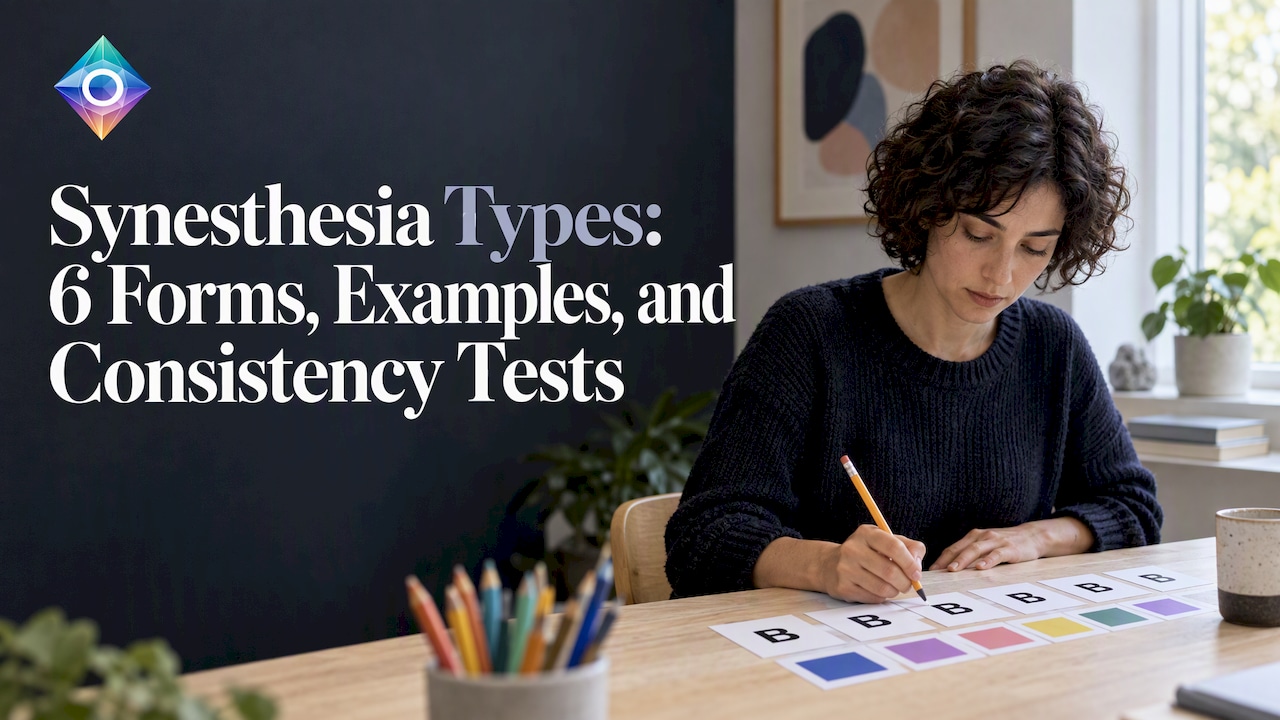
The principal synesthesia types are grapheme-colour, chromesthesia, mirror-touch, lexical-gustatory, sequence-space, and ordinal linguistic personification, each pairing one sense or concept with an unexpected second perception. Below we walk through clear examples of each, show you how researchers confirm genuine synesthesia using consistency testing, and explain what the evidence says about how common these experiences are and why they tend to cluster together.
Key Takeaways
Synesthesia involves consistent, automatic pairings between senses or concepts, with types clustering into groups that share underlying neural mechanisms, which can be verified through behavioral testing.
| Point | Details |
|---|---|
| Main types of synesthesia | The most studied types include grapheme-colour, chromesthesia, lexical-gustatory, mirror-touch, sequence-space, and ordinal linguistic personification. |
| Experience varies between projector and associator | Projectors perceive their synesthetic experiences externally, while associators experience them internally in the mind’s eye. |
| Self-assessment and consistency testing | Tracking experiences over time and using validated online tests can reliably indicate whether someone has genuine synesthesia. |
| Prevalence and links | Grapheme-colour synesthesia is common, with links to autistic traits and specific cognitive styles, though environmental influences exist. |
| Research and verification methods | Objective consistency testing, like the Synesthesia Battery, helps differentiate genuine synesthesia from guesses or associations. |
1. What are the main types of synesthesia?
Synesthesia describes a consistent, automatic pairing between one sense or concept (the inducer) and an unrelated perception (the concurrent). Researchers have documented dozens of variants, but a handful account for most reported cases and most of the research literature.
Grapheme-colour synesthesia is the most studied form: letters, numbers, or both trigger a specific, stable colour. Someone with this type might always see the letter “A” as red or the number “7” as green, regardless of the ink colour printed on the page. It often becomes noticeable in childhood, when a child insists that a letter “is” a certain colour rather than just reminding them of one.
Chromesthesia links sound to colour. A particular musical note, a car horn, or even a voice can trigger a burst of colour, shape, or movement in the mind’s eye. Some people describe a violin passage as producing streaks of gold, while a drumbeat might appear as pulses of dark red. This type is common among musicians, though it is not limited to them.
Lexical-gustatory synesthesia is rarer and more vivid: specific words or sounds produce a taste sensation. The word “jail” might taste of cold bacon, or a name might trigger the flavour of oranges. Because tastes are so specific and hard to fake, this type has become a useful test case for researchers studying the difference between a synesthete’s internal experience (an associator) and one who perceives the taste as if it were really on the tongue (a projector), a distinction explored further below.
Mirror-touch synesthesia causes someone to feel a touch on their own body when they observe another person being touched. Watching someone get a pat on the shoulder might produce a genuine tactile sensation on the observer’s own shoulder. This type has been linked to heightened empathic response, though the relationship is still being studied.
Sequence-space synesthesia, sometimes called a ticker-tape or spatial-form experience, causes numbers, dates, or time periods to occupy a fixed location in space. Someone might report that the months of the year form a loop around their body, or that numbers extend along an invisible line running from their left to their right.
Ordinal linguistic personification gives sequential items, such as numbers, letters, or days of the week, a personality, gender, or mood. The number three might always feel “stubborn” or Tuesday might always feel “shy”, consistently and without effort.
A smaller number of documented forms round out the picture: auditory-tactile synesthesia (sounds trigger physical sensations on the skin), kinaesthetic synesthesia (movement triggers other sensory responses), and day-colour synesthesia (specific days of the week evoke consistent colours). These are reported less often in the literature but follow the same basic principle: one sense or concept reliably summons another.
- Grapheme-colour: letters or numbers trigger a fixed colour, often noticed first in childhood.
- Chromesthesia: sounds or music trigger colour, shape, or movement.
- Lexical-gustatory: specific words trigger a taste sensation.
- Mirror-touch: watching someone being touched produces a felt touch on your own body.
- Sequence-space: numbers or time units occupy a consistent spatial layout.
- Ordinal linguistic personification: sequences such as numbers or days carry a fixed personality.
2. Projector vs associator: how synesthetic experiences differ
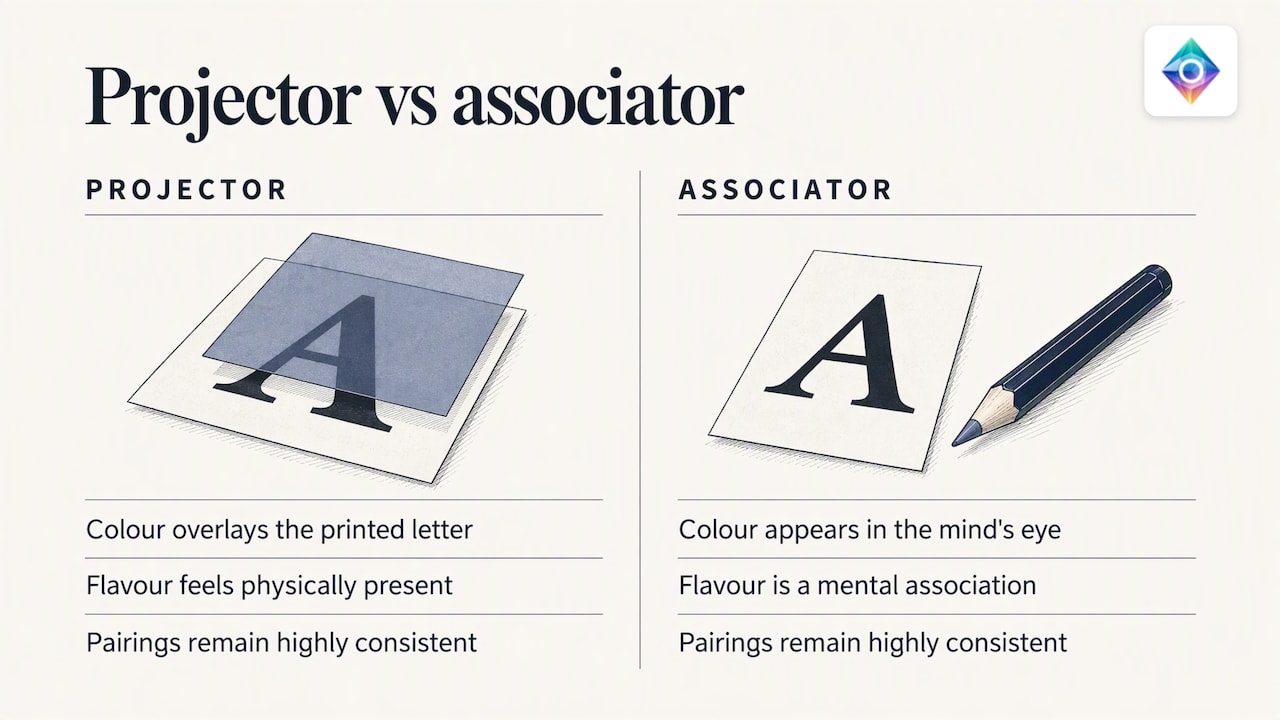
Synesthetes do not all experience their pairings the same way, and researchers split them broadly into two groups. A projector perceives the concurrent sensation as if it exists in the outside world: a projector with grapheme-colour synesthesia genuinely sees the letter on the page tinted with colour, overlaid onto the physical ink. An associator experiences the same pairing internally, in the mind’s eye, without it appearing to sit on the object itself.
The difference shows up clearly in lexical-gustatory synesthesia too. A projector might report that a word “tastes” as vividly and immediately as food in the mouth, while an associator describes a strong mental association with a flavour that never feels physically present. Both groups report highly consistent pairings, which is the detail researchers care about most.
This distinction matters for how synesthesia gets tested and reported. Projectors sometimes describe their experience in language that sounds closer to hallucination, which can make self-report less straightforward to interpret, while associators’ accounts can be harder to distinguish from ordinary vivid memory or imagination. Objective consistency testing, covered next, sidesteps this problem by measuring whether the same inducer produces the same concurrent response over time, regardless of how vividly the person describes the experience.
3. How can you tell if you have synesthesia?
If letters, sounds, or words consistently trigger an unrelated sensation for you, and that pairing has stayed stable since childhood, you may have synesthesia. The clearest way to find out is to track your experiences over time and compare them against validated consistency measures, rather than relying on a single moment of reflection.
Start with a simple log. Each time you notice a pairing, write down four things: the inducer (the letter, sound, or word), the concurrent sensation it produces, the context you were in, and how immediate or automatic the reaction felt. Repeat this across several days or weeks rather than relying on a single instance, since genuine synesthesia shows up reliably across occasions.
- Keep a short log for at least a week, noting the inducer, the concurrent sensation, and whether it felt automatic.
- Check for consistency by revisiting the same inducers days or weeks later and seeing whether the same pairing returns unchanged.
- Try a validated online battery, which presents the same stimuli multiple times and scores how close your repeated answers are.
- Compare your results against the general pattern for your suspected type (colour, taste, touch, or spatial layout).
- Speak to a clinician if your experiences are distressing, confusing, or linked to other sensory or neurological symptoms.
Consistency is the central diagnostic marker in synesthesia research. Rather than asking whether a pairing sounds plausible, researchers ask whether the same inducer reliably produces the same concurrent, often retested months apart, because genuine synesthetic associations tend to remain stable where guesses or invented answers drift. Consistency of inducer-concurrent pairings is now treated as a core behavioural marker and inclusion criterion in research, though relying on it as both an inclusion test and a diagnostic marker requires careful interpretation, since some self-reported synesthetes who fall short of strict cut-offs still behave like synesthetes on other measures.
Online tools built around this principle, such as the Synesthesia Battery, present the same stimuli repeatedly within a single session and calculate a consistency score, while specialised tools exist for rarer types. You can also run a structured synesthesia self-assessment online in 15 to 25 minutes as a starting point before deciding whether to pursue further testing.
Pro Tip: Log your pairings before researching synesthesia further, since reading examples first can unintentionally shape how you describe your own experience.
If your experiences cause distress, interfere with daily tasks, or appear alongside other sensory or neurological symptoms, a conversation with a clinician or occupational therapist is worthwhile, and practical signposting for sensory processing concerns can help you decide when that step makes sense.
4. Is synesthesia common, and what is it linked to?
Grapheme-colour synesthesia is the best-studied and most frequently reported type, though exact prevalence estimates vary depending on how researchers test for it and which population they sample. Single-session online batteries have been shown to reproduce estimates comparable to long-term retest methods, which gives researchers more confidence in population-level figures gathered through accessible digital tools rather than only lengthy clinical retesting. Validation of the Synesthesia Battery against conventional long-term retesting supports this approach for grapheme-colour synesthesia specifically.
Some studies report higher prevalence of synesthesia within autistic samples compared with non-autistic samples, though estimates vary across studies and the interpretation requires caution rather than treating the association as settled or universal, according to a summary of this research.
Separately, grapheme-colour synesthetes tend to score higher on verbal and vivid imagery dimensions of cognitive style compared with non-synesthetes, suggesting the trait may sit alongside particular ways of thinking rather than occurring at random. Grapheme-colour synesthesia and cognitive style found this link specifically for verbal and imagery-based thinking.
Prevalence figures also need a cultural caveat. Not every pairing is purely innate: analysis of a very large sample of grapheme-colour synesthetes found that a measurable minority had acquired many of their letter-colour pairings from an external source, specifically a coloured-letter toy manufactured and sold commercially, with notable proportions of learned matches among people born after the toy went on the market. Learned grapheme-colour pairings shows that environmental exposure can shape some synesthetic associations, which is a reminder that not every case has the same origin even within a single type.
5. Do synesthesia types cluster together?
Large-sample research increasingly suggests that synesthesia types are not a loose collection of unrelated quirks but instead group into coherent clusters. Cluster analysis of self-referred samples has identified distinct groupings, for example types that involve language and colour sitting together, types built around personification, types involving visualised internal sensations, and spatial-form or sequence-space experiences forming their own island.
The same research describes what has been termed a snowball effect: possessing one cluster of synesthetic traits measurably increases the likelihood that a person also experiences traits from another cluster, rather than each type occurring in isolation. Clustering of synesthesia types documents this co-occurrence pattern and its implications for how researchers think about underlying causes.
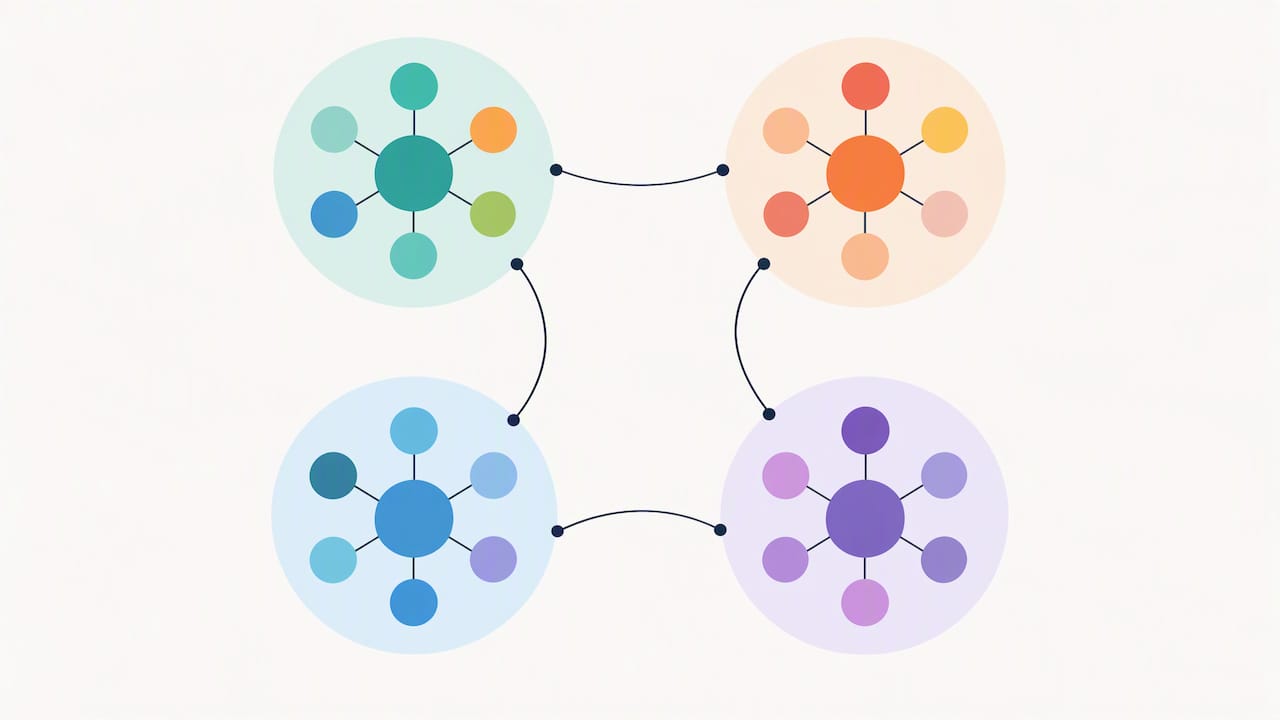
The practical takeaway is that if you recognise one type of synesthesia in yourself, it is worth paying attention to whether related experiences show up too, since multiple pairings are the rule rather than the exception in this research. This also complicates the idea of synesthesia as a single, neatly defined condition: the clustering evidence points towards overlapping neurological mechanisms that produce related but distinct experiences, rather than one uniform trait that simply varies in flavour from person to person.
6. How do researchers verify genuine synesthesia?
Researchers rely on behavioural testing rather than self-report alone, because consistent pairings are hard to fake convincingly across repeated sessions. The long-standing gold standard is a retest administered weeks or months apart: a genuine synesthete will reproduce close to the same inducer-concurrent pairings on both occasions, while someone guessing or inventing answers shows far more variation. Methods for assessing synesthesia and their psychological basis outline how this distinction separates genuine cross-modal experience from ordinary associations shared by much of the general population.
Modern tools have made this testing far more accessible:
- The Synesthesia Battery presents the same stimuli multiple times within one sitting and scores consistency against population norms, producing results comparable to long-interval retesting for grapheme-colour cases.
- The MULTISENSE test was built specifically for lexical-gustatory synesthesia, using consistency-based scoring and statistical thresholding to separate genuine synesthetes from controls with good discriminatory power in a single automated session, as described in the MULTISENSE validation study.
- Congruency tasks, which measure reaction time when a stimulus matches versus mismatches a person’s reported pairing, provide a second layer of objective evidence.
These tools have clear limits. Self-report still shapes how test results are interpreted, ordinary people show weaker but real cross-modal correspondences that can blur the line in borderline cases, and cut-off scores can shift depending on the language or cultural context the test was built in. None of this undermines the overall approach, but it explains why researchers treat consistency testing as the strongest available evidence rather than an infallible yes-or-no verdict.
7. What is the neurological basis of different synesthesia types?
Different synesthesia types appear to involve distinct patterns of brain connectivity rather than one single mechanism. Grapheme-colour synesthesia has been associated with cross-activation between brain regions that process visual symbols and regions that process colour, which sit near each other in the visual processing pathway. Mirror-touch synesthesia has been linked to heightened activity in networks involved in processing observed touch and bodily sensation, consistent with its association with empathic response.
This difference in underlying mechanism is part of why cluster research treats synesthesia types as related but distinct phenomena rather than variations on a single theme. The clustering pattern described earlier, where having one type increases the likelihood of others, fits with the idea of overlapping but not identical neural pathways that can be jointly affected by shared developmental or genetic factors. Understanding this helps explain why someone can have vivid grapheme-colour pairings but no trace of mirror-touch experiences, while someone else has both.
8. Everyday effects: learning, creativity, and daily life with synesthesia
Synesthesia is not typically a problem to manage; most people who have it experience it as a stable, neutral, or even useful feature of how they perceive the world. Grapheme-colour synesthetes sometimes describe using their colour associations as a built-in memory aid, for instance recalling a phone number or a word by recalling its colour pattern rather than the digits or letters alone, which connects to broader findings about synesthetes’ verbal and imagery-based cognitive style. Understanding how memory and attention interact with sensory load can also help put these everyday advantages in context, as explored in this primer on cognitive load and learning strategies.
Chromesthesia shows up often among musicians, some of whom describe using the colours and shapes triggered by sound as a creative tool when composing or arranging. The broader relationship between sound, rhythm, and perception is worth exploring if this resonates with you, and this accessible overview of music and brain rhythms offers useful background.
Mirror-touch synesthesia can occasionally be more demanding in daily life, since crowded or physically busy environments may produce a near-constant stream of felt sensations, which is one reason some people with this type prefer quieter or less visually busy settings.
9. Recording synesthesia through a structured self-assessment
A self-assessment can turn scattered personal observations into a structured, consistent record you can revisit or share. We built our self-assessment at Omniprism to cover 14 domains, including synesthesia alongside traits such as ADHD, autism, dyslexia, and sensory processing, without requiring an email address, an account, or any ongoing data collection.
For families, we offer guided assessments designed for children and teens, so a parent or guardian can work through age-appropriate questions with a child rather than relying on an adult-oriented questionnaire. Once an assessment is complete, you receive an instant, plain-language profile you can keep for your own reference or bring into a conversation with a healthcare professional.
For anyone preparing for a clinical appointment, we offer an optional Specialist Briefing report that summarises assessment results in a format designed for easy use by healthcare professionals, turning a personal log of inducer-concurrent pairings into something more structured to discuss. You can read more about how we approach privacy and validation in self-assessment design and how the 14-domain framework maps strengths alongside sensory traits like synesthesia.
10. A note on making assessment accessible
I was diagnosed with ADHD at 42, long after years of wondering why certain things felt harder for me than they seemed to for other people. That experience is part of why we built Omniprism around clear, private, and accessible self-assessment, so that people and families do not have to wait as long as I did to start understanding their own patterns.
— Valerio Cozzi
11. Try a free self-assessment or request a Specialist Briefing
If reading through these synesthesia types has left you wanting a clearer picture of your own sensory profile, our free self-assessment is the simplest next step. It takes you through structured questions across 14 domains, including synesthesia, with no account, no email address, and no data collection required at any point.
- Run the free self-assessment to get an instant, plain-language profile of your traits.
- Use the guided assessment for children and young people if you are exploring these questions on behalf of a child.
- Order the optional Specialist Briefing for a one-time fee; current prices are on the pricing page if you want a clinician-ready summary to bring into an appointment.
Our Specialist Briefing turns your results into a format built for easy use by healthcare professionals, which is particularly useful if you suspect lexical-gustatory or mirror-touch synesthesia and want a clearer starting point for a clinical conversation. You can start with the free self-assessment on our main site whenever you are ready.
FAQ
What is the rarest form of synesthesia?
Lexical-gustatory synesthesia, where words trigger specific taste sensations, is among the rarest documented forms and has historically been harder to study because of how few people report it. Researchers developed the MULTISENSE automated test specifically to make identifying this type more accessible and objective.
Is synesthesia a form of autism?
No, synesthesia and autism are distinct, separately defined conditions, but some research has found higher prevalence of synesthesia within autistic samples compared with non-autistic samples. Estimates vary across studies, so this association should be read as a documented pattern rather than a rule that applies to every autistic person.
How many types of synesthesia are there?
Researchers have documented several dozen reported variants, but a smaller group of around six to eight types, including grapheme-colour, chromesthesia, lexical-gustatory, mirror-touch, sequence-space, and ordinal linguistic personification, account for most studied cases. Large-sample cluster analysis suggests these types group into related clusters rather than existing as entirely separate categories.
How can you tell if you have synesthesia?
The clearest sign is a pairing between an inducer, such as a letter or sound, and a concurrent sensation that stays consistent every time you encounter it, often since early childhood. Logging your experiences over several weeks and checking them against a validated consistency test is the most reliable way to confirm a genuine pattern rather than a one-off association.
Sources
- How “diagnostic” criteria interact to shape synesthetic behavior: The role of self-report and test-retest consistency in synesthesia research
- The MULTISENSE Test of Lexical–Gustatory Synaesthesia: An automated online diagnostic
- How do Different Types of Synesthesia Cluster Together? Implications for Causal Mechanisms
- Prevalence of learned grapheme-color pairings in a large online sample of synesthetes
- Grapheme-color synaesthesia is associated with a distinct cognitive style
- Validation of the Synesthesia Battery against conventional long-term retesting
Recommended
- Synesthesia self assessment: run a validated 15–25 min online test
- NHS and OT steps for sensory processing in UK neurodivergent adults
- Sensory Diets for Adults: Start With a Two Minute Self Assessment
Written and edited by Valerio Cozzi, founder of Omniprism. Omniprism began after my own ADHD diagnosis at 42.
This article is educational. It is not medical advice, not a diagnosis, and not a substitute for assessment by a qualified clinician. The Omniprism self-assessment is free, needs no account and no email address, and runs entirely in your browser — your answers are never sent to a server. The optional Specialist Briefing report is a paid add-on.