Synesthesia self assessment: run a validated 15–25 min online test
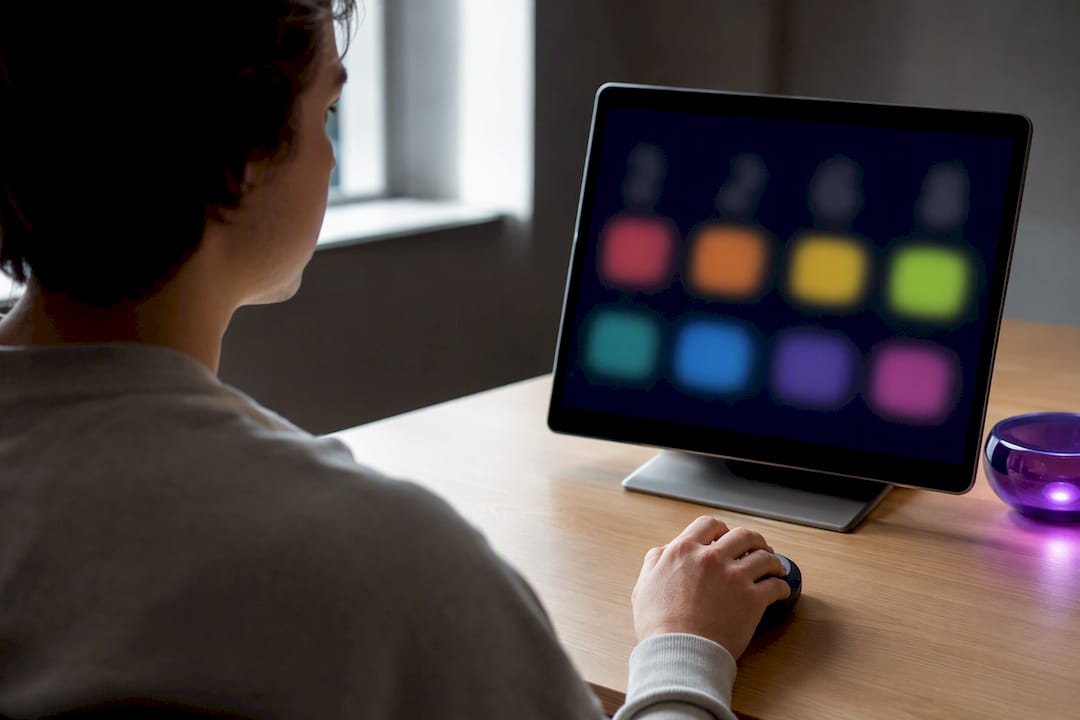
A consistency-based self-test can flag genuine synesthetic traits with reasonable confidence, but it cannot diagnose you. The right next step depends on your result: repeat a single-session consistency check to confirm a strong result, or run a privacy-first self-assessment like Omniprism’s if you want a structured, plain-language readout before deciding whether to raise it with a clinician.
TL;DR:
- A consistency score below 1.0 on online tests indicates a strong likelihood of genuine grapheme-color synesthesia, but scores near the cutoff require cautious interpretation.
- Factors like high memory, autism, or anxiety can produce consistent responses without true automatic synesthetic experience, so context and additional traits matter.
- Reliable responses should be fast, stable across time, specific to triggers, and accompanied by distinct sensory qualities, not just associations or emotional links.
- Repeating the test after a few weeks or testing different types of synesthesia can clarify borderline or ambiguous results before seeking clinical diagnosis.
- Self-assessment results are most trustworthy when combined with behavioral evidence, detailed notes, and awareness of factors like suppression, memory, and co-occurring neurodivergent traits.
Synesthesia self-assessment guide: the quick checklist
Before touching an online battery, run through six markers researchers use to separate genuine synesthesia from strong association or vivid imagination. None of these confirms anything on its own. Together, they tell you whether a fuller consistency check is worth your time.
- Automaticity — the colour, taste, or spatial position appears without you trying to summon it. If you have to think “what colour is Tuesday?” and construct an answer, that is different from a colour that simply arrives the moment you see the word.
- Consistency across occasions — the same trigger produces the same response weeks or years apart, not just within one sitting.
- Specificity to defined triggers — letters, numbers, musical notes, or days of the week, rather than a vague mood that shifts with context.
- A distinct sensory quality — an actual colour, taste, texture, or spatial location, not just an emotional association (“Mondays feel heavy”).
- Multiple forms co-occurring — many synesthetes report more than one type, such as grapheme-colour alongside sequence-space.
- Distress or disruption — most synesthesia is neutral or pleasant, but some report sensory overload in noisy or number-dense environments.
Reviews of the condition point to automaticity, reliability, and consistency as the three features that separate synesthesia from imagery or memorised mnemonic tricks. If most of the six markers ring true, the online consistency test below will give you a sharper answer than intuition alone.
How to run a short online consistency check
This is the exact procedure researchers use in single-session testing, adapted for home use. It takes 15 to 25 minutes and needs nothing beyond a quiet room and a computer.
Setup. Pick one sitting, ideally when you are not tired. Close any notes, colour charts, or previous test screenshots; the entire point is to capture your automatic, unrehearsed response. Put your browser in fullscreen mode to remove distraction, and turn off notifications.
-
Choose which variant to test first. Grapheme-colour (letters and numbers triggering colours) is the most studied and the easiest to self-assess. If you suspect sound-to-colour or sequence-space synesthesia (where numbers or months occupy a fixed spatial layout in your mind), note that too, but test one type properly before moving to the next.
-
Run the consistency test. Each letter, digit, or grapheme is shown three separate times, in random order, mixed with the other stimuli. Each time, you pick a colour from a full palette rather than a preset swatch. The Synesthesia Battery methodology developed for this exact purpose presents each grapheme three times and calculates how far apart your three colour choices sit on the colour wheel.
-
Do the speeded congruency check. After the colour-matching stage, you are shown a grapheme paired with a colour, sometimes matching your earlier choice, sometimes not, and asked to confirm or reject the pairing as fast as possible. Genuine synesthetes respond faster to congruent pairs and slower to incongruent ones, because a colour that clashes with their automatic association creates a genuine moment of friction. This step exists because speeded tasks make it harder to fake or intellectualise an association rather than experience it involuntarily.
-
Calculate your consistency score. For each grapheme, the test measures the distance between your three colour choices across the colour wheel, then averages that distance across every letter and number you were tested on. Lower scores mean tighter, more automatic consistency.
-
Read the threshold with caution. Eagleman-style batteries typically use a score below 1.0 to classify someone as showing grapheme-colour synesthesia, a cutoff drawn from the original test battery validation. Treat this as a strong signal, not a hard cutoff. More recent work shows that optimal cutoffs shift depending on language and measurement method, and some people who score just above 1.0 still behave like synesthetes on other behavioural tasks.
-
Record everything for later. Write down your raw score, the date, which variant you tested, and two or three example trigger-response pairs (e.g. “the number 7 is always mustard yellow”). This record matters more than the score itself if you decide to talk to a clinician later.
Pro Tip: Do the speeded congruency task before you look at your consistency score. Knowing your own number in advance can unconsciously bias how fast you react to “wrong” colour pairings on a retest.
Co-occurring traits that change how you read your results
Synesthesia rarely arrives alone. Clinician guidance from the MULTISENSE Synaesthesia Toolkit notes that autism and elevated anxiety appear more often in some synesthete samples than in the general population, which matters because it changes what a borderline score might mean.
If you already know you are autistic, or you score highly on anxiety measures, treat a middling consistency score with a bit more patience rather than dismissing it. Heightened attention to detail or a strong visual memory can sometimes produce colour-grapheme pairings that look consistent on a single test without being genuinely automatic in the synesthetic sense.
A few other factors worth noting before you interpret your score:
- Multiple types often travel together. Someone with grapheme-colour synesthesia has a meaningfully higher chance of also experiencing sequence-space or sound-colour synesthesia, so if you suspect more than one form, test each separately rather than assuming one result covers all of them.
- Masking can flatten your apparent consistency. If you have spent years consciously suppressing or downplaying an unusual sensory response, socially or professionally, your self-report might undersell how strong the underlying experience actually is.
- Superior memory can inflate a false positive. People with strong episodic memory sometimes recall a colour they assigned once, rather than generating it automatically, which can nudge a non-synesthetic consistency score lower than it should be.
For your own notes, record onset age (many synesthetes report the association as being present since early childhood), the exact triggers involved, and whether the experience ever interferes with reading, arithmetic, or concentration. That short list becomes genuinely useful if you ever discuss it with a clinician or psychologist.
How reliable are online self-assessments? What the research says
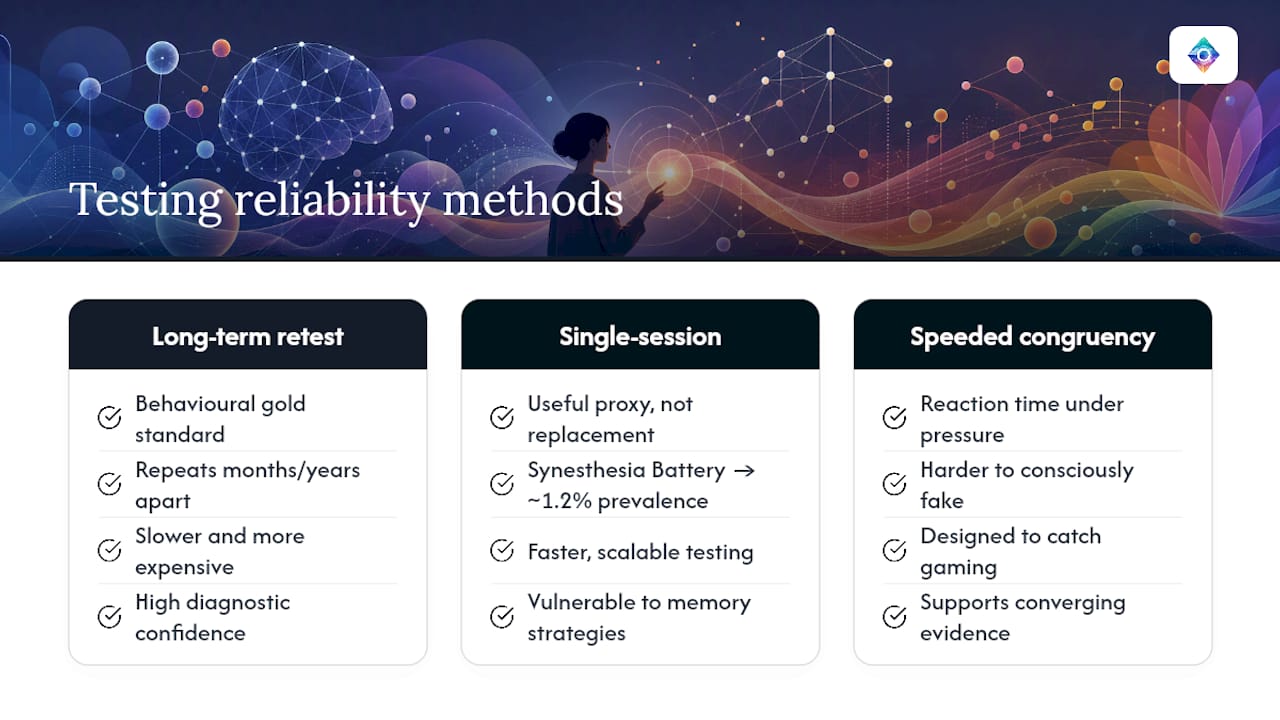
Long-term test–retest, repeating the same consistency test months or years apart, remains the behavioural gold standard for confirming synesthesia. A single online session is a useful proxy, not a replacement, but the evidence for that proxy is stronger than most people assume.
A validation study involving 2,847 participants found that the Synesthesia Battery’s single-session testing produced a prevalence estimate of roughly 1.2% for grapheme-colour synesthesia, a figure that closely matched estimates from studies using long-term retesting. That convergence is the main argument for trusting a well-designed single-session test: it is not simply guessing at scale, it is landing in roughly the same place as slower, more expensive methods.
Some self-reported synesthetes who technically “fail” a standard consistency cutoff still behave like synesthetes on other behavioural measures, which suggests the threshold itself is a useful guide rather than a strict diagnostic line.
That nuance comes from recent work on how self-report and test–retest consistency interact to shape synesthetic behaviour, and it is the single most important caveat in this whole guide. A score just above the typical 1.0 threshold does not mean you have nothing going on.
Online testing has real weaknesses. People can consciously game a colour-matching task if they know the rules in advance, memory strategies can mimic automaticity over a short session, and interface design (how colours are laid out on screen) can subtly nudge choices. The speeded congruency task exists specifically to catch this, because reaction time under pressure is far harder to fake than a leisurely colour pick. The practical takeaway: trust converging evidence over any single number. A low consistency score, a faster reaction time on congruent pairs, and a self-report history that matches all three carry more weight than any one measure alone.
Interpreting results and sensible next steps
What you do after testing depends entirely on where your score landed.
-
If your result was clearly consistent (comfortably under the typical 1.0 threshold, with fast, confident congruency responses), write down three to five concrete examples: specific triggers, the exact sensory response, and roughly how long you have experienced it. This short summary is exactly what a psychologist or GP needs to take the report seriously, rather than a vague “I think I might have synesthesia.”
-
If your result was borderline, do not treat it as a dead end. Repeat the same test after a few weeks rather than immediately, since consistency cutoffs vary by language and measurement approach, and a single ambiguous session is genuinely inconclusive. Testing a second trigger type, such as sound-to-colour if you started with grapheme-colour, often clarifies the picture.
-
If the sensory experience causes real distress or interferes with reading, maths, or concentration, that is worth raising with a GP or educational psychologist regardless of your consistency score. Bring your recorded examples, your test date, and a plain description of when the interference happens.
-
If you want a broader picture before any clinical conversation, a structured self-assessment that covers related neurodivergent traits alongside synesthesia can help you and a clinician see the full context rather than one isolated trait in a vacuum.
Research and reliability behind this guide
The recommendations here rest on peer-reviewed testing methodology, not intuition. The original Synesthesia Battery paper laid out the colour-matching and speeded congruency design still used in most online consistency checks today, including the widely cited sub-1.0 threshold for classifying grapheme-colour synesthesia.
A key figure to hold onto: the large-scale validation study found a 1.2% prevalence estimate for grapheme-colour synesthesia using single-session testing, closely matching long-term retest studies. That convergence is why single-session batteries are considered a legitimate screening tool rather than a gimmick, even though they remain a step below full test–retest confirmation.
A privacy-first self-assessment tool covering 14 domains, including synesthesia, can give plain-language results without requiring an account or data collection. Full detail on how the assessment maps to established research sits on the Omniprism methodology page.
What separates real synesthesia from a strong association
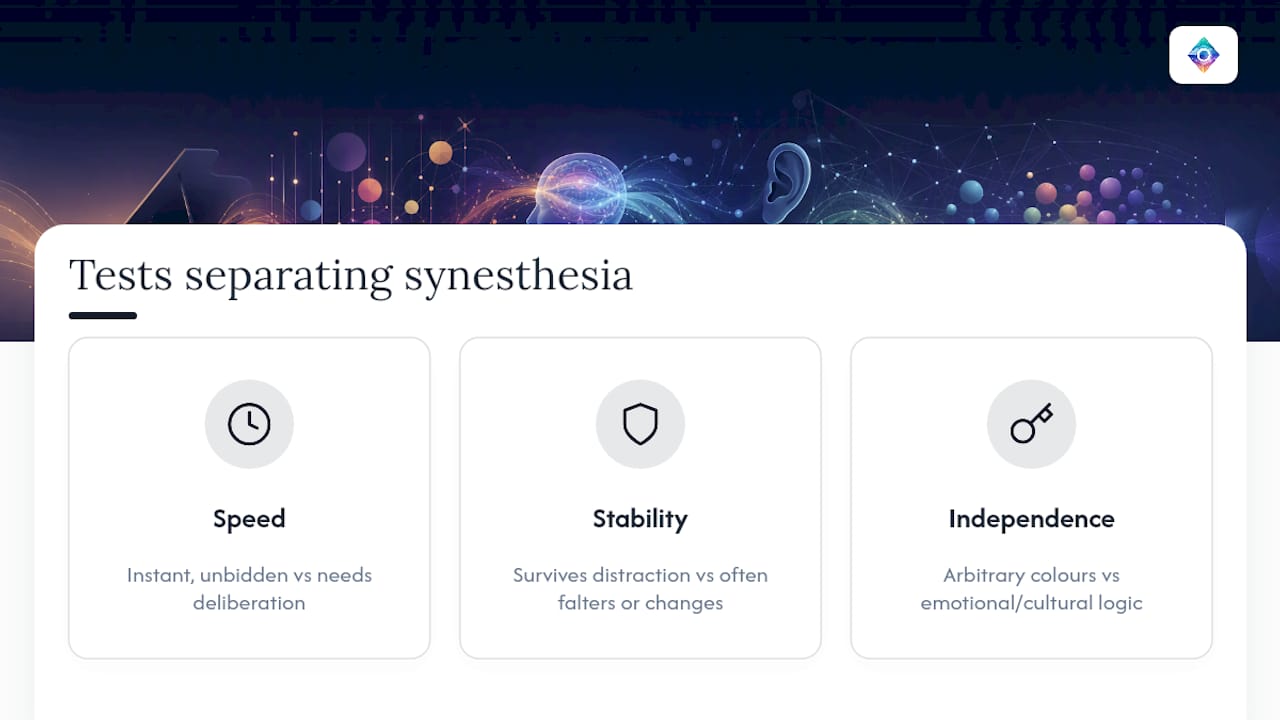
The line between synesthesia and a strong learned association is not about intensity. It is about how the response is generated. A synesthete’s colour for the letter “A” appears the instant they see the letter, unbidden and effortless. Someone with a strong association, say, they always picture red when they think of anger, has to actively summon that link through reasoning or emotional context.
Three tests separate the two reliably. First, speed: genuine synesthetic responses are close to instantaneous and do not require deliberation. Second, stability under distraction: ask yourself the trigger while doing something else mentally demanding; a real synesthetic response tends to survive that interference, while a constructed association often falters or changes. Third, independence from meaning: synesthetic colours are frequently arbitrary and unrelated to the emotional tone of the trigger. A synesthete’s “7” might be a specific shade of teal with no symbolic connection to the number, whereas a strong association usually has some traceable emotional or cultural logic behind it.
Memory effects are the trickiest confound. If you were shown a colour-coded alphabet chart as a child and simply remember which colour matched which letter, you can produce a “consistent” answer without any genuine cross-sensory blending happening. The giveaway is usually onset: true synesthetic associations tend to be reported as present for as long as someone can remember, appearing before any deliberate exposure to colour-letter charts, and they do not change if you are shown a different chart later in life.
How to document and track your experiences over time
A single test session gives you a snapshot. A short log kept over weeks gives you something far more useful: a pattern.
Keep it simple. A basic spreadsheet or notes app entry with four columns works well: the trigger (a specific letter, number, sound, or day), the response (colour, taste, texture, spatial position), the date, and a short note on context (tired, distracted, calm). You do not need to log every single instance, just enough entries across different moods and settings to see whether the pairing holds steady.
Pay particular attention to entries recorded under different conditions. If your “Wednesday is olive green” association shows up whether you are relaxed on a Sunday or rushing through a Monday morning, that consistency across contexts is more convincing than a single well-remembered example. If it shifts depending on your mood or what you saw recently, that points more towards association than synesthesia.
Revisit your log after a month, ideally before rerunning any formal consistency test. Seeing your own past entries without editing them in the moment is one of the more honest ways to check whether you are describing a stable perceptual experience or reconstructing one from memory each time you are asked. This log becomes genuinely valuable if you eventually want to summarise your experience for a clinician, since it gives them dated, specific examples rather than a retrospective impression formed on the spot.
What to do next: professional diagnosis and finding community
If your self-assessment points strongly towards synesthesia, or the experience is affecting daily function, the next reasonable step is a conversation with a GP, educational psychologist, or a specialist familiar with cross-sensory perception. There is no single standardised clinical pathway for a synesthesia diagnosis in most healthcare systems, so bringing your own documented examples and test results genuinely speeds up that conversation. A structured written summary, of the kind produced by Omniprism’s Specialist Briefing, gives a clinician something concrete to work from rather than a verbal description reconstructed under pressure in an appointment.
For parents wondering about a child, synesthesia often appears earlier than adults realise; a child mentioning that numbers “have colours” or that Tuesday “tastes like something” is not necessarily being fanciful, making it helpful to leverage interactive screens for creative classroom learning to better support their unique experience. A guided, age-appropriate assessment can help put language around an experience the child may have assumed everyone shares.
Beyond clinical routes, informal synesthesia communities and online forums offer something a test score cannot: other people who recognise the exact texture of your experience. Comparing notes with other synesthetes often clarifies which details are common to the condition and which are personal quirks, and many people find that validating in itself, entirely separate from any formal diagnosis.
Common misconceptions about synesthesia self-assessment
A few myths distort how people read their own results, so it is worth clearing them up directly.
“Synesthesia means you’re a genius.” The association between synesthesia and unusually high intelligence is largely a media narrative built around a handful of famous cases, not a settled research finding. Plenty of synesthetes have entirely ordinary cognitive profiles; the trait affects perception, not general intellect.
“If I don’t score under the threshold, I don’t have it.” As covered above, the sub-1.0 cutoff is a useful guide, not a hard diagnostic line, and some people just above it still show synesthetic behaviour on other tasks.
“Synesthesia is the same as having a vivid imagination.” Automaticity is the dividing line. A vivid imagination can be summoned and adjusted; a genuine synesthetic response arrives unprompted and does not change on demand.
“Only grapheme-colour synesthesia counts.” It is simply the most studied variant because it is the easiest to test with a colour palette. Sound-to-colour, sequence-space, and other forms are equally real and simply harder to measure with a simple online tool.
“A famous person having synesthesia proves what it feels like for everyone.” Public figures who discuss synesthesia describe their own specific experience, which varies enormously from one synesthete to the next, even within the same type.
Author perspective: making self-assessment accessible
Valerio Cozzi was diagnosed with ADHD at 42, long after his own patterns had shaped decades of decisions he never fully understood. That delay is why Omniprism exists: to give people a clear, private way to recognise their own traits far earlier, without waiting years for a system that moves slowly and asks a lot of someone who is already unsure what they are looking for.
— Valerio Cozzi
Omniprism: a privacy-first self-assessment and Specialist Briefing
The service provides an instant, plain-language profile across multiple domains, including synesthesia, without requiring an account, an email address, or any data collection. That matters if you would rather explore a sensitive personal question privately before deciding whether to mention it to anyone else.
The free self-assessment is the right starting point if you simply want clarity for yourself. If you are considering an assessment for a child or teenager, options built for that age group provide language and questions suited to them rather than borrowing a version written for adults. If you are heading towards a clinical conversation and want your results presented in a format a professional can use quickly, the Specialist Briefing turns your profile into a clinician-ready summary for a one-off fee of €9.99. Start with the free assessment, see where your synesthesia result and the other 13 domains land, then decide from there whether a briefing is worth adding.
Sources
- How ‘diagnostic’ criteria interact to shape synesthetic behavior: The role of self-report and test–retest consistency in synesthesia research
- Synesthesia: a colourful word with a touching sound?
- The MULTISENSE Synaesthesia Toolkit — Clinician
FAQ
Can synesthesia be diagnosed by self-report alone?
Self-report can be sufficient to classify many synesthetes, particularly when paired with a consistency test, but it works best as a screening step rather than a formal diagnosis. Research shows that self-reported synesthetes sometimes fall just outside standard consistency cutoffs while still behaving like synesthetes on other tasks, so self-report and behavioural testing work better together than either alone.
What synesthesia does Billie Eilish have?
Billie Eilish has spoken publicly about experiencing synesthesia, describing sounds and music as having associated colours and visual textures, consistent with sound-to-colour synesthesia. Her account, like any individual’s, describes her own specific experience rather than a template for how sound-colour synesthesia feels for everyone.
Am I neurodivergent if I have synesthesia?
Synesthesia is generally considered a form of neurodivergence, since it reflects a difference in how the brain processes sensory information compared with the majority. It commonly appears alongside other traits, and clinician guidance notes higher rates of autism and anxiety in some synesthete samples, though having synesthesia alone does not automatically indicate any other specific condition.
Is synesthesia linked to high IQ?
No reliable evidence supports a general link between synesthesia and unusually high IQ. The idea persists largely because of well-known individual cases, but synesthetes as a group show the same range of cognitive ability as the general population.
How much does Omniprism’s Specialist Briefing cost?
The Specialist Briefing costs €9.99 as a one-off purchase, available after completing the free self-assessment on the Omniprism site. It turns your results into a plain-language summary designed for sharing with a clinician or psychologist.
Recommended
- Sensory Diets for Adults: Start With a Two Minute Self Assessment
- Interoception in Autism: OT Tools and a Self Check for Caregivers
- Map Neurodivergent Strengths in 14 Domains Without a Diagnosis
Written and edited by Valerio Cozzi, founder of Omniprism. Omniprism began after my own ADHD diagnosis at 42.
This article is educational. It is not medical advice, not a diagnosis, and not a substitute for assessment by a qualified clinician. The Omniprism self-assessment is free, needs no account and no email address, and runs entirely in your browser — your answers are never sent to a server. The optional Specialist Briefing report is a paid add-on.