Research Backed High Sensitivity Self Assessment: Validity and Privacy

A validated self-assessment can reliably screen for high sensory-processing sensitivity, but it cannot diagnose anything. The Highly Sensitive Person Scale and its short forms are well-studied screening tools, not clinical instruments. Take one, read your score against published bands, and speak to a professional only if the trait is causing real distress or interfering with daily life.
TL;DR:
- Validated self-assessments accurately screen for high sensitivity but cannot diagnose any condition or mental disorder.
- Shorter scales like HSP-12 and SPSQ-SF offer quick screening, while the full HSPS provides a more detailed profile for those seeking depth.
- Achieving reliable results depends on answering honestly, using the same scale consistently, and answering in a calm, distraction-free environment.
- About 20 to 30% of adults score high on sensitivity scales, and high scores are linked to traits like deeper processing and stronger emotional responses.
- Self-assessment results should guide whether to seek professional advice, especially if overstimulation affects daily functioning or well-being.
Which validated self-assessments measure sensory-processing sensitivity?
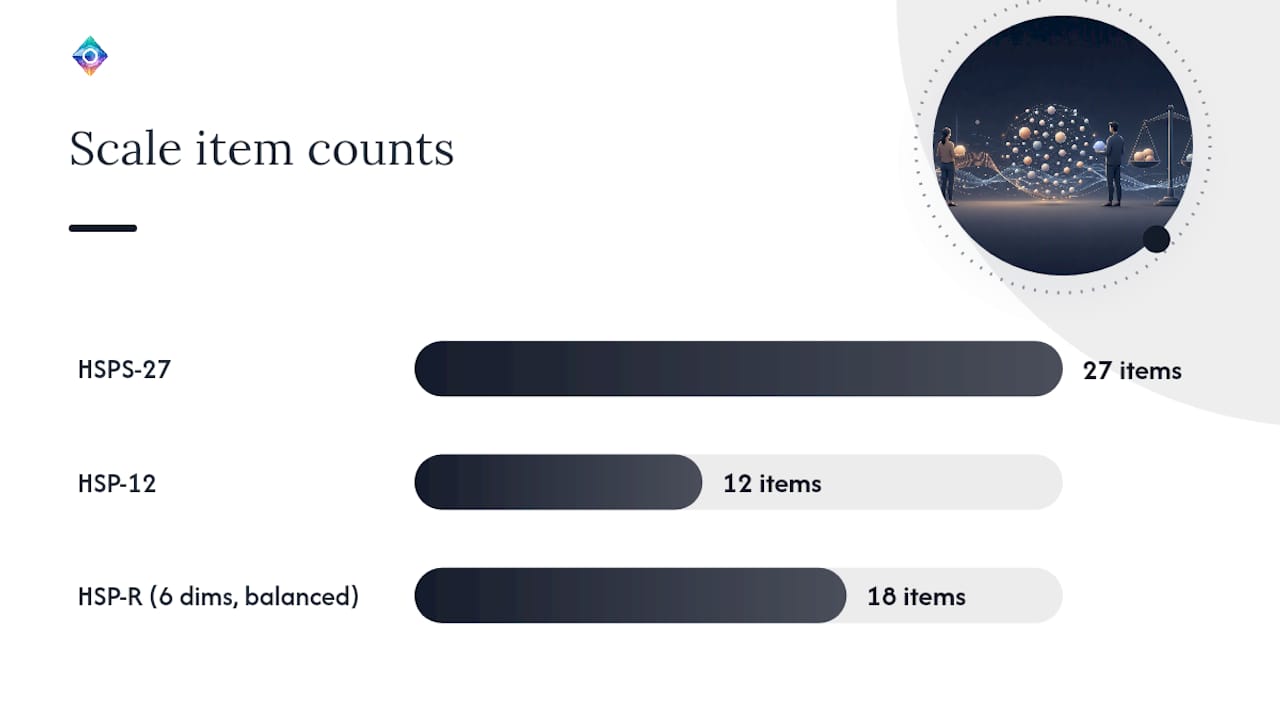
Elaine Aron’s original Highly Sensitive Person Scale (HSPS), developed in 1997, remains the reference point. It runs to 27 items covering emotional reactivity, sensory discomfort, and aesthetic sensitivity, and it takes most people under ten minutes to complete.
Shorter versions exist because 27 questions is a lot to ask of someone doing a quick self-check. The 12-item HSP-12 and similar short forms strip the scale down to its most reliable items while keeping the same broad focus on overstimulation and emotional depth. They sacrifice some nuance for speed, which matters if you want a fast read rather than a detailed profile.
The newer HSP-R (Highly Sensitive Person Scale, Revised) takes a different approach. Rather than compressing the original, it rebuilds sensitivity measurement around six distinct dimensions, including depth of processing, overstimulation, and sensitivity to positive experiences. Earlier scales leaned heavily on negatively framed items (“Are you easily overwhelmed?”), which risked pathologising a trait that also has upsides. The HSP-R corrects that imbalance and, at 18 items, sits between the full HSPS and its short forms in length.
You’ll also see Sensory Processing Sensitivity Questionnaires (SPSQ and SPSQ-SF) used in research and some clinical screening contexts. These take a few minutes and are built for rapid triage rather than detailed profiling.
What you choose depends on what you want:
- HSP-27 for the most detailed, historically validated picture
- HSP-12 or similar short forms for a fast, reasonably reliable check
- HSP-R for a more balanced, multidimensional view that captures strengths alongside sensitivities
- SPSQ-SF for the quickest possible screen
Population studies estimate that roughly 20 to 30% of adults fall into a distinct high-sensitivity group, so whichever scale you pick, a high score puts you in recognisable company rather than a statistical outlier.
How do you complete a high-sensitivity self-assessment reliably?
Getting a trustworthy result depends less on which scale you choose and more on how carefully you take it. Here’s the process that keeps results interpretable:
- Pick one validated scale and stick with it. Mixing items from different questionnaires wrecks the scoring logic each one was built on.
- Find a quiet moment. Sensory scales ask about reactions to stimulation, so answering mid-argument or with the television blaring skews your responses.
- Anchor your answers to the last few weeks, not an unusually stressful day or an idealised version of yourself.
- Answer every item honestly, including ones that feel unflattering. If an item genuinely doesn’t apply, most scales allow a neutral midpoint rather than a skip.
- Use the scale’s own rating anchors consistently. Most HSP measures use a 1-to-7 Likert scale (“not at all” to “extremely”). Decide what “extremely” means to you early and apply that standard throughout, rather than drifting as you go.
- Calculate your score using the instrument’s own method. The HSPS uses a mean across items; some short forms use a sum. Using the wrong calculation method invalidates the comparison to published norms.
- Compare your score to published bands for that specific scale rather than a generic cut-off you’ve seen elsewhere.
Consistency in the process matters more than most people expect. Measurement guidance from scale developers is explicit that inconsistent administration, different settings, different reference periods, different anchor interpretations, undermines comparability between attempts. If you retake a scale months later to track change, replicate the conditions as closely as you can.
Pro Tip: If your score sits right on the boundary between “medium” and “high,” retake the scale a week later under the same conditions. A single sitting can be skewed by a bad night’s sleep or a stressful morning, and one score alone shouldn’t carry too much weight.
Once you have a number, the real work starts: deciding what, if anything, to change. That might mean adjusting your environment, building in recovery time after socially demanding days, or simply naming a pattern you’d previously written off as being “too much.” If overstimulation is a daily problem rather than an occasional one, that’s the point to consider professional input rather than another self-check.
What do low, medium and high sensitivity scores actually mean?
Sensitivity research increasingly treats sensitivity as three groups rather than a simple sensitive/not-sensitive split. Latent-class analysis across multiple samples consistently finds low, medium, and high-sensitivity clusters, with the high-sensitivity group making up around 30% of the adult population, the medium group forming the largest middle band, and the low-sensitivity group at the other end.
Scoring in the high band tends to correlate with several recognisable traits:
- Deeper cognitive processing of information before acting on it
- Stronger empathic response to others’ emotional states
- Heightened awareness of subtle sensory detail, such as changes in lighting, sound, or texture
- Faster and more intense emotional reactions, both positive and negative
That same heightened processing has a cost. Research on sensory-processing sensitivity finds it’s associated with higher rates of burnout, anxiety, depression, and physical stress complaints when someone is in an unsupportive or overstimulating environment. Critically, the same research finds the reverse holds too: highly sensitive people show greater benefit from supportive, low-stress environments than less sensitive people do. Psychologists call this differential susceptibility, and it’s arguably the most useful concept in the whole field. Sensitivity isn’t a fixed liability; it’s a trait that amplifies whatever context you’re in, good or bad.
None of this makes high sensitivity a disorder. It’s a temperament trait, sitting within normal personality variation, not a diagnosis in any recognised clinical framework. It overlaps in places with autism (both can involve sensory intensity and a need for predictability) and with ADHD (both can involve emotional intensity and being easily overwhelmed), but the underlying patterns differ. High sensitivity doesn’t typically involve autism’s differences in social communication or ADHD’s attention-regulation profile, which is exactly the kind of distinction a broader, multidomain assessment is built to tease apart.
How valid are these self-assessments, and what are their limits?
The psychometrics behind the core HSP scales hold up well for a screening tool. A synthesis of HSPS research spanning two decades reports aggregated internal consistency around .87, a strong figure for a self-report personality measure, while cautioning that individual subscales are less reliable than the total score.
Neurobiological evidence is catching up too. Replicated fMRI studies find that higher HSP scores correlate with greater activation in brain regions tied to awareness, empathy, and sensory integration, including the insula and cingulate cortex. A more recent EEG study found high-sensitivity groups showed higher beta and gamma power during rest, consistent with increased background information processing.
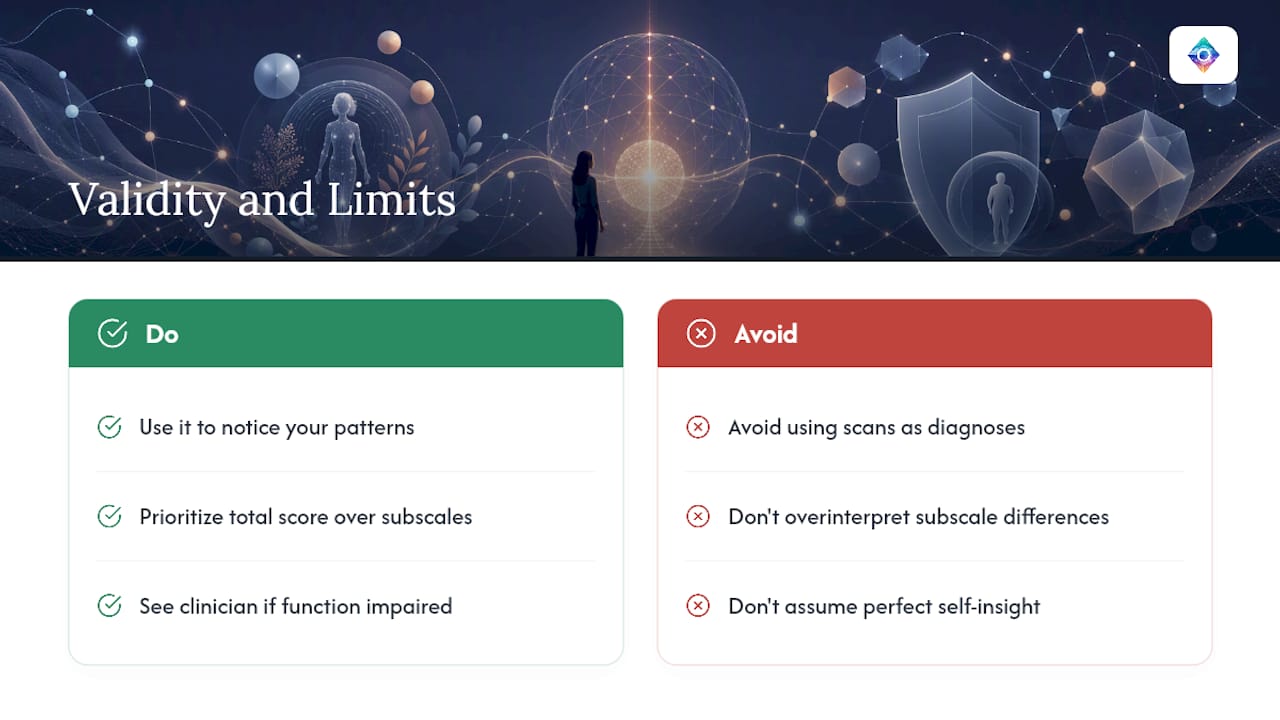
None of that amounts to a brain scan that can diagnose sensitivity. These are group-level research findings, not individual diagnostic markers, and no clinic currently offers an EEG or fMRI test for sensory-processing sensitivity. Self-report also carries the usual caveats: people under or overestimate their own reactivity, and cultural norms shape how comfortable someone is admitting to being easily overwhelmed. Treat a self-assessment as a structured way to notice your own patterns, and treat a clinician as the right next step if those patterns are causing real functional difficulty.
An honest note from Omniprism’s founder
I’m Valerio Cozzi, founder of Omniprism, and I was diagnosed with ADHD at 42. That late diagnosis is exactly why Omniprism exists: to give people a clear, private picture of their own traits without waiting years for someone else to name them. High sensitivity is one of several areas Omniprism maps, and the goal is always the same, insight to bring into a conversation with a clinician, not a label to replace one.
— Valerio Cozzi
Where Omniprism fits if you want a fuller picture
A single HSP scale tells you one thing well: where you sit on sensory-processing sensitivity. Omniprism is built for readers who want that answered alongside how it interacts with everything else, ADHD traits, autism traits, sensory processing, masking, and ten other domains, because sensitivity rarely operates in isolation. Omniprism’s self-assessment delivers an instant, plain-language profile across 14 domains with no email, account, or data collection required, so you get a private result rather than another form sitting in someone’s database.
If you’re heading into a conversation with a GP, therapist, or psychologist and want something more structured than a printed scale, Omniprism’s paid Specialist Briefing turns your results into a clinician-ready summary available for a one-time fee. For parents wondering whether a child’s sensory reactions warrant a closer look, Omniprism also offers guided assessments for children and young people. Start with the free assessment, and decide from there whether a Specialist Briefing is worth the small cost for your next appointment.
Sources
- The functional highly sensitive brain: a review of the brain circuits underlying sensory processing sensitivity and related disorders - PMC
- Neurophysiological signatures of sensory-processing sensitivity — Frontiers in Neuroscience
- Exploring sensory processing sensitivity: relationships with mental and somatic health and evidence for differential susceptibility
- Dandelions, tulips and orchids: evidence for the existence of low-sensitive, medium-sensitive and high-sensitive individuals | Translational Psychiatry
- Psychometric synthesis of the Highly Sensitive Person Scale
- Evolution of the concept of sensitivity and its measurement: The Highly Sensitive Person Scale — Revised (HSP‑R)
This article is general information, not a substitute for advice from a qualified doctor. Consult a qualified healthcare professional about your own circumstances before acting on anything here.
FAQ
What are the common signs of a highly sensitive person?
Common signs include feeling overwhelmed by bright lights, strong smells, or loud noises, needing more downtime after socially demanding events, and reacting strongly to others’ emotions. People often also report a rich inner life and strong reactions to art, music, or beauty. These traits cluster around the four dimensions most HSP scales measure: emotional reactivity, sensory discomfort, aesthetic sensitivity, and overstimulation.
Can I test if I’m highly sensitive with a self-test?
Yes. Validated tools like the HSP Scale and its short forms give a reliable screening indication of where you sit on sensory-processing sensitivity. A high score is a strong signal worth taking seriously, but it’s a screening result, not a clinical diagnosis.
Is HSP a personality disorder?
No. High sensitivity, or sensory-processing sensitivity, is a temperament trait that sits within normal personality variation, not a disorder listed in any recognised diagnostic manual. It’s better understood as a trait that increases responsiveness to both positive and negative environments, sometimes called differential susceptibility.
What are the symptoms of a highly sensitive nervous system?
A highly sensitive nervous system typically shows up as quick physical reactions to stimulation, easy overstimulation in busy or loud environments, and needing longer to recover from sensory or emotional intensity. EEG research has found high-sensitivity groups show distinct patterns of brain activity at rest, though this remains a research finding rather than a diagnostic test.
How is high sensitivity different from autism?
Both can involve sensory intensity, but the underlying patterns differ: autism centres on differences in social communication and a strong preference for routine, while high sensitivity centres on emotional and sensory reactivity without those social-communication differences. If you’re unsure which pattern fits, a broader multidomain assessment such as Omniprism’s self-assessment can help clarify the overlap before you speak to a clinician.
Recommended
- Sensory Diets for Adults: Start With a Two Minute Self Assessment
- Interoception in Autism: OT Tools and a Self Check for Caregivers
- Alexithymia and autism: why the two get confused so often
Written and edited by Valerio Cozzi, founder of Omniprism. Omniprism began after my own ADHD diagnosis at 42.
This article is educational. It is not medical advice, not a diagnosis, and not a substitute for assessment by a qualified clinician. The Omniprism self-assessment is free, needs no account and no email address, and runs entirely in your browser — your answers are never sent to a server. The optional Specialist Briefing report is a paid add-on.