OCD Traits Self-Assessment: What a Checklist Can Show
An OCD traits self-assessment can show you whether the pattern of unwanted thoughts and repeated actions you notice matches how OCD is described, and how much time and distress it takes up. It cannot diagnose OCD, because only a qualified clinician can do that, but a clear written profile gives you something specific to take into that conversation.
This guide covers the traits clinicians look for, the questions to ask yourself, what a result means, and when to book an assessment. Parents and educators will find a section on children and teenagers too.
Key Takeaways
- OCD involves obsessions (intrusive, unwanted thoughts, urges or images), compulsions (repeated physical or mental acts), or both.
- Everyone double-checks things sometimes. What separates OCD traits from OCD is time taken, distress and interference with daily life.
- Three questions used by clinicians cover intrusive thoughts, driven repetition and the effect on your life. You can answer them at home.
- A self-assessment organises what you notice. A diagnosis needs a clinician, and a GP is the usual first step in the UK.
- Children’s OCD traits can look different at home and at school, so comparing observations across settings helps.
What are common OCD traits?
The US National Institute of Mental Health (NIMH) explains that OCD may involve obsessions, compulsions, or both. Obsessions are intrusive and unwanted thoughts, urges or images. Compulsions are repetitive behaviours, often performed in response to them.
Common obsessions listed by the same source include fears of germs, harm, losing control, taboo thoughts and a need for symmetry. Compulsions include cleaning, ordering, checking, counting, and mental acts such as silently praying or repeating words. Mental rituals are easy to miss because nobody can see them, so a checklist that only lists hand washing and locked doors will understate what some people experience.
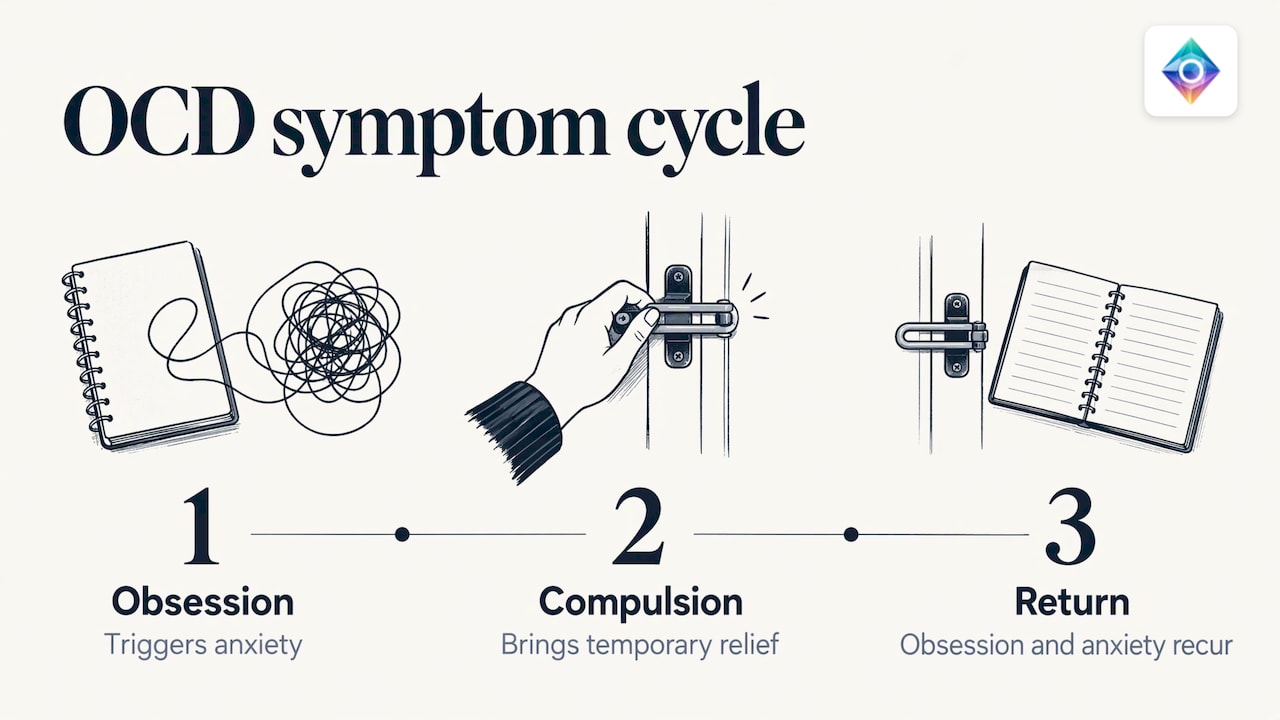
The NHS describes a cycle: an obsession causes anxiety, a compulsion brings temporary relief, and then the obsession and anxiety return. If you recognise that loop in your own day, it is the most useful single observation to write down.
The NHS also states that unwanted violent or sexual thoughts can be distressing, but having them does not mean you will act on them. This matters when you answer a checklist honestly: an intrusive thought you find horrifying is a trait to describe to a clinician, not evidence about your character.
The Canadian Centre for Addiction and Mental Health (CAMH) adds that OCD is sometimes called the “doubting disease”, and that what makes a thought an obsession is its quality, meaning intrusive, unwanted and hard to suppress, rather than its content. A mundane doubt such as whether you locked the door can be as much an obsession as a disturbing image.
How do I complete an OCD traits self-assessment?
Work through these steps in one sitting, with a notepad, thinking about the last month.
- Ask about intrusive thoughts. CAMH’s screening guidance suggests asking whether unwanted thoughts, images or impulses repeatedly intrude into your mind.
- Ask about driven repetition. Do you feel compelled to repeat acts such as washing, checking, rearranging, or repeating something mentally?
- Ask about cost. Does this waste significant time or cause problems at school, at work or in relationships? CAMH notes that this third question helps establish whether symptoms reach the DSM-5 severity threshold. The DSM-5 is the American Psychiatric Association’s diagnostic manual, which UK clinicians also use alongside the World Health Organization’s ICD.
- Estimate the time. Add up a typical day, including mental rituals and the time spent avoiding triggers. NIMH names more than an hour a day as one sign that may characterise OCD.
- Note the NICE screening questions. NICE guideline CG31 suggests clinicians ask whether you wash or clean a lot, check things a lot, have a troubling thought you cannot get rid of, take a long time to finish daily activities, or are upset by mess or lack of order, and whether these problems trouble you.
- Write examples, not labels. “I re-read each email five times and replay conversations for an hour” tells a clinician far more than “I’m a perfectionist”.
Pro Tip: Record how long each ritual takes and what happens if you resist it. Those two details are the ones clinicians most need and the ones people most often cannot remember when asked cold.
Our free adult self-assessment includes OCD traits among 14 areas and returns a plain-language profile instantly, with no email, account or data collection.
What can an OCD traits checklist tell you?
A checklist can tell you which traits you recognise, how strongly, and whether the pattern is worth raising with a professional. NIMH cautions that everyone sometimes rethinks or double-checks things, and that not all repeated thoughts are obsessions or all habits compulsions.
The line between a trait and a disorder sits in the DSM-5’s second criterion: obsessions or compulsions must be time-consuming (for example more than an hour a day) or cause clinically significant distress or impairment. Further criteria require that clinicians rule out substances, medical conditions and other mental disorders. A checklist cannot do that work, which is why its output is a starting point.
Stanford Medicine makes the same point: OCD-like symptoms occur in many people without warranting a diagnosis, and clinical significance depends on distress or interference with social or role functioning.
Where severity scales fit
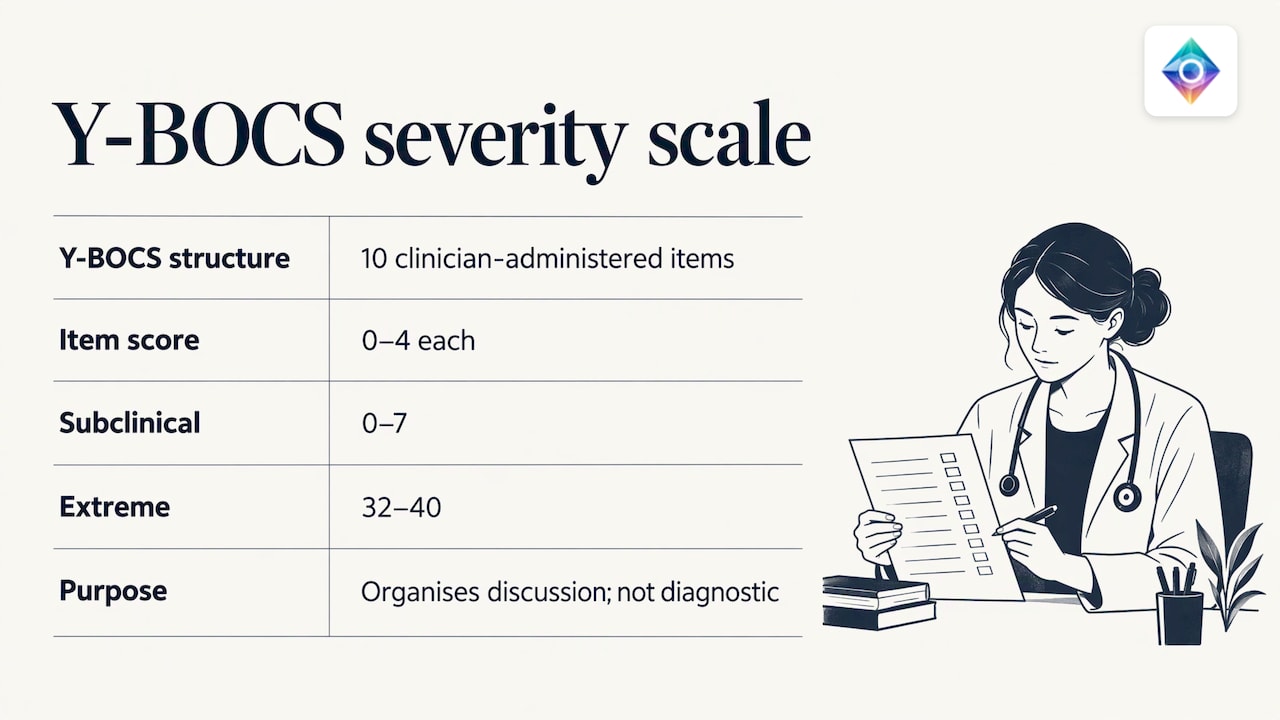
The Yale-Brown Obsessive Compulsive Scale (Y-BOCS) is a 10-item scale administered by a clinician, with each item scored 0 to 4. Stanford Medicine lists severity bands from 0 to 7 (subclinical) up to 32 to 40 (extreme), and says the person first completes a symptom checklist that the clinician reviews to agree treatment targets. Such a scale organises the discussion of symptoms and goals but is not itself diagnostic, a distinction also explored in how assessment scales are used.
For a wider view of what online tools can and cannot say, our guide to self-assessment versus diagnosis walks through it.
When should I seek a professional OCD assessment?
NIMH advises considering an assessment when symptoms are hard to control, take more than an hour a day, or cause significant problems in daily life. A health care provider can ask about your health history and refer you to a mental health professional for further evaluation. In the UK, your GP is the usual route in. If you feel unable to cope or are thinking of harming yourself, contact your GP urgently, call NHS 111, or call 999 in an emergency.
A 2023 review in the peer-reviewed literature describes evidence-based OCD assessment as potentially combining structured clinician interviews, parent and child reports, and adult self-report. The same review says assessment should consider symptom severity alongside insight, family accommodation and impairment. Your own written account is therefore one genuine component of the process, not a stand-in for the rest.
Guidance is also moving towards earlier recognition. NICE’s September 2026 draft guideline recommends considering assessment for OCD in people with depression, anxiety, autism or ADHD, and proposes personalised “matched care” in place of a fixed stepped pathway. It is a draft, so check NICE’s site for the final version.
If you decide to go ahead, the Specialist Briefing turns your results into a summary written for clinicians. It costs €20, one-off, and is designed to make the first appointment easier to prepare for.
How can parents and teachers spot OCD traits in children?
Children often hide rituals, and what you see depends on where you look. The American Academy of Family Physicians’ summary of child psychiatry recommendations notes that childhood symptoms may wax and wane, appear more in one setting than another, and be hidden from others. It recommends a full evaluation when screening suggests possible symptoms.
A 2022 Canadian study found agreement between school staff and parents was less consistent for OCD-specific symptoms, and suggested that sharing concerns about impairing symptoms may support earlier recognition. In practice, a parent and a teacher each noting what they see, and when, builds a fuller picture than either alone.
Our children and young people assessment is free and guided, with versions for ages 7 to 10 and ages 11 to 13. The Youth Briefing costs €20, one-off, and summarises results for the clinician.
How do OCD traits overlap with ADHD, autism and OCPD?
Repetitive behaviours, rigid routines and intense worry appear across several neurodivergent profiles, which is one reason a broad profile is useful before an appointment. The NICE draft mentioned above specifically links OCD assessment with autism and ADHD. Our articles on ADHD versus OCD and OCD versus OCPD explain how the overlaps look in daily life and what to raise with a clinician.
Our view on self-assessing OCD traits
We designed Omniprism around one idea: you should be able to describe your own patterns in plain language before anyone asks you to.
OCD traits rarely show up alone. Our free assessment covers 14 areas, including ADHD, autism, dyslexia, masking, sensory processing and OCD traits, so the profile shows how they sit together. It returns results instantly, with no email, no account and no data collection, so the only person who sees your answers is you.
I was diagnosed with ADHD at 42, and I know how much a clear starting point matters when you are preparing to speak to a professional.
For those who want to take results into a consultation, the Specialist Briefing summarises them in a format built for clinicians. The assessment gives you the language, and the clinician makes the diagnosis.
Valerio Cozzi
Start with the free profile
If you want to see where OCD traits sit among your other patterns, the Free Adult Self-Assessment takes you to an instant profile at no cost. Parents can begin with the children and young people assessment. Our wider neurodivergence self-assessment guide explains what to expect from the results.
FAQ
Can an online OCD checklist diagnose me?
No. Diagnosis requires a clinician to apply the DSM-5 or ICD criteria, including ruling out other conditions and substances. A checklist shows which traits you recognise and how much they affect you, which is useful evidence to bring to a GP.
What is the difference between OCD traits and OCD?
Traits are tendencies such as double-checking or liking order. OCD involves obsessions or compulsions that take more than an hour a day or cause significant distress or impairment, according to NIMH. A clinician judges where you sit.
Are intrusive violent or sexual thoughts a sign I am dangerous?
The NHS states that such thoughts can be very distressing but do not mean you will act on them. Describe them to your GP or a mental health professional, who will have heard them before.
Is a mental ritual such as counting or praying silently a compulsion?
It can be. NIMH lists silent praying, repeating words and counting among compulsions when they are performed in response to an obsession to ease distress. Note them on your checklist even though nobody else can see them.
Sources
- NIMH: Obsessive-Compulsive Disorder
- NHS: Obsessive compulsive disorder (OCD) symptoms
- CAMH: OCD screening and assessment
- NICE guideline CG31: Recommendations
- NICE: Draft guidance on identifying OCD and body dysmorphic disorder
- DSM-5 OCD criteria
- Stanford Medicine: OCD diagnosis
- PubMed: Clinical considerations for an evidence-based assessment of OCD (2023)
- School and parent perspectives on symptomatology (2022)
- AAFP: AACAP recommendations on diagnosis and treatment of OCD
Recommended
- OCD assessment cost: €9.99 for a clinician ready Specialist Briefing
- OCD vs OCPD: How to Tell the Difference
- ADHD vs. OCD: Key Differences, Overlap, and Next Steps
- Self Assessment vs Diagnosis: ADHD and Autism Quizzes Aren’t Diagnoses
Written and edited by Valerio Cozzi, founder of Omniprism. Omniprism began after my own ADHD diagnosis at 42.
This article is educational. It is not medical advice, not a diagnosis, and not a substitute for assessment by a qualified clinician. The Omniprism self-assessment is free, needs no account and no email address, and runs entirely in your browser — your answers are never sent to a server. The optional Specialist Briefing report is a paid add-on.