OCD assessment cost: €9.99 for a clinician ready Specialist Briefing

An online OCD-traits screen costs nothing, and it produces an instant plain-language result. The only fee in this process is the optional Specialist Briefing, a one-off digital report priced at €9.99, built to summarise your results for a GP or therapist rather than to diagnose you.
TL;DR:
- The online OCD-traits screen is free and provides an instant plain-language result, with the optional Specialist Briefing costing €9.99 to summarize results for clinicians.
- The Specialist Briefing offers a clinician-focused note, a user-friendly profile, domain scores, an exportable PDF, and prompts for discussion, but it is not a clinical assessment or diagnosis.
- Online scores indicate the severity of traits based on Y-BOCS bands, but they do not replace detailed face-to-face assessments or open-ended clinical questioning.
- Bringing a summarized report to appointments speeds up clinical conversations by highlighting severity bands and observable behaviors, especially in time-pressed consultations.
- An online screen does not cover assessment costs or treatment, which involve separate, often higher, fees in private settings or wait times in public systems; insurance rarely covers digital reports.
What does the paid Specialist Briefing report cost, and what does that price cover?
The Specialist Briefing costs €9.99 as a one-off purchase, not a subscription and not a recurring fee. That price sits well below what most people assume a written clinical summary should cost, mainly because it isn’t replacing an assessment appointment. It’s a document that organises what you’ve already told the free screen into something a clinician can read in two minutes instead of twenty.
What you actually get for that fee breaks down into a few concrete pieces:
- A clinician-facing summary written in the kind of language a GP or psychologist expects to see on a referral note.
- A plain-language profile explaining your results in terms you’d use talking to a friend.
- Domain scores across all 14 areas Omniprism screens for, including your OCD-traits results alongside things like sensory processing and masking.
- An exportable PDF you can print, email, or hand over at an appointment.
- Suggested prompts and questions to raise with a clinician, based on where your scores landed.
The fee covers the operational cost of turning raw self-report answers into a structured, editable, privacy-preserving document.
None of this is a psychiatric diagnostic assessment fee. A private OCD evaluation with a psychiatrist or clinical psychologist runs to a separate, considerably higher cost structure involving consultation time, professional indemnity, and clinical liability. The Specialist Briefing is a conversation starter you bring to that appointment, not a substitute for it.
How are OCD traits screened online, and what do the scores actually mean?
Online screening works as triage, not diagnosis. Structured questions ask directly about things like excessive cleaning, checking behaviours, or persistent unwanted thoughts, and a positive response to those direct screening questions is what flags the need for a fuller clinical look, not a confirmed diagnosis on its own.
Y-BOCS severity bands, the standard clinical reference clinicians use to interpret symptom severity: 8–15 is mild, 16–23 moderate, 24–31 severe, and 32–40 extremely severe.
If your online result places you somewhere in the moderate-to-severe range, that’s useful information, but it isn’t the same measurement instrument a clinician would use in a face-to-face assessment. Some NHS services and clinics already use short validated tools such as the Obsessive Compulsive Inventory as part of their own assessment pathway, so the concept of a brief structured screen feeding into a longer clinical process isn’t new.
A few things worth holding in mind about what your score can and can’t tell you:
- It reflects self-reported behaviour over a recent period, not an observed clinical interview.
- It can under-report obsessions you haven’t fully articulated to yourself yet, which is why structured open-ended questioning during a real assessment often surfaces more.
- It’s a starting point for a conversation, not the final word on severity.
How to bring your results into a clinical appointment
Turning a ten-minute online screen into something useful at the GP’s desk takes three steps, and most people skip the middle one.
- Complete the free screen and note your domain scores. Pay particular attention to how your OCD-traits result compares with the general severity bands above, and jot down which specific behaviours triggered a positive response.
- Decide whether the Specialist Briefing is worth the one-off fee for your situation. If you’re heading into an appointment where time is short, a formatted PDF summarising 14 domains saves the clinician from reconstructing your history from scratch.
- Bring the report and lead with the clinician-facing summary. Point specifically at the suggested prompts section rather than making the clinician read the whole document cold.
What clinicians tend to find genuinely useful in a report like this is severity banding paired with observable behaviours, because it lets them prioritise the first few minutes of a consultation instead of spending them on intake questions. RCPsych’s own assessment modules stress structured approaches specifically because open, unstructured conversation tends to under-elicit obsessions people find embarrassing to raise unprompted.
Pro Tip: Highlight your two or three highest domain scores on the printed report before your appointment. Clinicians working to tight slots respond better to a marked page than a document they have to read start to finish.
Why privacy matters more here than for most online forms
Mental health responses count as special category data under UK GDPR, which means any service collecting them needs both a lawful basis and a specific Article 9 condition before processing a single answer. That’s a materially higher bar than a newsletter signup or a shopping cart.
Organisations handling this kind of data at scale are also expected to run a Data Protection Impact Assessment, a formal risk review required whenever processing is likely to be high risk to individuals. Before trusting any online OCD screen with honest answers, check for a few concrete signals:
- Does it ask for an email address or account creation before showing results, or does it show your profile instantly?
- Does the privacy notice state how long your answers are retained, and whether they’re deleted after the session?
- Is there a clear route to contact the provider if you have questions about how your data was handled?
Transparent consent and a minimal-data approach aren’t cosmetic details. They’re what genuinely builds trust with people answering sensitive questions about intrusive thoughts they may never have said out loud before.
When should you see a clinician despite an online screen or report?
An online result, however detailed, should never be the last stop if certain signs show up. Some situations call for a booked appointment now, not next month.
- OCD-related rituals or thoughts are stopping you working, studying, or leaving the house for meaningful periods.
- Your result sits in the severe or extremely severe Y-BOCS band.
- You’re experiencing any thoughts of self-harm or feel you’re a risk to yourself.
- Symptoms have worsened noticeably over a short period rather than staying stable.
Early recognition genuinely changes outcomes here. NICE’s own evidence review found that individual CBT and cognitive therapy are both clinically effective and cost-effective treatments for OCD, so a screen that gets you into a clinician’s office sooner is doing real work, even if it’s just a triage step. The NHS is clear that screening tools identify a need for professional evaluation rather than replacing it, and that framing holds whether the tool is free or paid. If any of the above applies to you, bring your Specialist Briefing to that appointment rather than starting the conversation from zero.
Average time duration of an OCD assessment session
A free online OCD-traits screen typically takes somewhere between five and fifteen minutes to complete, depending on how many follow-up questions your initial answers trigger. That’s a fraction of what a full clinical assessment involves.
A formal clinical assessment for OCD, by contrast, usually runs considerably longer. Clinicians conducting a structured, open-ended interview need enough time to explore obsessions you might not volunteer immediately, particularly ones that feel embarrassing or hard to describe. For children specifically, NICE guidance notes that caregiver reports are often essential because young people tend to display compulsions as observable behaviour rather than describing the underlying obsessive thought, which extends how long a thorough first consultation needs to run.
This is one reason a Specialist Briefing can genuinely shorten a clinical appointment rather than lengthen it. Handing a clinician a structured summary with domain scores and suggested prompts means less time spent on intake and more time on the parts of the conversation that actually need a professional in the room. If your GP appointment is booked for a standard slot, arriving with your key scores already flagged, as covered in the appointment steps above, makes that time count for more.
Potential additional costs beyond the initial report
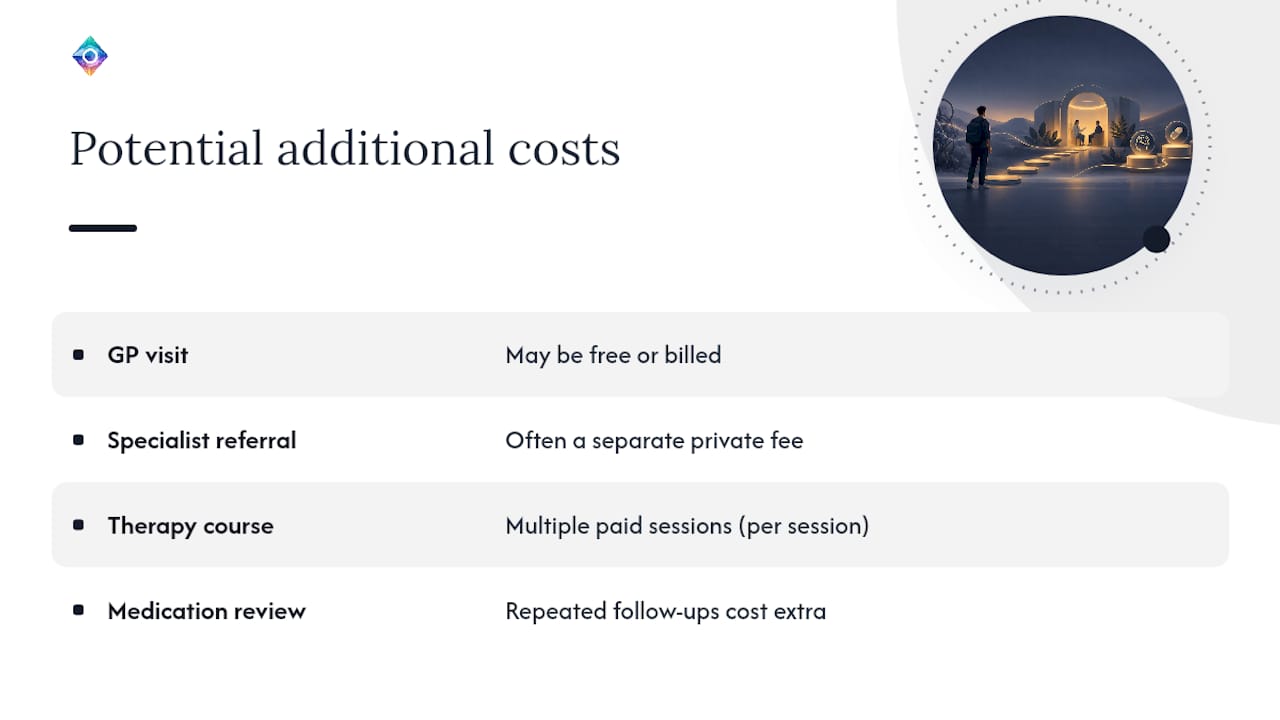
The €9.99 Specialist Briefing fee is a one-off, but it sits at the start of a pathway that can involve further costs depending on what your clinician recommends next. Worth knowing these upfront rather than being surprised later.
A GP consultation itself may be free at the point of use depending on where you live and how your local healthcare system is funded, but a referral to a specialist psychiatrist or psychologist often carries separate fees in private healthcare systems, and even public systems can involve waiting times that may push some people toward paid options. NICE’s own economic modelling for OCD interventions factors in GP visits, psychiatrist contacts, and treatment costs as genuinely distinct cost categories, which underlines that a one-off digital report and an ongoing course of clinical treatment are priced on entirely different scales.
If a clinician recommends therapy, individual CBT or cognitive therapy sessions typically run as a course of multiple appointments rather than a single visit, and each one carries its own fee unless covered by insurance or a public health service. Follow-up consultations to review medication, if prescribed, add further costs over time. None of this is included in, or implied by, the Specialist Briefing price. Budgeting for a report that costs under €10 doesn’t mean the entire pathway from screen to treatment stays that cheap.
Comparing online and in-person OCD assessment costs
The gap between these two routes is stark, and it explains why so many people start online before ever booking an in-person slot.
An online OCD-traits screen through Omniprism costs nothing, and the optional Specialist Briefing adds a fixed €9.99 if you want a document to take further. There’s no travel, no waiting list, and no consultation fee attached to getting that first read on where you stand.
An in-person clinical assessment, by comparison, involves a clinician’s time, which is priced very differently depending on whether you’re seeing an NHS-equivalent public service or paying privately. Private psychiatric assessments in particular tend to be priced per hour of clinical time, and that figure alone frequently exceeds the cost of ten Specialist Briefing reports. Public system routes may carry no direct fee but come with waiting times that can stretch to months in some areas.
The honest comparison isn’t really “which is cheaper” since they’re not doing the same job. An online screen and its optional report are a low-cost way to arrive at that in-person assessment better prepared, not a cheaper way to skip it. If you’re trying to work out whether your experience looks more like OCD or a related but distinct pattern, it’s worth reading about OCD versus OCPD before you commit to either route, since the two get confused more often than you’d expect.
Does insurance cover OCD assessment and treatment costs?
Insurance coverage for OCD assessment varies enormously depending on your policy, your country, and whether you’re looking at diagnostic assessment or ongoing treatment. There’s no single answer that applies universally here.
Private health insurance policies that include mental health cover will often reimburse psychiatric or psychological assessment appointments, though many require a GP referral first and some apply annual session limits or excess payments. Employer-provided health schemes sometimes include a fixed number of therapy sessions per year as a standard benefit, which can materially reduce out-of-pocket costs once a diagnosis or referral is in place. Public healthcare systems in many countries cover assessment and treatment costs directly, though typically with waiting times attached rather than an upfront bill.
What insurance essentially never covers is a one-off digital self-assessment report like the Specialist Briefing, since these products sit outside formal clinical care and aren’t billed through medical insurance codes. The Briefing isn’t designed to be claimed against a policy. It’s designed to make whatever comes next, whether that’s an insurance-covered assessment or an NHS referral, faster to get through. Checking your policy’s specific terms around mental health assessment before booking anything privately will save you from an unwelcome bill later.
A founder’s note on why this exists
I was diagnosed with ADHD at 42, long after I’d have benefited from knowing earlier. That’s part of why Omniprism exists as a privacy-first tool with no email or account required. It gives instant plain-language profiles across 14 areas, including OCD traits, with guided versions for children and teens too. The Specialist Briefing came from a simple observation: people arriving at appointments with a clear, organised summary tend to get more out of that time than people starting from scratch.
— Valerio Cozzi
Get your free screen and, if you want it, the Specialist Briefing
This process costs nothing until you decide you want a document to take further. There’s no email required, no account to create, and no ongoing subscription buried in the small print, just an instant profile across multiple domains including OCD traits, delivered the moment you finish answering.
If your results leave you wanting something more structured to bring to a GP or therapist, the Specialist Briefing turns your answers into a clinician-facing PDF for a one-off €9.99, complete with suggested prompts so the appointment doesn’t start from zero. Parents and guardians can also run guided assessments for children and young people rather than trying to interpret an adult-style questionnaire on their child’s behalf; for practical family strategies on managing behaviour and screen usage, see Battling Screen Time Overload? Discover a Healthy. Start with the free self-assessment today, and decide afterwards whether the paid report earns its place in your next appointment.
Sources
- Obsessive-compulsive disorder: diagnosis and assessment — NICE CKS
- OCD and BDD assessment and management — NICE guidance evidence
- A guide to lawful basis: special category data — ICO
FAQ
Is the Specialist Briefing a diagnosis?
No. It’s a clinician-facing summary of your self-reported screening results, meant to support a conversation with a GP or therapist, not replace a formal clinical assessment.
How much does the Specialist Briefing cost?
The Specialist Briefing is a one-off €9.99 digital report, with no subscription or recurring charge attached.
Does Omniprism collect my email or require an account?
No. Omniprism’s free assessment delivers instant results without requiring an email address or account creation, which keeps your sensitive answers out of a stored profile you didn’t ask for.
Can I use my results or report for school purposes?
The plain-language profile can help explain observable patterns to a school, though for formal educational support you’ll typically still need a clinician’s input, since schools generally require documentation tied to a professional assessment rather than a self-report.
What should I do if my OCD-traits score is severe?
Book a GP appointment as soon as possible rather than waiting, and bring your Specialist Briefing if you’ve purchased one, since severe or extremely severe Y-BOCS-range results warrant a professional evaluation without delay.
Recommended
- ADHD Assessment Cost: Free Screen or Paid Report?
- OCD vs OCPD: How to Tell the Difference
- ADHD vs. OCD: Key Differences, Overlap, and Next Steps
- Omniprism for Professionals — Psychologists, Coaches & Companies
Written and edited by Valerio Cozzi, founder of Omniprism. Omniprism began after my own ADHD diagnosis at 42.
This article is educational. It is not medical advice, not a diagnosis, and not a substitute for assessment by a qualified clinician. The Omniprism self-assessment is free, needs no account and no email address, and runs entirely in your browser — your answers are never sent to a server. The optional Specialist Briefing report is a paid add-on.