Monotony Aversion in ADHD: Why Waiting Feels Unbearable and What Helps
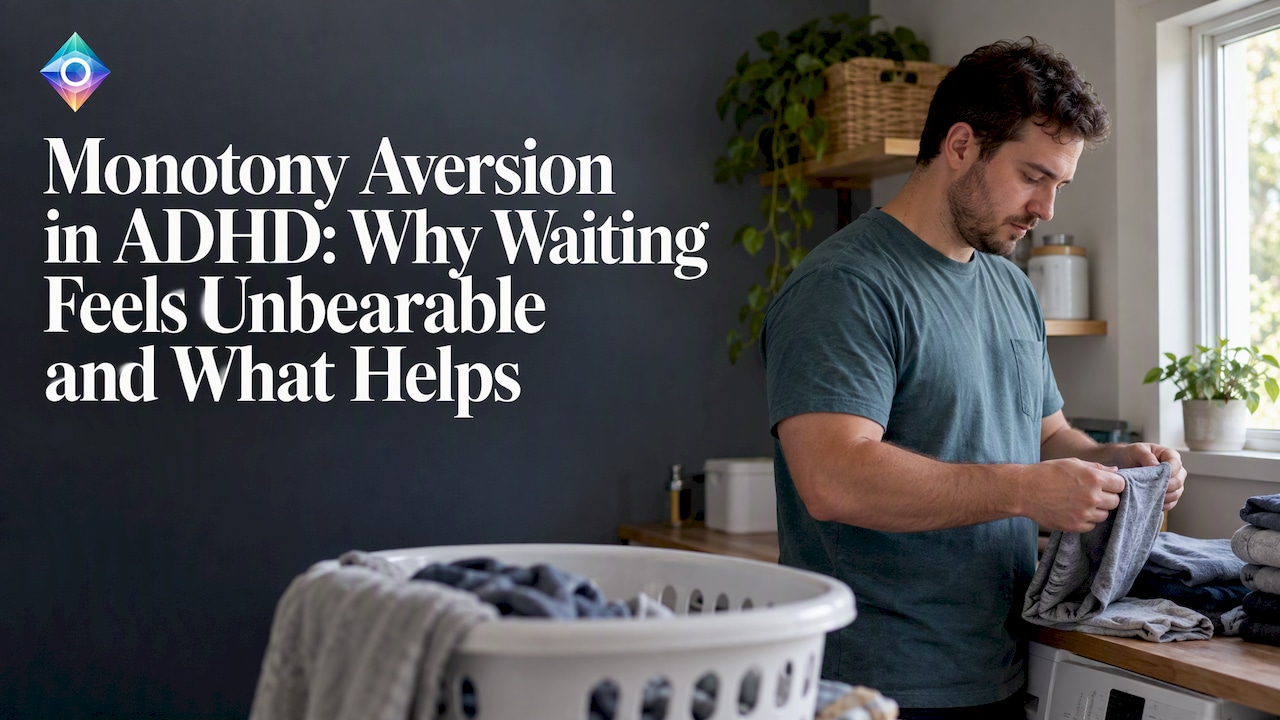
Monotony feels unbearable for many people with ADHD because their brains process delay, reward and novelty differently, making low-stimulation tasks genuinely aversive rather than simply unpleasant. This isn’t a motivation failure. Research on delay aversion, dopamine-driven reward learning and difficulty switching off the brain’s default mode network points to a biological basis, and there are practical, evidence-backed tactics that reduce the distress.
Key Takeaways
Monotony aversion in ADHD stems from biological factors such as delay aversion, reward processing differences, and difficulty suppressing the default mode network, requiring structural coping strategies.
| Point | Details |
|---|---|
| Break tasks into small steps | Dividing tasks into segments under ten minutes provides clear endpoints and reduces perceived effort. |
| Use timed work and breaks | Implement cycles like the Pomodoro Technique to schedule relief and enhance focus. |
| Add immediate rewards | Incorporate small, quick rewards at checkpoints to counter delay aversion and motivate continued effort. |
| External scaffolds help focus | Visual checklists, noise control, short movement breaks, and deliberate novelty refresh attention. |
| Omniprism offers personalized support | Our self-assessment maps traits linked to monotony aversion, guiding tailored tactics and long-term management. |
What causes monotony aversion in ADHD?
Delay aversion is one of the clearest explanations. Experimental work from King’s College London found that people with ADHD more often choose smaller, sooner rewards over larger, delayed ones, and this pattern grows stronger when picking the immediate option also shortens the overall waiting time. A boring task, in this light, isn’t just unstimulating: it represents an open-ended stretch of time with no payoff, which the brain is wired to avoid.
Reward processing adds another layer. ADHD is linked to altered reward-learning rates and a stronger pull towards novel stimuli, which helps explain why switching tasks feels satisfying even when it isn’t productive.
The third piece is the default mode network (DMN), the brain system active during rest and mind-wandering that’s supposed to switch off during focused work. Imaging research from the University of Nottingham found that children with ADHD often fail to suppress the DMN during low-incentive tasks, and that sufficient incentive or stimulant medication can restore that suppression. In practice, a repetitive task doesn’t just bore the ADHD brain: it fails to quiet the internal chatter that competes with it.
Where monotony aversion shows up most
Certain situations reliably trigger this reaction. Recognising the pattern makes it easier to plan around it rather than being caught off guard.
- Long meetings, data entry, filing and other admin-heavy work with no clear endpoint.
- Household chores like washing up or laundry that offer no feedback loop.
- Reading dense material with low narrative pull.
- Sensory amplifiers such as background noise, flickering lighting or an uncomfortable chair, which make the underlying aversion sharper.
Tasks that feel personally meaningful or pitched at the right challenge level are tolerated far better than identical tasks that feel arbitrary. Monotony aversion also compounds with executive function difficulties and fatigue: the more depleted someone already is, the less capacity remains to push through a dull task, which is why the same chore can feel manageable one day and impossible the next.
Evidence-based coping strategies you can try now
Small structural changes reduce the friction of monotonous work more reliably than willpower does. NHS guidance on managing ADHD symptoms recommends chunking tasks and using timers as first-line, low-cost measures.
- Break the task into steps small enough to finish in under ten minutes each, so there’s a visible endpoint rather than an open-ended slog.
- Use timed work and break cycles (a Pomodoro-style 25 minutes on, 5 minutes off pattern is a common starting point) so the brain knows relief is scheduled and close.
- Build in a micro-reward at each checkpoint, something as simple as ticking a box, a short walk or a specific snack, to counter the pull of delay aversion with immediate feedback.
- Alternate a boring task with a more engaging one rather than batching all the dull work together.
Beyond timing, a few external scaffolds help the brain stay anchored:
- A written or visual checklist so progress is tracked outside your own memory.
- Noise control, such as earplugs or consistent background sound, to reduce sensory competition.
- A short movement break between blocks rather than sitting through fatigue.
- Deliberate novelty injection, such as changing location, playlist or tool, to refresh attention without abandoning the task.
Pro Tip: Pair the first five minutes of a dreaded task with something you enjoy, like a specific drink or playlist, so starting itself becomes the small reward rather than something you wait to earn.
For longer-term change, psychosocial approaches matter too. A feasibility study from the University of Huddersfield on a self-determination theory-based intervention for adults with ADHD reported clinically significant improvements in psychological distress and ADHD symptoms, suggesting that coaching built around autonomy and personal meaning can support motivation alongside day-to-day tactics.
What adjustments help at work and in education
Framing a request around functional impact, rather than the diagnosis alone, tends to get a better response from employers and schools. Describe what the task does to you (loss of focus, errors, exhaustion) and propose a specific, low-cost fix rather than a vague ask for help.
- A quieter workspace or permission to use noise-cancelling headphones during focused blocks.
- Flexible or more frequent breaks instead of one fixed lunch period.
- Visual timers or written task lists provided alongside verbal instructions.
- Permission to alternate task types across the day rather than batching all repetitive work together.
These adjustments align with practical guidance from NHS trust resources on ADHD reasonable adjustments, which lists flexible breaks, visual prompts and time management supports among standard, low-cost workplace changes. For students specifically, a look at classroom adjustments that help ADHD in UK schools covers how teachers can apply similar principles in lessons.
What role do medication and clinical supports play?
Medication and clinical support can shift how much capacity someone has for monotonous tasks, though neither replaces the tactics above. A small experimental study summarised by the University of Cambridge found that stimulant medication significantly improved task performance and reward-learning rates on low-stimulation tasks compared with placebo, alongside increased incentives.
Worth raising with a prescriber or clinician:
- Whether current medication timing matches the parts of the day where monotonous tasks are concentrated.
- Whether low-stimulation task performance specifically has changed since starting or adjusting medication.
- Whether a structured psychosocial programme, alongside medication, is appropriate for building longer-term coping skills.
A formal assessment is worth pursuing if monotony aversion is consistently affecting work, study or relationships, since that’s the starting point for discussing either medication or structured psychosocial support.
How a self-assessment can help you understand and manage monotony aversion
A structured self-assessment can help pinpoint where monotony aversion sits alongside other traits, such as executive function difficulties or sensory sensitivity, which shapes which tactics are worth trying first. Our self-assessment tool maps traits across multiple domains related to neurodivergence and produces an instant plain-language profile with no account or data collection required.
- A mapped profile can show whether monotony aversion is paired with strong novelty-seeking, which favours tactics like task alternation.
- Where it’s paired with executive function strain, structured scaffolds like checklists and timers tend to matter more.
- A Specialist Briefing report is also available to summarize results for clinician conversations.
I was diagnosed with ADHD at 42, long after monotony aversion had already shaped how I worked and lived. Understanding the mechanism behind it changed how I approached my own routines.
Impact of monotony aversion on daily functioning and relationships
Monotony aversion rarely stays contained to the task at hand. Unfinished admin piles up, bills get paid late, and household responsibilities that depend on repetition, like cleaning or meal planning, fall behind in ways that affect everyone sharing that space. At work, avoidance of low-stimulation duties can look like procrastination or inconsistency to colleagues who don’t see the underlying effort it takes to start.
In relationships, the strain often shows up as an uneven division of labour. A partner may end up absorbing more of the repetitive, low-reward tasks, routine chores, scheduling, paperwork, which can breed resentment on both sides if the pattern isn’t named and understood. Friends and family sometimes misread the avoidance as carelessness rather than a genuine difficulty with sustaining attention on tasks that offer no immediate payoff.
The emotional toll compounds over time. Repeated failure to complete mundane but necessary tasks often triggers shame or self-criticism, which then makes starting the next similar task even harder. This cycle, task avoidance leading to guilt, guilt leading to further avoidance, is one of the more corrosive effects of monotony aversion, separate from the practical consequences of the missed task itself.
Naming the pattern explicitly, both to yourself and to people you live or work with, tends to reduce this friction. A short, factual explanation (“repetitive tasks with no clear feedback are much harder for me to start”) reframes the behaviour as a known difficulty with a workaround, rather than a character flaw to apologise for repeatedly.
How monotony aversion looks different across age groups
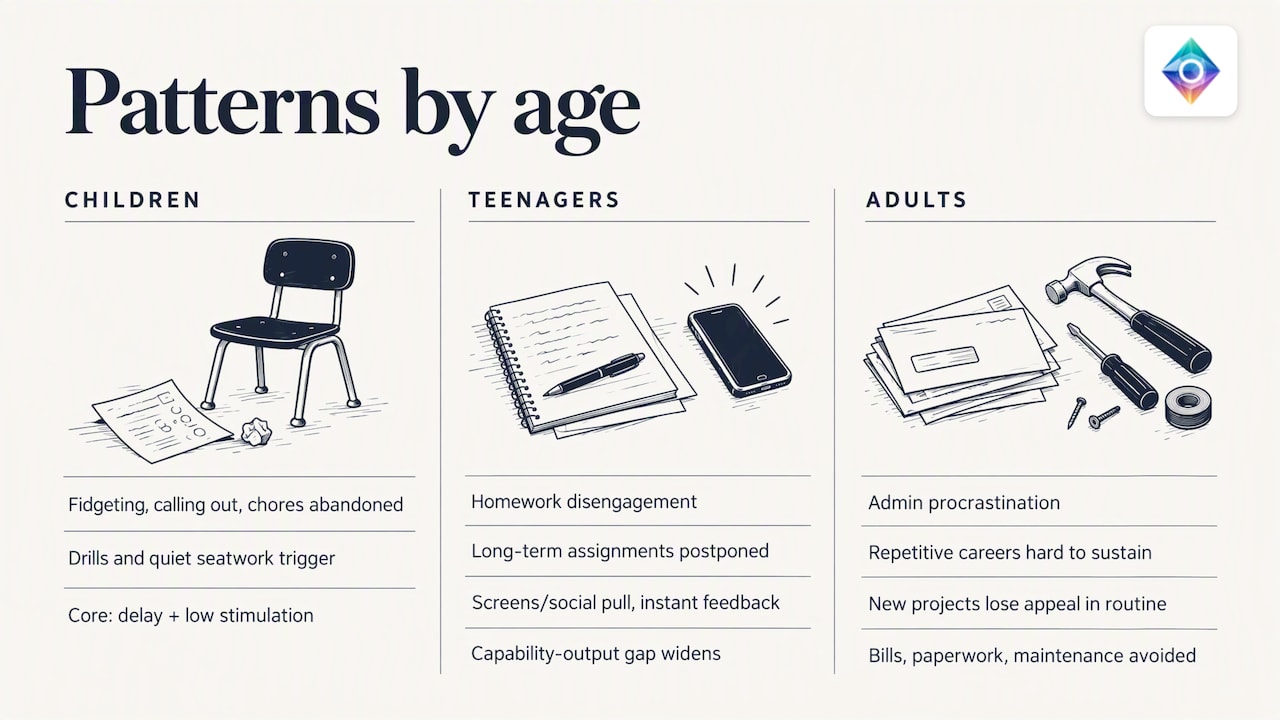
In children, monotony aversion often shows up as fidgeting, calling out, or abandoning worksheets and chores midway through, behaviours that are easy to mislabel as defiance rather than a genuine struggle with sustained low-stimulation effort, which practical classroom strategies can help address (Neurodiversity in Education: A Practical Guide for Teachers). Classroom tasks with repetitive drills or long periods of quiet seatwork are particularly likely to trigger this.
Teenagers tend to show it differently: disengagement from homework, procrastination on long-term assignments, and a pull towards screens or social contact that offer instant feedback over schoolwork that doesn’t. The gap between intellectual capability and inconsistent output often becomes more visible in adolescence, when workloads increase and external structure from parents and teachers typically decreases.
In adults, monotony aversion more often appears as chronic procrastination on admin, difficulty sustaining careers that are heavy on repetitive tasks, or a pattern of starting new projects, hobbies or jobs for the novelty and then losing interest once the task becomes routine. Adults also carry more independent responsibility for the tasks they find hardest, bills, paperwork, maintenance, which raises the practical stakes of avoidance compared with childhood or adolescence.
Across all three groups, the underlying mechanism, difficulty with delay and low stimulation, stays consistent; what changes is the context and the consequences. A structured look at study strategies for ADHD students offers tactics suited specifically to school and coursework demands, where the teenage pattern is most acute.
Strategies to leverage strengths alongside managing monotony aversion
The same novelty-seeking that makes repetitive tasks hard can be redirected rather than only suppressed. People with pronounced novelty-seeking traits often bring genuine creative problem-solving and quick pattern recognition to work that rewards fresh thinking, so pairing monotony-management tactics with deliberate use of that strength tends to work better than treating the trait purely as an obstacle.
Hyperfocus is a related asset worth structuring around rather than fighting. Many people with ADHD can sustain intense, high-quality attention on tasks that genuinely interest them, and scheduling the most demanding, high-stakes work for those windows, while reserving external scaffolds like timers and checklists for the unavoidable monotonous tasks, uses both patterns to advantage. A guide to harnessing hyperfocus in ADHD covers how to identify and plan around these windows deliberately.
Role design matters too. Where there’s some control over how a job or course is structured, shifting repetitive duties towards the edges of the day and protecting peak-focus time for engaging, strength-aligned work reduces the total exposure to monotony without pretending it can be eliminated. For tasks that can’t be avoided, treating them as a known weak point to scaffold, rather than a personal failing to overcome through effort alone, keeps the strategy focused on structure rather than willpower.
Author perspective: validation and a practical nudge
Monotony aversion in ADHD is often mistaken for laziness when it’s closer to a mismatch between task design and how the brain processes delay. Small structural changes, not more willpower, tend to make the difference.
— Valerio Cozzi
Map your own traits before choosing tactics
Not every coping tactic works equally well for everyone, since monotony aversion shows up alongside different combinations of traits from person to person. Our free self-assessment gives you an instant profile across multiple neurodivergence-related domains with no email, account or data collection required, so you can see which patterns are driving your experience before picking tactics.
For readers who want a clinician-ready summary, our Specialist Briefing turns your results into a document designed for easy use in appointments, for 9.99 EUR one-off. Start with the free self-assessment to see your profile first.
This article is general information, not a substitute for advice from a qualified doctor. Consult a qualified healthcare professional about your own circumstances before acting on anything here.
FAQ
Why does ADHD make boring tasks feel unbearable?
ADHD is linked to delay aversion, a tendency to find waiting and low-reward stretches of time genuinely distressing, shown in experimental work from King’s College London. Difficulty suppressing the brain’s default mode network during low-incentive tasks, documented by Nottingham researchers, adds to the effect.
Can medication help with boredom intolerance in ADHD?
Small experimental studies summarised by the University of Cambridge found stimulant medication improved performance on low-stimulation tasks and increased reward-learning rates. Medication works alongside structural tactics like task chunking and timers rather than replacing them.
What is the quickest way to start a boring task with ADHD?
Breaking the task into a step small enough to finish in under ten minutes, then pairing the start with an immediate small reward, directly counters delay aversion by shortening the wait for payoff. NHS guidance recommends this kind of task chunking as a first-line measure.
Is monotony aversion the same in children and adults with ADHD?
The underlying mechanism is consistent, but it looks different by age: children often show fidgeting or task abandonment, teenagers show procrastination and disengagement, and adults show chronic avoidance of admin and routine responsibilities. Context and consequences change with age even though the core difficulty with delay and low stimulation stays the same.
How do I ask my employer for adjustments related to monotony aversion?
Describe the specific functional impact, such as errors or exhaustion during repetitive tasks, and propose a low-cost solution like flexible breaks, a quiet space or a visual timer. Guidance from NHS trust resources lists these as standard, reasonable workplace adjustments for ADHD.
Sources
- Delay and reward choice in ADHD: an experimental test of the role of delay aversion — King’s College London
- Managing ADHD symptoms — NHS
- Faulty ‘off-switch’ stops children with ADHD from concentrating — University of Nottingham
- A neuroaffirmative self-determination theory-based psychosocial intervention for adults with ADHD — University of Huddersfield
- How medication and motivation can help children with ADHD focus on boring tasks — University of Cambridge (news summary)
Recommended
- ADHD Task Paralysis: Why You Freeze and How to Start
- Time Blindness in ADHD: How to Spot It and Manage It
- Match Tactics to Your Brain to Cut Decision Fatigue in ADHD
- 5 Clinician Backed Ways to Harness Hyperfocus in ADHD
Written and edited by Valerio Cozzi, founder of Omniprism. Omniprism began after my own ADHD diagnosis at 42.
This article is educational. It is not medical advice, not a diagnosis, and not a substitute for assessment by a qualified clinician. The Omniprism self-assessment is free, needs no account and no email address, and runs entirely in your browser — your answers are never sent to a server. The optional Specialist Briefing report is a paid add-on.