Two Tactics for Two Weeks: Study Strategies for ADHD Students

Short, timed study sessions combined with active recall and a stripped-back environment produce some of the fastest gains commonly seen for students with ADHD. Set a focus block matching your actual attention span, pick one active technique like flashcards or self-testing, and remove your phone from the room before you start. If these adjustments alone don’t hold your attention after a few honest attempts, that’s a signal to loop in a tutor, disability service, or clinician rather than a personal failing.
TL;DR:
- Shorter focus blocks tailored to your attention span, combined with active recall, outperform longer sessions for improving ADHD study efficiency.
- Creating a habit of visual planning and micro-deadlines helps manage time blindness and reduce overwhelm during revision.
- Using external memory aids like checklists and chunking enhances working memory, preventing multistep tasks from collapsing.
- Pairing study sessions with an accountability partner or body doubling makes starting and maintaining focus easier, especially when impulsivity strikes.
- Personalizing techniques based on a clear profile accelerates finding effective strategies, supported by structured self-assessment tools like Omniprism.
Study strategies for ADHD: 11 tactics that make the biggest difference
These are the tactics with the strongest track record, whether the goal is homework, revision, or a looming deadline. Try two or three at once rather than all eleven. Overloading a new system is how most students with ADHD abandon it by day three.
-
Adapt your timer, don’t just copy the standard Pomodoro. The classic 25 minutes on, 5 minutes off pattern works for plenty of people, but ADHD brains vary. If 25 minutes feels too short to get into a task, try 40/10. If focus collapses fast, drop to 15/5 and build up. The interval should match your actual attention span on a bad day, not an ideal one.
-
Curate your environment deliberately. Low-level ambient noise, a coffee shop hum, instrumental music, or a fan running, can actually support attention by giving the brain something steady to filter against. What should go is the phone, left in another room, and social apps blocked during the block. Environmental modifications such as shorter focus periods and seating changes are widely recommended as practical, low-cost supports precisely because they reduce cognitive load without asking for more willpower.
-
Use active recall instead of rereading. Turn notes into questions before you study them, then quiz yourself without looking. Cognitive science reviews consistently rank active recall and spaced repetition among the highest-utility study methods for making information stick, far more than highlighting or passive rereading ever does.
-
Space your revision instead of massing it. Revisit material after a day, then three days, then a week, rather than cramming it into one sitting. A simple spaced-repetition guide can help you build a realistic exam schedule around this principle, as outlined in this science-backed spaced repetition breakdown.
-
Mix in movement and multiple formats. Watching a short video then sketching a diagram from memory, or pacing while talking through a concept aloud, engages more of the brain than sitting still with a textbook. Standing desks or a walk with voice notes work for some students better than any desk setup.
-
Run your week on a visual planner, not a mental list. A wall calendar or whiteboard with colour-coded blocks beats a notes app for most people with ADHD because it’s visible without having to be remembered. Pair it with the 1/3/5 rule: one big task, three medium tasks, five small tasks per day, capped, so the list itself doesn’t become the source of overwhelm.
-
Time-block with buffer, and set micro-deadlines. Book study sessions into the calendar like appointments, and break a big deadline into two or three earlier checkpoints. Time-blindness is one of the more overlooked ADHD traits, and micro-deadlines are the most direct counter to it.
-
Body-double or find an accountability partner. Studying alongside someone else, even silently on a video call, often makes starting easier than any amount of self-discipline. Pair this with small, immediate rewards (a snack, ten minutes of a show) rather than distant ones like grades.
-
Watch for hyperfocus and build in a cooling-off edit pass. Hyperfocus can produce hours of brilliant, unstructured work, followed by a mess that’s hard to hand in. Set a timer to interrupt it, then schedule a separate short session purely to tidy and structure what was produced. Practical tactics for channelling hyperfocus productively can turn this from a liability into an advantage.
-
Request accommodations early, not after falling behind. Extra time, a quiet room, or alternative formats for exams and coursework are standard requests at most schools and universities, and ADHD-focused environmental modifications are part of NICE’s recommended non-pharmacological support for exactly this reason. Contact the disability or learning support office directly rather than routing it through a tutor.
-
Protect sleep and movement before adding another technique. Poor sleep and no exercise undercut every tactic above. You don’t need a perfect routine, just consistent basics: a fixed wake time and twenty minutes of movement most days.
- Pre-session cue: same drink, same seat, same playlist, every time, to signal “we’re starting.”
- Zero-to-three-minute setup: phone away, timer set, one task written down before the clock starts.
- Immediate short review: two minutes at the end noting what got done and what didn’t, no judgement attached.
Pro Tip: Keep a small “I need a break” card on your desk. Flipping it face-up instead of quietly drifting off-task turns an invisible lapse into a visible, five-minute reset.
How to build a personalised study system you’ll actually use
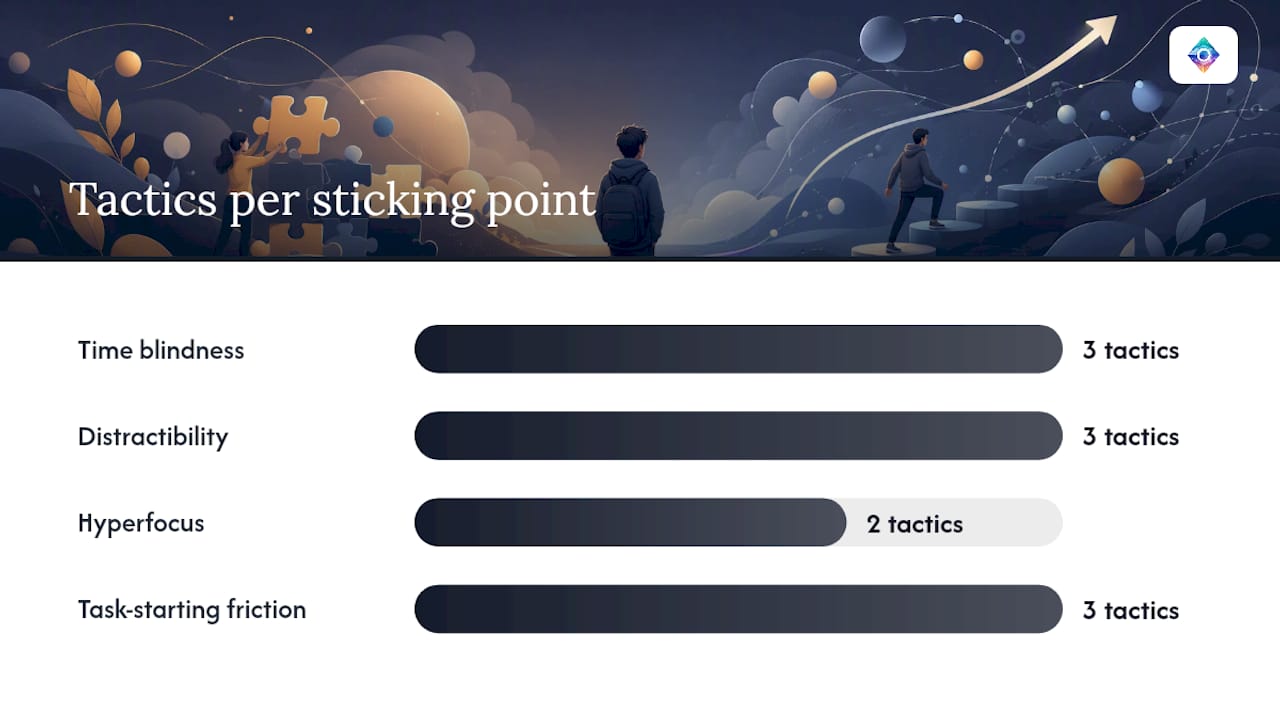
Pick two tactics, not eleven, and run them for two weeks before judging anything. Choose based on your main sticking point: if starting tasks is the problem, body doubling and micro-deadlines matter more than a fancy planner; if losing track of time is the issue, time-blocking and visible calendars should come first; if messy hyperfocus derails you, the cooling-off edit pass is the priority.
Match the tactic to the presentation rather than picking whatever’s trending:
- Time blindness: visual calendar, time-blocking, micro-deadlines.
- Distractibility: ambient noise, phone removal, shorter intervals.
- Hyperfocus without structure: timer interruptions, separate editing pass.
- Task-starting friction: body doubling, the 1/3/5 rule, micro-rewards.
Track three simple measures each week rather than grades alone, since grades lag behind and mask what’s actually working:
- Did the session happen at all (completion)?
- How did it feel while doing it (effort, one to five)?
- Mood immediately after (better, same, worse)?
A weekly five-minute review answers one question: keep, tweak, or drop each tactic. If a technique still feels miserable after two honest weeks, it’s not the right fit, drop it rather than forcing it through sheer stubbornness. If nothing in your two-tactic experiment moves the needle at all after a month, that’s the point to bring in a tutor, disability adviser, or clinician rather than trying a third round solo.
What the research and guidelines actually say
NICE guidance recommends structured, ADHD-focused psychological interventions alongside environmental modifications as standard care, not an optional add-on to medication. That’s a stronger endorsement of study-skills work than most students realise.
The evidence has real limits worth knowing before you set expectations:
- A systematic review of university-level interventions found organisation, time management and planning (OTMP) programmes, CBT, and coaching improve attention and executive-function skills reliably.
- The same review found academic grade improvements were inconsistent, skills got better even when grades didn’t immediately follow.
- School-based interventions across 54 studies found short-term, targeted programmes often outperformed vague, long-running ones.
- Coaching interventions tend to improve organisation and emotional wellbeing more consistently than they move grades.
None of that is a reason to skip strategy work, it’s a reason to measure the right things. When requesting university or school accommodations, bring a written list of specific difficulties (not just an ADHD label) and, where possible, documentation from an assessment.
Omniprism’s take: why a personal profile speeds up finding what works
Valerio Cozzi, founder of Omniprism, was diagnosed with ADHD at 42, after years of assuming his study struggles were a discipline problem rather than a wiring one. That late diagnosis is exactly why a clear profile matters early: it turns years of guesswork into a shorter, more targeted list of tactics worth trying first. A structured self-assessment reduces decision fatigue by pointing you toward the two or three techniques most likely to fit your specific presentation, rather than the eleven above tried at random. Omniprism’s free, privacy-first assessment and optional Specialist Briefing exist to turn that kind of insight into something usable.
Techniques to improve working memory during study
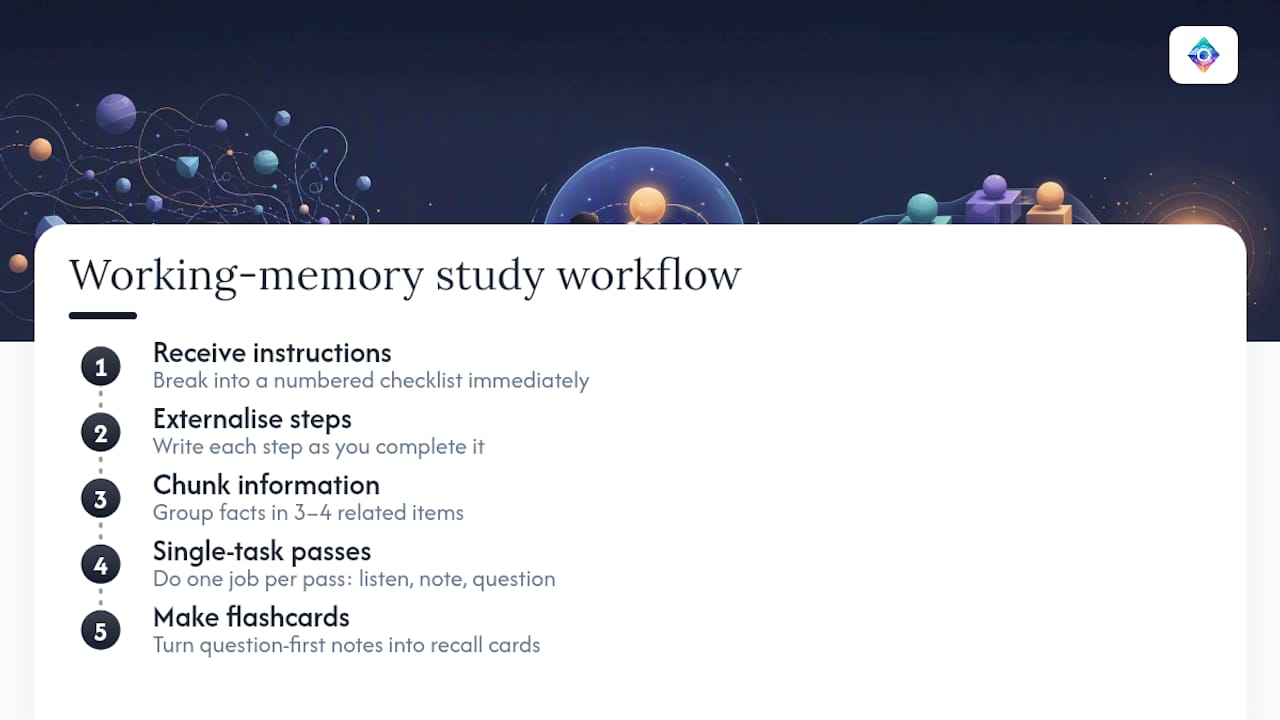
Working memory, holding a few pieces of information in mind while using them, is often the weak link that makes multistep problems and long instructions collapse midway through. Externalising information is the most reliable fix: write down each step of a problem as you complete it instead of trying to hold the whole sequence in your head. Break instructions into a numbered checklist the moment you receive them, so recall is replaced by a glance.
Chunking helps too. Grouping information into small clusters, three or four related facts rather than a long list, reduces the load on working memory during recall. Reading a question aloud before answering it also helps, since it forces the information into both verbal and visual channels at once, which is a form of the multimodal approach that supports attention more broadly.
Reducing simultaneous demands matters as much as any specific trick. Trying to take notes, listen, and think of a question at the same time overloads working memory fast. Pick one job per pass: listen first, note second, question third. Flashcards built from your own question-first notes double as both an active-recall tool and a working-memory offload, since the deck holds what your head doesn’t have to.
Strategies for managing impulsivity and procrastination
Impulsivity and procrastination in ADHD often come from the same source: the gap between deciding to start and actually starting feels physically uncomfortable, so the brain reaches for something easier. The fix isn’t more willpower, it’s shrinking that gap. Commit to just two minutes of a task, not the whole thing, since starting is usually the hardest part and momentum tends to carry on from there.
Remove the decision point entirely where possible. Laying out books and closing distracting tabs the night before means there’s no moment where impulsivity gets to choose an easier option instead. Body doubling works here too: studying next to someone, even on a silent video call, makes the impulsive urge to switch tasks far harder to act on unnoticed.
For impulsive spending of time on low-value tasks (reorganising notes instead of writing the essay), a written priority order at the start of each session removes the in-the-moment decision. The 1/3/5 task rule mentioned earlier does double duty here, capping the list means there’s no room for impulsive task-switching to fill.
Micro-rewards close the loop. A short break, a snack, five minutes of something enjoyable, immediately after finishing a block reinforces starting behaviour far more effectively than a reward that’s days away.
Ways to handle emotional regulation challenges affecting studying
Frustration, shame after a missed deadline, or the sudden flood of feeling behind can derail a study session faster than any distraction. These reactions are a documented part of the ADHD picture, not a character flaw layered on top of it. Coaching-based approaches show consistent improvements in emotional wellbeing and study satisfaction, even in cases where grades don’t shift immediately, which makes emotional regulation a legitimate outcome to work on in its own right.
A short reset ritual between the emotional spike and returning to the task helps more than trying to push through it. Two minutes of slow breathing, a walk around the room, or naming the feeling out loud (“I’m frustrated because this is harder than I expected”) can lower the intensity enough to restart.
Self-talk matters more than it sounds. Replacing “I’m behind again” with “this session didn’t go to plan, the next one can” keeps a single bad session from spiralling into abandoning the whole system. Tracking mood alongside completion, as suggested in the personalised system section above, also makes emotional patterns visible over weeks rather than something that only gets noticed in a crisis.
If shame or anxiety around studying is constant rather than occasional, that’s a sign worth raising with a GP, counsellor, or student wellbeing service rather than managing alone.
Technology and apps built for ADHD study support
Timer apps with visual countdowns work better than a phone’s default clock because the shrinking bar gives a constant, ambient sense of time passing, directly countering time blindness. Task apps that force a hard limit on daily items, rather than allowing an infinite scrolling list, mirror the 1/3/5 rule digitally and stop the list itself from becoming a source of dread.
Spaced-repetition flashcard software automates the scheduling that’s hard to manage manually, resurfacing cards exactly when they’re about to be forgotten rather than on a fixed daily basis. Text-to-speech tools help when reading dense material solo is the bottleneck, turning a page of text into something that can be absorbed while pacing or doing something with the hands.
Website and app blockers that require a delay before overriding (rather than a single tap) add just enough friction to interrupt impulsive switching. None of these tools replace a personalised system, they support one. A self-assessment that maps your specific ADHD traits, rather than a generic checklist, makes it easier to choose which category of tool is worth the setup time and which will sit unused after a week.
A short, encouraging note for students with ADHD
None of this works perfectly on the first try, and that’s not a sign it’s failing. Trial and error is the actual method, not a fallback for when the “real” system doesn’t work. Small wins, one finished session, one honest week of tracking, count for more than a perfect plan abandoned by Thursday. If a tactic doesn’t fit after a fair test, drop it without guilt and try the next one. Student services and clinicians exist for exactly the moments when self-help alone isn’t enough.
— Valerio Cozzi
How Omniprism can support personalising your study approach
Working out which of these tactics fits your specific brain is largely a matter of knowing your own profile, and that’s exactly the gap Omniprism’s free self-assessment is built to close. It takes a straightforward, privacy-first format, no email, no account, no data collection, and returns an instant, plain-language profile across 14 areas including ADHD, giving you a clearer starting point than guessing which of the eleven tactics above to try first.
For students who want to bring something concrete to a tutor, disability adviser, or GP, the optional Specialist Briefing turns your results into a clinician-ready summary for a one-time fee, useful groundwork before requesting formal accommodations. Parents supporting a younger student can use the guided assessment for children and young people to start that same conversation earlier.
This article is general information, not a substitute for advice from a qualified doctor. Consult a qualified healthcare professional about your own circumstances before acting on anything here.
Sources
- A systematic review of actions aimed at university students with ADHD
- Non-pharmacological interventions for ADHD delivered in school settings (NIHR)
- Learning techniques and memory: review of effective study strategies
- Attention deficit hyperactivity disorder: diagnosis and management - NCBI Bookshelf
- Coaching interventions for ADHD (PubMed summary)
FAQ
What is the best study method for ADHD?
There isn’t one single best method, but short timed sessions paired with active recall and a decluttered environment consistently produce the most reliable gains, supported by both cognitive science reviews and ADHD-specific guidance.
What is the 1/3/5 rule for ADHD?
It’s a daily task cap: one big task, three medium tasks, and five small tasks, designed to stop an open-ended to-do list from becoming overwhelming and triggering avoidance.
What are the symptoms of ADHD burnout?
Burnout typically shows up as persistent exhaustion, a drop in motivation even for previously manageable tasks, irritability, and a sense of dread around starting work, often after a period of pushing through without adjusting the workload.
What is the 30% rule in ADHD?
There’s no single, widely agreed clinical definition of a “30% rule” in ADHD research or guidelines, so treat any specific figure you see quoted online with caution rather than as an established standard.
Can a self-assessment help me choose study strategies?
Yes. A structured profile across traits like attention, time perception, and impulsivity narrows down which tactics are worth testing first, which is the basis of Omniprism’s free self-assessment.
Recommended
- Match Tactics to Your Brain to Cut Decision Fatigue in ADHD
- Time Blindness in ADHD: How to Spot It and Manage It
- 5 Clinician Backed Ways to Harness Hyperfocus in ADHD
Written and edited by Valerio Cozzi, founder of Omniprism. Omniprism began after my own ADHD diagnosis at 42.
This article is educational. It is not medical advice, not a diagnosis, and not a substitute for assessment by a qualified clinician. The Omniprism self-assessment is free, needs no account and no email address, and runs entirely in your browser — your answers are never sent to a server. The optional Specialist Briefing report is a paid add-on.