ADHD at Work Strategies: Nine Practical Ways to Manage Your Day

The strategies that help most at work are the ones that put structure outside your head: a short daily planning slot, tasks cut into small pieces, visible timers, fewer interruptions and clear written expectations. Which of them suit you depends on your own pattern of difficulties, so it helps to know that pattern before you build a routine around it. Our free adult self-assessment gives you an instant plain-language profile across 14 areas, with no email, account or data collection.
Key Takeaways
- Spend 5 to 10 minutes a day planning, break work into small chunks and batch emails and calls, as NHS Berkshire Healthcare guidance recommends.
- Make time visible with clocks, timers and alarms, and overestimate how long tasks and meetings will take.
- Cut distractions at the source with headphones, a quiet space or a set time for answering calls.
- Disclosure to your employer is your decision. Going in with specific adjustments in mind makes the conversation easier.
- Strategies work best when tailored to your own pattern of difficulties, which a structured self-assessment can help you see.
What are the best ADHD at work strategies?
These nine steps come from NHS guidance, professional bodies and occupational-medicine research. Start with two or three and add more once they have become habits.
- Plan for 5 to 10 minutes every day. NHS Berkshire Healthcare suggests setting aside this time to organise the day or week. Where it goes wrong: planning that grows into a 40-minute colour-coding session. Keep it to a fixed slot, ideally before you open email.
- Break large projects into small pieces with their own due dates. CHADD, a US ADHD organisation, recommends step-by-step deadlines and rewarding progress along the way. A task that reads “write report” is hard to start; “list the three headline figures” is not.
- Make time visible. Visible clocks, timers and start reminders are recommended in the ADDA’s work-habits guide and in the UK ADHD Foundation’s employer guide. Set the alarm for the start of a task as well as the end.
- Overestimate everything. CHADD advises allowing more time than you think tasks and meetings will take. If a report feels like an hour, book ninety minutes.
- Batch emails and calls. The NHS guidance recommends grouping them rather than responding as they arrive. Two or three fixed windows a day are enough for most roles.
- Work on one task at a time. CHADD suggests keeping a notebook for stray ideas, so you can park a thought without acting on it, and finishing the current task before starting another.
- Match demanding work to your best hours. A 2024 occupational-medicine review in Zentralblatt für Arbeitsmedizin recommends putting difficult work in higher-attention periods and alternating monotonous tasks with stimulating ones.
- Get instructions in writing. The same review suggests written instructions or recordings of meetings. Send a two-line summary after any verbal brief and ask your manager to correct it.
- Agree outcomes and deadlines with your manager. The NHS guidance advises seeking clear expected outcomes, and asking a manager or colleague to help you prioritise when everything feels urgent.
Pro Tip: Put your single most important task into your calendar as a meeting with yourself, with the timer set, before anyone else can book that slot.
How does ADHD affect you at work?
The CDC lists several ways adult ADHD can make work harder: managing attention, finishing long tasks unless they are interesting, staying organised, controlling behaviour and feeling restless inside. A 2025 lived-experience study by Grinblat and Rosenblum found participants reporting trouble with time management, planning, working memory, focus, distractions and emotional regulation. Those difficulties were linked in the study with frustration, stress and low confidence in their own work performance.
The same study points to individualised support as a need: workers described executive-function and emotional challenges that overlapped, and named psychoeducation, self-regulation and workplace adjustments as things that would help. CHADD also stresses tailoring strategies to your own pattern. Someone whose main trouble is starting tasks needs a different toolkit from someone who loses hours to interruptions.
Executive function covers the mental skills that plan, start and finish tasks. If that sounds like your day, our guide to executive dysfunction explains the signs and what tends to help.
How do you reduce distractions and start tasks with ADHD?
CHADD suggests a quiet office or cubicle, white-noise earphones or music, an unused meeting room, or sending calls to voicemail with a set time for replying. The ADHD Foundation and MIT Sloan Management Review both mention noise-cancelling headphones and quieter workspaces as well. Room dividers and movement breaks appear in the German occupational-medicine review.
Starting is often harder than continuing. These approaches help:
- Shrink the first step until it takes two minutes, then set a timer and follow it with a break, a pattern MIT Sloan recommends.
- Visual prompts such as wall charts and sticky notes can hold routines and checklists in view.
- Working alongside someone can help. A 2025 virtual-reality study with 12 participants found they completed tasks faster with a human or AI body double than alone, and reported greater accuracy and sustained attention. It was a small study, so treat it as an idea to try with a colleague rather than a settled method.
If you find that some tasks pull you in for hours while others will not start at all, our article on harnessing hyperfocus covers how clinicians suggest using it. When decisions themselves drain you, matching tactics to your brain offers a way to cut the load.
What is the 1/3/5 rule for ADHD?
It is a daily planning method: one large task, three medium tasks and five small ones. The large task is your key deliverable, the medium tasks support it and the small ones are quick actions such as replying to a message or booking a room. Fluidwave’s explanation describes it as a productivity habit rather than a clinically validated ADHD treatment.
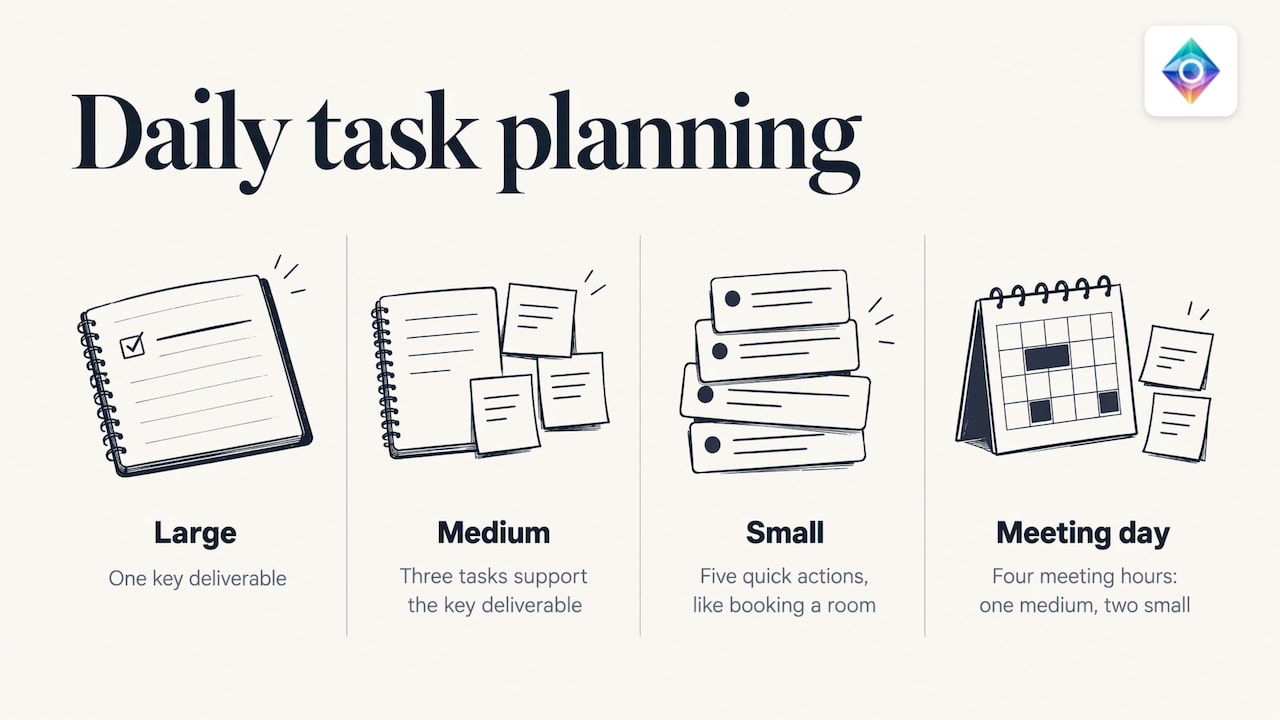
It works as a prioritising scaffold when you fit it to your real day. If you have four hours of meetings, the list shrinks accordingly: one medium task and two small ones is a perfectly good day. Pair it with the daily planning slot from step one.
How can you cope with ADHD when working from home?
Remote work can remove the cues an office supplies. MIT Sloan Management Review notes that without external time cues, supervision and accountability, time management can slip and deadlines can be missed. Its suggestions include daily planners, accountability check-ins and visible clocks.
The NHS guidance mentions occasional home working where it suits the individual and the job, along with flexible start and finish windows. Once you are at home, your set-up matters: this guide to optimising your home workspace is a good starting point for adding structure through planning, reminders and check-ins. A weekly 15-minute check-in with a manager or colleague, agreed in advance, replaces some of the accountability an office provides.
Should I tell my boss I have ADHD?
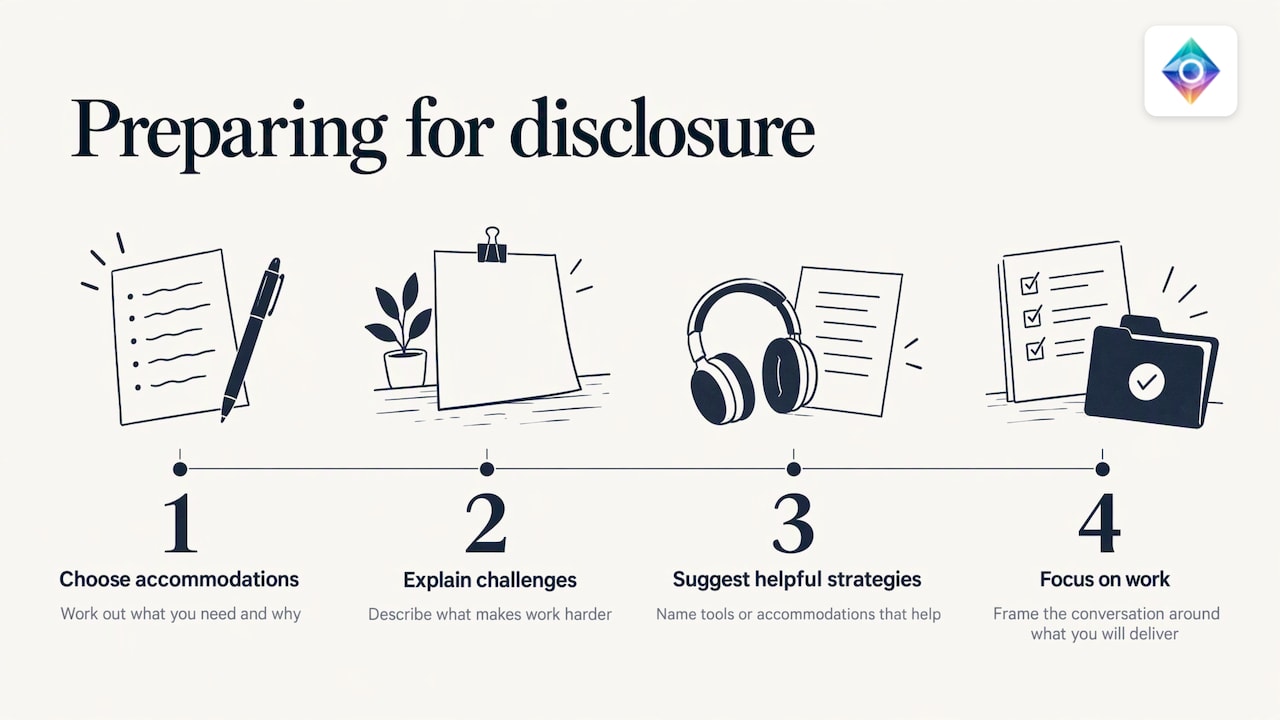
It is your decision. ADDA says disclosure may open a route to accommodations and legal protections, while acknowledging that misunderstanding or discrimination is a concern for some people. Before you speak to an employer, ADDA advises working out which accommodations you need and why, then explaining your challenges and suggesting strategies or tools that help.
In practice, that means arriving with a short list: for example, written instructions after meetings, a quiet desk or headphones, and a weekly check-in on priorities. Framing the conversation around the work you will deliver keeps it concrete.
If you do not yet have a diagnosis, our piece on when to seek an ADHD diagnosis in the UK explains when difficulties across more than one area of life point towards an assessment.
What workplace adjustments can you ask for in the UK?
In Great Britain the Equality Act 2010 is the framework: ADHD UK’s summary explains that it requires employers to make reasonable adjustments for employees and applicants with a disability, and that ADHD can qualify. Northern Ireland has its own legislation. Whether an adjustment counts as reasonable depends on your job and the employer’s circumstances.
Adjustments named across the guidance above include:
| Area | Examples |
|---|---|
| Time and structure | Flexible start and finish windows, flexible breaks, extended deadlines where feasible |
| Communication | Written instructions, recordings of meetings, fewer necessary meetings, asynchronous updates |
| Environment | Quiet workspace, noise-reducing headphones, room dividers, adjustable desk or active seating |
| Tools | Reminders, dictation or audio-recording tools, planners, assistive technology |
| Support | Frequent check-ins, a buddy, help with prioritising |
The UK ADHD Foundation cautions that apps are not a magic bullet: the useful tool is the one chosen with you for your own work. Our practical guide to workplace accommodations for ADHD goes through how to phrase requests.
In the US, the CDC notes that adults with ADHD may request workplace accommodations and that not everyone needs them.
How can Omniprism help you prepare?
To choose strategies that fit, it helps to know where your difficulties sit. The Free Adult Self-Assessment returns a profile across 14 areas, including ADHD, autism, dyslexia, dyspraxia, sensory processing and masking, in plain language and without an account or any data collection.
When you want something to take to a conversation with a clinician, the Specialist Briefing summarises your results for healthcare professionals and costs €20 as a one-off payment. Parents can use the children and young people assessment, and the Youth Briefing is also €20 one-off. Our clinician checklist for describing ADHD symptoms helps you put your experience into words.
Our perspective
I was diagnosed with ADHD at 42, and I built Omniprism because understanding how your own mind works should not depend on a long wait or on handing over personal data.
We believe the strongest workplace strategies begin with a clear picture of your own profile. The research points the same way: both CHADD and the 2025 lived-experience study stress individualised support, because ADHD at work looks different from person to person. Our assessment is designed to give you that picture in plain language, across 14 areas, so you can see which strategies deserve your effort.
When a conversation with a clinician or an employer is the next step, a Specialist Briefing gives you a summary built for that purpose. We designed it for easy use by healthcare professionals, so the time you have with them goes on decisions rather than on explaining where to begin.
Valerio Cozzi
FAQ
What is the best way to stay focused at work with ADHD?
Remove what pulls your attention first: headphones, a quieter space or a set time for calls. Then work on one task at a time using a timer followed by a break, and park stray ideas in a notebook, as CHADD suggests.
Can I ask for flexible hours because of ADHD?
Yes, you can ask. The NHS Berkshire Healthcare guidance suggests flexible start and finish windows and flexible breaks as options. In Great Britain, employers must consider reasonable adjustments, and what is reasonable depends on your role.
Do I need a diagnosis to use these strategies?
No. Planning slots, timers, written instructions and fewer interruptions are useful for anyone. A diagnosis can matter when you request formal adjustments, and a self-assessment can help you decide whether to seek one.
How long should daily planning take?
Five to ten minutes, according to NHS Berkshire Healthcare guidance. Do it at the same time each day so it becomes automatic.
Sources
- ADHD in the workplace, NHS Berkshire Healthcare
- Work Performance Challenges and Needs of Adults with ADHD, Grinblat and Rosenblum (2025)
- ADHS review, Zentralblatt für Arbeitsmedizin (2024)
- You Are Not Alone: Designing Body Doubling for ADHD, arXiv (2025)
- ADHD in Adults, CDC
- Workplace Issues, CHADD
- 15 Good Work Habits for Adults with ADHD, ADDA
- Should I Disclose My ADHD? ADDA
- How to Help Employees With ADHD Address the Challenges of Remote Work, MIT Sloan Management Review
- The 1 3 5 Rule, Fluidwave
- ADHD Reasonable Adjustments, ADHD UK
Recommended
- Workplace Accommodations for ADHD: A Practical Guide
- Time Blindness in ADHD: How to Spot It and Manage It
- Match Tactics to Your Brain to Cut Decision Fatigue in ADHD
- 5 Clinician Backed Ways to Harness Hyperfocus in ADHD
Written and edited by Valerio Cozzi, founder of Omniprism. Omniprism began after my own ADHD diagnosis at 42.
This article is educational. It is not medical advice, not a diagnosis, and not a substitute for assessment by a qualified clinician. The Omniprism self-assessment is free, needs no account and no email address, and runs entirely in your browser — your answers are never sent to a server. The optional Specialist Briefing report is a paid add-on.