Workplace masking: what it is and how to handle it
Workplace masking is the habit of hiding or suppressing neurodivergent traits, such as stimming, direct speech or sensory discomfort, so that you appear to fit your workplace’s idea of “normal”. It is common, it is tiring, and a UK study of workplace masking found that the effort can lead to burnout, sick leave and, for some people, leaving a job altogether.
Key takeaways
- Masking at work means concealing or managing your natural traits to appear neurotypical. It is most often discussed for autistic people, but ADHD and other profiles mask too.
- Work masking is hard to switch off because you cannot easily step away mid-meeting, which is why it so often ends in exhaustion.
- In the UK, autism and other neurodivergent conditions can count as a disability under the Equality Act 2010, so employers may owe you reasonable adjustments once they know.
- Disclosure is your decision. Nobody is legally obliged to tell an employer.
- A structured self-assessment can give you language for what you are doing, before you decide what to ask for.
What is workplace masking?
Masking is the management of your social presentation so that others see fewer of your neurodivergent traits. The NHS England guidance on autistic adults in mental health services describes it in these terms, and adds that not all autistic people mask, and those who do may not always be aware they are doing it. The Leicestershire Partnership NHS Trust describes the same thing as trying to hide differences by suppressing or concealing behaviours to appear neurotypical.
At work, this often looks like:
- Rehearsing small talk, or scripting emails and meeting contributions in advance.
- Forcing eye contact, or copying colleagues’ facial expressions and tone.
- Holding back stimming, fidgeting or movement during meetings.
- Pushing through noise, lighting or open-plan sensory overload without saying anything.
- Overpreparing to hide time-keeping, organisation or memory difficulties, which is a pattern many adults with ADHD will recognise.
The UK study cited above looked at the workplace masking experiences of autistic, non-autistic neurodivergent and neurotypical adults. Its abstract notes that masking is particularly common for autistic people, though many non-autistic people also conceal aspects of their identity. Masking is not exclusive to any one diagnosis, and a person can mask without ever having been assessed.
Why is masking at work different from masking elsewhere?
Practitioners and participants in the same UK study describe workplace masking as relentless. Socially, you can leave a party or cancel a plan. In a job, you usually cannot step away, so the performance runs for hours, then days, then years.
Participants also described what the effort costs in the moment: hearing less, missing social cues and feeling less mentally agile, according to the Remington study. That has an irony worth noticing. The energy spent appearing capable can reduce the very capacity colleagues assume you are showing.
There is also a visibility problem. Managers tend to read a calm, productive employee as someone who is coping. NHS England’s guidance explicitly warns professionals not to assume an absence of risk in autistic people who do not report it, because masking can interfere with how accurately someone communicates their symptoms. The same reasoning applies to line managers: a lack of complaints says little about a lack of need.
Can masking cause burnout and mental health problems?
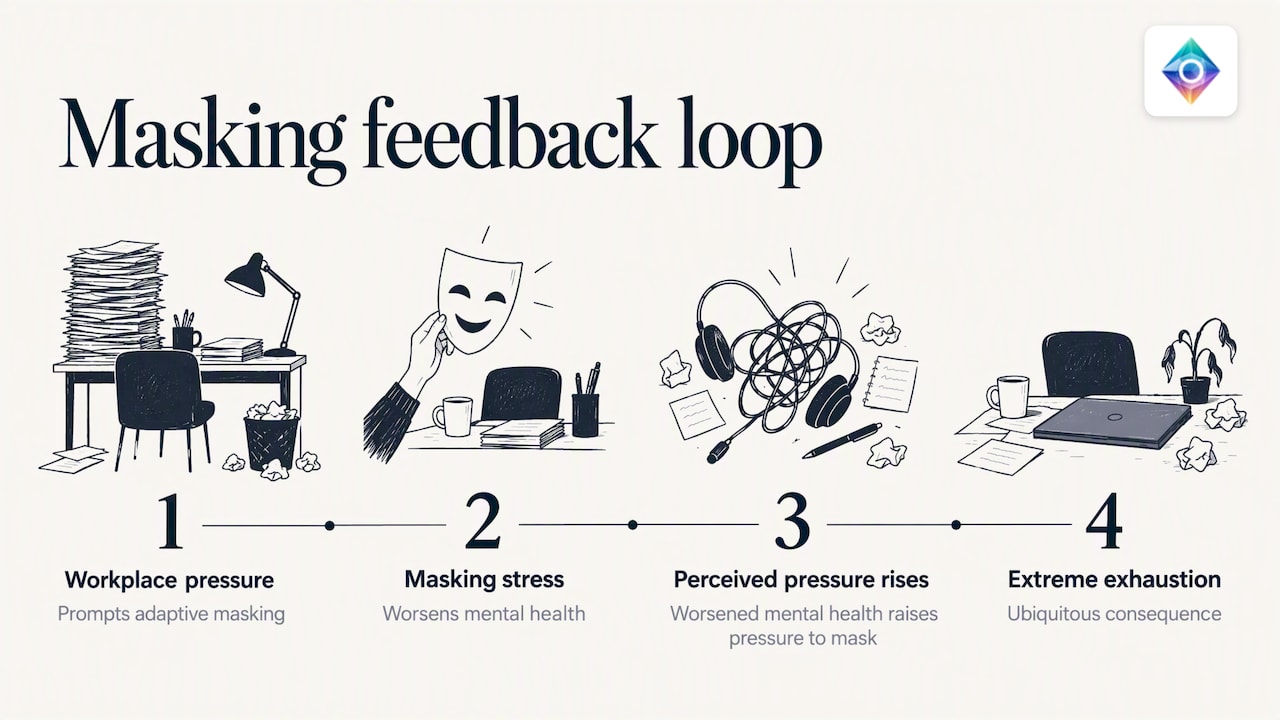
The evidence points that way, with some caution about cause and effect. In the 2024 UK workplace study, participants described a vicious circle: masking is an adaptive response to pressure, but the stress of keeping the mask up worsens mental health, and that in turn increases the perceived pressure to mask further. Extreme exhaustion was a ubiquitous consequence, and some participants reported extended sick leave or leaving a job permanently (Remington et al., PLOS ONE).
NHS England’s guidance also names masking as a factor to consider when assessing mental health risk, because it can hide how much distress someone is in. It sits alongside depression, anxiety and suicidality in the clinical picture (NHS England, 2023). If you are struggling now, speak to your GP, or call NHS 111 or Samaritans on 116 123 if you feel unsafe.
Some people reach a point where the mask slips without choice. Practitioners describe this as masking burnout, where you lose the ability to manage your presentation consciously, sometimes ending in an emotional collapse once you reach somewhere safe. People often notice it at home after work, which is why the cost can stay invisible to colleagues.
The question of panic attacks comes up often. We found no source tying masking directly to panic attacks, so we will not claim it. What the sources do support is the link between prolonged masking, anxiety and exhaustion, and a panic attack is a good reason to talk to your GP regardless of cause.
How do I start to reduce masking at work?
There is no single procedure, and unmasking all at once is rarely wise. The UK researchers report that many people feel an identity crisis when they begin, having performed a version of themselves for years, and that recovery calls for safe, neuro-affirming spaces where the mask can be set aside without fear of reprisal (UCL study). So the sensible approach is gradual.
- Notice what you do. For a week, jot down moments when you script, suppress or push through. Patterns matter more than single incidents.
- Sort the effort. Separate masking that costs you little from masking that leaves you wrecked by Wednesday.
- Pick one change. Camera off for one recurring call, headphones on in the open-plan area, or agendas sent in advance.
- Choose a safe person. A trusted colleague, a union rep or a mentor is a lower-stakes place to practise being less guarded.
- Protect recovery time. Plan quiet time after demanding days rather than hoping to bounce back.
- Put requests in terms of tasks. “I work best with written instructions” is easier for an employer to act on than a description of how you feel.
For ADHD specifically, our guide to unmasking without burning out goes through five steps in more detail, and our piece on unmasking autism safely covers the adult autism side for you and your allies.
Pro Tip: Start with the situation that drains you most, not the one that scares you most. A small, well-chosen change usually shows within a fortnight whether you have found a real lever.
Do I have to tell my employer?
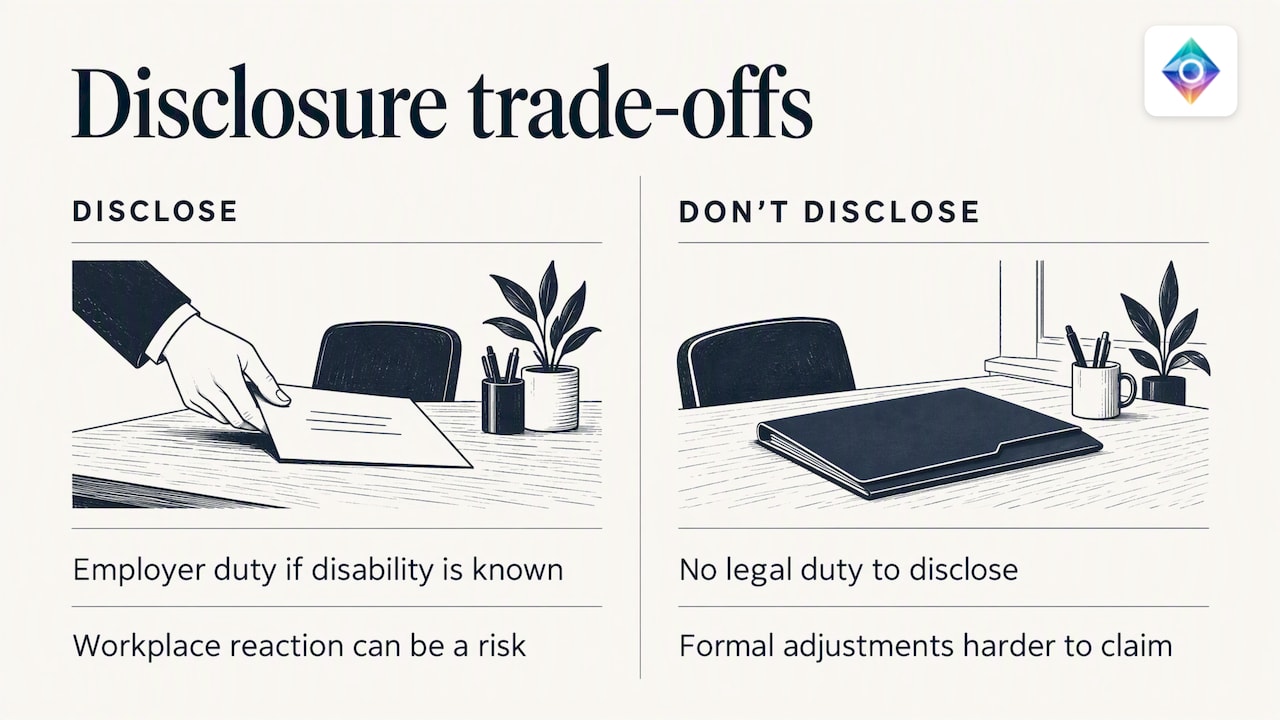
No. The South London and Maudsley NHS Foundation Trust describes disclosure as a deeply personal and complex decision, and notes that some autistic people choose not to disclose and are not legally obliged to.
The trade-off is practical. Employers generally only have a legal duty to make reasonable adjustments if they know, or could reasonably be expected to know, that someone meets the legal definition of disability, as the National Autistic Society explains. Without disclosure, formal adjustments are harder to claim. With it, you carry the risk of how your particular workplace reacts.
The same SLaM blog lists reactions that do not help, such as “everyone is a bit autistic” or “you don’t look autistic”. Helpful responses are practical, for example asking how they can best support you or which reasonable adjustments could be made. If you plan to disclose, it can help to go in knowing which response you are hoping for.
What reasonable adjustments can I ask for?
Under the Equality Act 2010, autism is considered a disability in the UK, and employers must make reasonable adjustments for employees who disclose. The NHS page on autism and adult life gives examples including working in a quieter area of the office and flexible communication, and the National Autistic Society also points to the government’s Access to Work scheme, a grant for extra practical support. Adjustments and Access to Work are separate routes, and you can pursue either.
Adjustments that directly reduce the need to mask tend to be the useful ones:
| Masking pressure | Adjustment to consider |
|---|---|
| Sensory overload in open-plan space | Quieter desk, noise-cancelling headphones, lighting changes |
| Scripting live conversation | Written follow-ups, agendas in advance, chat as an alternative to speaking |
| Performing constant availability | Remote or hybrid days, protected focus time |
| Hiding time or organisation difficulties | Written task lists, clear deadlines, body-doubling or coaching |
The Equality Act’s wording is about disability rather than diagnosis labels, and the specifics for ADHD differ from autism. We cover those in our practical guide to workplace accommodations for ADHD. For teams building this kind of culture, a leadership perspective on workplace wellbeing offers a management-side view on making environments safe enough to be open.
What does it mean for managers and colleagues?
If you manage people, the most useful shift is to stop reading quiet competence as proof of comfort. High performers who mask may be paying for it elsewhere in their lives. Ask open questions regularly, offer adjustments before they are requested, and make it clear that raising a need will not count against someone.
Only a small number of changes are needed to start: agendas shared in advance, a quiet space, written follow-ups and a norm that cameras and speaking up are optional. None of these cost much, and they help people who never disclose anything.
Our perspective on masking
At Omniprism we see masking as the hidden layer under many assessment conversations. People arrive saying they “cope fine”, then describe a working life of scripting and recovering.
I was diagnosed with ADHD at 42, and the constant energy drain of trying to fit in at work left nothing for life outside the office. That silent effort to appear “normal” is, in our view, what often leads to the crushing burnout so many people struggle to explain to managers and families.
We built Omniprism around that gap. Understanding your patterns is not about collecting labels. It is about having the language to advocate for the environment you need. That is why the tool gives you a plain-language profile instantly, with no email, account or data collection, so you can explore without anyone looking over your shoulder.
— Valerio Cozzi
Where can I map my own traits before I talk to anyone?
Our free self-assessment gives you an instant profile across 14 domains, including ADHD, autism, dyslexia, masking, sensory processing and more. It is not a diagnosis. It is a structured way to see your patterns and strengths.
If you then want to talk to a GP, occupational health or a clinician, the optional Specialist Briefing (€9.99, one-off) summarises your results in a format designed for clinicians. For families, there are guided assessments for children and young people. Read the disclaimer first so you know what the tool can and cannot do.
FAQ
How does masking affect people with autism at work?
It can drain energy, dull cognitive performance and lead to burnout. In the UK study cited above, participants described missing cues and hearing less when masking heavily, and some needed extended sick leave or left their jobs. Many also reported that the strain worsened their mental health, which increased the pressure to mask.
What is a masking personality?
There is no recognised clinical “masking personality”. Masking is a set of learned behaviours used to manage how others see you, and it can be so practised that you stop noticing it. NHS England’s guidance notes that some people who mask are not always aware they are doing it.
Is masking only an autism issue?
No. The UK workplace study included autistic, non-autistic neurodivergent and neurotypical adults, and found many non-autistic people also conceal aspects of their identity. Masking is most often researched in autistic people, so the evidence is strongest there.
Where can I get funded support at work?
In the UK, the government’s Access to Work scheme can help pay for additional practical support or equipment, and your employer may also owe reasonable adjustments if they know about your condition. The National Autistic Society page linked above explains both routes.
Sources
- The workplace masking experiences of autistic, non-autistic neurodivergent and neurotypical adults in the UK (PLOS ONE, UCL)
- Meeting the needs of autistic adults in mental health services (NHS England)
- Autism and adult life (NHS)
- Masking when you’re autistic (Leicestershire Partnership NHS Trust)
- Creating an Autism-Friendly Workplace (South London and Maudsley NHS Foundation Trust)
- What support can I get at work as an autistic person? (National Autistic Society)
- Workplace Wellbeing: A Transformational Leadership Perspective (Leaderly)
Recommended
- Workplace Accommodations for ADHD: A Practical Guide
- Stop sensory overload at work: 4 quick steps UK employees can use
Written and edited by Valerio Cozzi, founder of Omniprism. Omniprism began after my own ADHD diagnosis at 42.
This article is educational. It is not medical advice, not a diagnosis, and not a substitute for assessment by a qualified clinician. The Omniprism self-assessment is free, needs no account and no email address, and runs entirely in your browser — your answers are never sent to a server. The optional Specialist Briefing report is a paid add-on.