What Is Subclinical OCD? Meaning, Signs and When to Get Help
Subclinical OCD describes obsessions and/or compulsions that are present without causing functional impairment, according to a PubMed-indexed review of subclinical OCD in children and adolescents. It is not a formal diagnosis. It is a label researchers use for people whose symptoms sit below the threshold for obsessive-compulsive disorder, and it is worth taking seriously because for some people it grows into OCD and for others it affects daily life while staying below the diagnostic line.
Key Takeaways
- Subclinical OCD means obsessive or compulsive symptoms without functional impairment, and there is no single universally agreed definition.
- Estimates suggest roughly 2% to 25% of people have substantial obsessive-compulsive symptoms without meeting OCD criteria.
- Even below the diagnostic line, symptoms have been linked with distress, work impairment and lower quality of life.
- If symptoms cause distress, interfere with daily functioning or get worse, speak to a GP or other clinician.
- A structured self-assessment profile can give you organised notes to bring to that conversation.
What does subclinical OCD mean?
The phrase covers obsessions (intrusive, unwanted thoughts) and compulsions (repeated actions or mental rituals) in someone who does not meet the criteria for an OCD diagnosis. The PubMed review places it in a middle ground of severity: more symptoms than people with none, fewer or milder than people with full OCD.
The term is a research convention rather than a clinical category. A 2006 paper on a cognitive behavioural workshop for subclinical obsessions and compulsions notes that no universally agreed definition exists, which is one reason studies are hard to compare. You may also see it called “OCD traits”, “OCD tendencies” or “obsessive-compulsive symptoms” in everyday writing.
The NHS describes the full condition as having three parts: obsessions, the anxiety they produce, and compulsions carried out to reduce that anxiety. Subclinical OCD uses the same building blocks at a level that has not (yet) disrupted your life enough to qualify.
What are the symptoms of subclinical OCD?
The symptoms resemble those of clinical OCD. A 2020 editorial on the neurobiology of subclinical OCD discusses obsessing, ordering, doubt and checking, and hoarding, and describes their phenomenology as similar to clinical OCD, with the difference lying in severity and functional impairment.
In practice, the common themes look like this:
- Contamination worries: washing hands more than the situation calls for, or avoiding certain surfaces.
- Symmetry and ordering: a strong need for objects to be lined up or for tasks to be done in a set sequence.
- Checking and doubt: returning to confirm that the door is locked or the hob is off, even when you remember doing it.
- Harm-related thoughts: unwanted images or ideas about something bad happening, which you recognise as out of character.
- Taboo thoughts: intrusive sexual or religious thoughts that cause discomfort without matching your values.
- Hoarding: difficulty discarding items, without the clutter taking over the home.
The key phrase in the research is “without functional impairment”. You might spend a few minutes on a routine and carry on with your day, which is quite different from rituals that take hours and block you from work, study or relationships.
How is subclinical OCD different from OCD?
The main difference is impairment. The PubMed review defines subclinical OCD as symptoms without functional impairment, whereas a diagnosis of OCD requires obsessions or compulsions that take up significant time or cause significant distress or interference.
The same review points out two possible paths. In people at risk for OCD, subclinical symptoms may herald its onset. In others, they may be an independent condition that never leads to full OCD. Nobody can say from symptoms alone which path you are on, which is a good reason to keep an eye on how things change over months.
Clinicians often measure severity with the Yale-Brown Obsessive Compulsive Scale (Y-BOCS). A 2026 clinical practice guideline describes it as a gold-standard instrument and states that a total score of 16 or greater indicates clinically significant OCD. That scale is administered by a trained clinician, so it is the reference point you would meet if you were later assessed.
OCD also overlaps with other conditions that can look similar. Our guides on ADHD versus OCD and OCD versus OCPD explain how repetitive thoughts, rigid routines and perfectionism can come from different sources.
How common is subclinical OCD?
The 2006 paper cited above reports estimates of about 2% to 25% for the share of the population with substantial obsessive-compulsive symptoms who do not meet OCD criteria. The wide range reflects the missing standard definition.
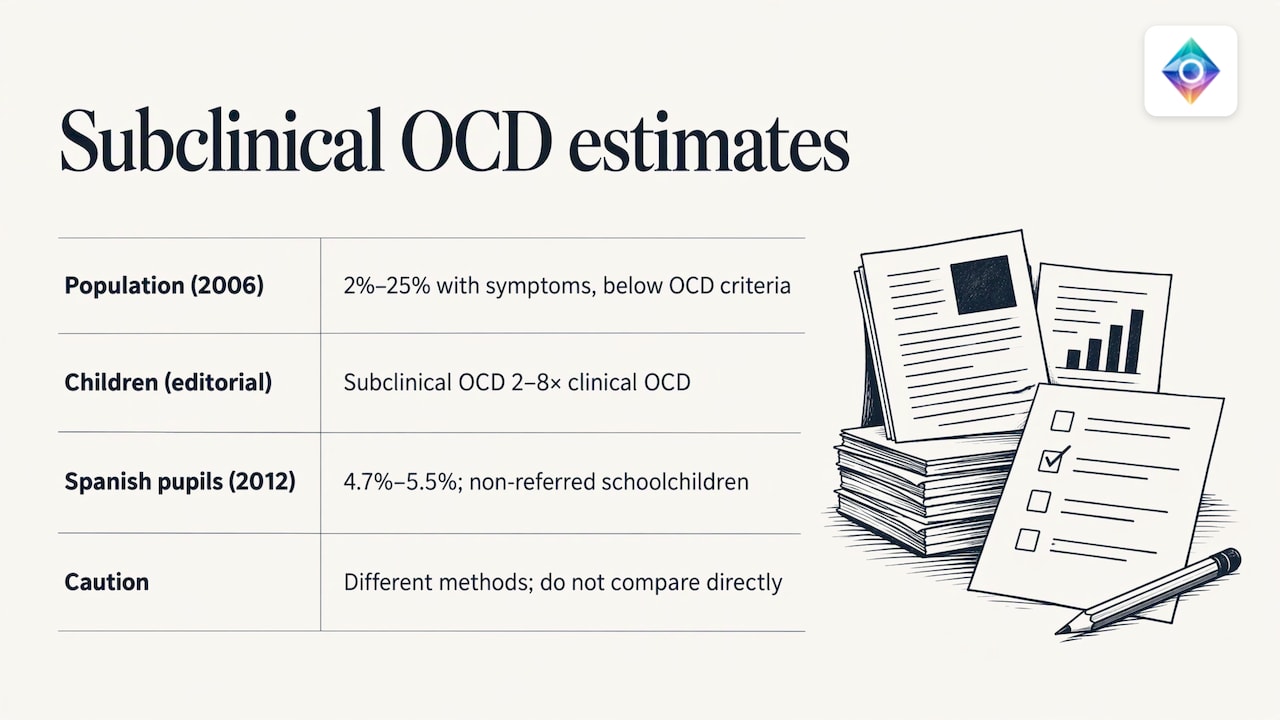
In children, a 2020 editorial by MacMaster and Rosenberg reports subclinical OCD as two to eight times more common than clinical OCD. A 2012 study of non-referred schoolchildren in Spain estimated subclinical OCD prevalence at between 4.7% and 5.5%. These figures come from different populations and methods, so they should not be compared directly with one another.
Many people with symptoms never reach a clinic. The American Academy of Child and Adolescent Psychiatry practice parameters suggest this may be because people are secretive about symptoms or unaware that the disorder and its treatment exist.
Can subclinical OCD affect work, school and daily life?
Yes, in some people it does, even without meeting the formal definition. The 2006 paper reports that subclinical obsessive-compulsive symptoms have been associated with elevated distress, greater work impairment and decreased quality of life. It also links them with higher rates of conditions such as major depression, panic disorder and social phobia, and with greater use of mental healthcare.
For children and teenagers the picture has its own details. The AACAP parameters note that compulsive re-reading or re-writing of school assignments may interfere with academic performance, and that in children subclinical OCD is frequently associated with anxiety, tic, mood and attention problems. The Spanish schoolchild study found academic performance was significantly lower in children with clinical OCD but did not show the same deficit in those with subclinical OCD, so a child with milder symptoms may be coping at school while still feeling the strain.

Parents of younger children may also find booklists for childhood mental wellness useful for opening conversations about worries at home. For attention-related overlap in the classroom, our piece on classroom adjustments for ADHD in UK schools covers practical changes teachers can make.
How is subclinical OCD assessed?
There is no separate diagnostic test for subclinical OCD, because it is not a diagnosis. A clinician such as a GP, psychiatrist or clinical psychologist asks about the thoughts, the behaviours, the time they take and the effect on your life. Tools like the Y-BOCS then put a number on severity.
Before that appointment, a structured self-assessment helps you put your experience into words. Omniprism’s Free Adult Self-Assessment gives an instant profile across 14 domains, with OCD traits among them, in plain language. It asks for no email and no account, and it collects no data. The profile is a starting point for reflection and for a conversation with a professional, and it does not replace a diagnosis.
For younger people, the Children & Young People Free Assessment offers guided assessments, with age-specific versions for ages 7 to 10 and ages 11 to 13.
What helps if symptoms do not meet OCD criteria?
The World Health Organization’s manual for primary care describes support for people who do not meet diagnostic criteria as including education, non-specific supportive therapy, empathic listening and cognitive behavioural techniques if symptoms cause enough distress. The approach is tailored to personal preference and to how much the symptoms affect daily functioning.
For children and young people, the NICE guideline on OCD and body dysmorphic disorder recommends guided self-help, with support and information for families or carers, when functional impairment is mild. Cognitive behavioural therapy including exposure and response prevention (ERP) is recommended for moderate to severe impairment.
Practical steps that fit alongside professional guidance:
- Write down which thoughts and routines bother you, how often they happen and how long they take.
- Note what triggers them and what changes when stress rises or sleep drops.
- Record any effect on work, study, sleep or relationships, even small ones.
- Bring those notes to your GP or clinician rather than relying on memory in the room.
Pro Tip: Keep a two-week log before your appointment. Dated entries show a clinician the pattern far more clearly than a general description.
When should you see a doctor about OCD symptoms?
The World Health Organization’s regional office advises seeking professional help when symptoms cause significant personal distress, interfere with social or daily functioning, or come with other concerns such as anxiety or depression, even if they do not meet full diagnostic criteria for OCD. It also recommends guidance when symptoms persist or worsen over time.
In the UK, your GP is the usual first step, and they can discuss referral to NHS talking therapies or specialist mental health services. If you ever have thoughts of harming yourself, contact your GP urgently, call NHS 111, or call 999 in an emergency.
If you want to arrive with something concrete, our Specialist Briefing summarises your results for a clinician. Our guide on what to bring after a self screen explains how to prepare for UK appointments more generally.
Why do we build self-assessments for OCD traits?
I was diagnosed with ADHD at 42, and that late diagnosis is the reason I started Omniprism. Many adults reach a clinic without a clear way to describe what they experience, and that gap is what we set out to close.
We believe understanding comes first. Our assessment covers 14 domains, including OCD traits alongside ADHD, autism, dyslexia and sensory processing, because these patterns often sit together and a single-condition checklist can miss the connections. You get an instant profile in plain language, with no email, no account and no data collection, so you can explore your own patterns without any pressure.
For people whose symptoms sit below a diagnostic line, a clear profile helps you decide what to do next. For people heading to a clinician, a Specialist Briefing turns your results into a summary designed for easy use by healthcare professionals.
Valerio Cozzi
Where can I check my OCD traits and prepare for an assessment?
Omniprism’s Free Adult Self-Assessment costs €0 and returns your profile straight away. If you then want a document to share with a GP or specialist, the Specialist Briefing is a one-off €20. Parents can start with the free assessment for children and young people, and the Youth Briefing is also €20 one-off.
FAQ
Is subclinical OCD a real diagnosis?
No. It is a research term for obsessive-compulsive symptoms without functional impairment, and no universally agreed definition exists, according to the 2006 workshop paper. Clinicians diagnose OCD only when symptoms reach the level of significant distress or interference.
Can subclinical OCD turn into OCD?
It can for some people. The PubMed review says that in people at risk for OCD, subclinical symptoms may herald its onset, while in others they may be independent and never lead to full OCD. If symptoms start to take more time or cause more distress, see your GP.
Does subclinical OCD need treatment?
Not always, but support is available. The WHO primary care manual lists education, supportive therapy and cognitive behavioural techniques when symptoms cause enough distress. The right level depends on your preferences and how much daily life is affected.
Can children have subclinical OCD?
Yes, and it appears to be more common than clinical OCD in children. The 2020 editorial reports it as two to eight times more common. Anxiety, tic, mood and attention problems often appear alongside it, so a parent who is concerned should speak to the child’s GP or school.
Sources
- Subclinical obsessive-compulsive disorder in children and adolescents (PubMed)
- A cognitive behavioral workshop for subclinical obsessions and compulsions (ScienceDirect, 2006)
- Editorial: Neurobiological Substrates of Subclinical OCD (PMC, 2020)
- Clinical practice guidelines for obsessive-compulsive disorder (PMC, 2026)
- Subclinical OCD in non-referred Spanish schoolchildren (University Rovira i Virgili, 2012)
- AACAP Practice Parameters for the Assessment and Treatment of OCD
- NICE guideline CG31: OCD and body dysmorphic disorder
- WHO manual for primary health care providers
- WHO EMRO: Mental health disorders
Recommended
Written and edited by Valerio Cozzi, founder of Omniprism. Omniprism began after my own ADHD diagnosis at 42.
This article is educational. It is not medical advice, not a diagnosis, and not a substitute for assessment by a qualified clinician. The Omniprism self-assessment is free, needs no account and no email address, and runs entirely in your browser — your answers are never sent to a server. The optional Specialist Briefing report is a paid add-on.