OCD Traits Profile: What It Shows and What to Do Next
An OCD traits profile is a structured picture of how strongly you recognise obsessive thoughts, repeated checking or ritual-like behaviours in your own life. It is not a diagnosis, and it gives you words and examples to take to a clinician. Our free assessment includes OCD traits among its 14 areas, and you get a plain-language result straight away.
Key Takeaways
- OCD traits means recognising patterns of unwanted intrusive thoughts and repeated behaviours or mental acts. Only a clinician can say whether they amount to the disorder.
- Unwanted thoughts are very common. What matters is distress, time taken and interference with daily life.
- OCD differs from OCPD and perfectionism mainly in how the person experiences the pattern: distressing and unwelcome, or reasonable and desirable.
- A profile is most useful when it is turned into concrete examples for a GP or specialist.
- Our free assessment needs no email or account, and the optional Specialist Briefing costs €20.
What does it mean to have OCD traits?
Having OCD traits means you notice some of the features of obsessive-compulsive disorder without necessarily meeting the threshold for the condition. The NICE Clinical Knowledge Summaries describe obsessions as unwanted intrusive thoughts, images or urges that repeatedly enter the mind and usually cause marked anxiety or distress. The National Institute of Mental Health defines the disorder as recurring, uncontrollable obsessions, compulsions or both that are time-consuming and cause significant distress or interfere with daily life.
A traits profile therefore looks at degree and pattern, not a yes or no. You might score high on checking and low on contamination worries, or find that the mental rituals are the main thing. That detail is what a clinician finds hard to get from a general description such as “I’m a bit OCD”.
What are common obsessions and compulsions?
NIMH lists frequent obsessive themes: contamination, fear of forgetting or losing things, losing control of behaviour, aggressive or taboo thoughts, and a need for symmetry or order. Its list of common compulsions includes excessive cleaning or handwashing, precise arranging, repeated checking, counting, and silently praying or repeating words.
Compulsions are not always visible. NICE notes that they can be observable or covert mental acts, and lists washing, checking, ordering, repeating, mental prayers or counting, memory checking and avoidance. Mental review of a conversation, or silently re-running a sequence until it feels right, can be a compulsion even though nobody sees it.
The cycle a profile tries to capture
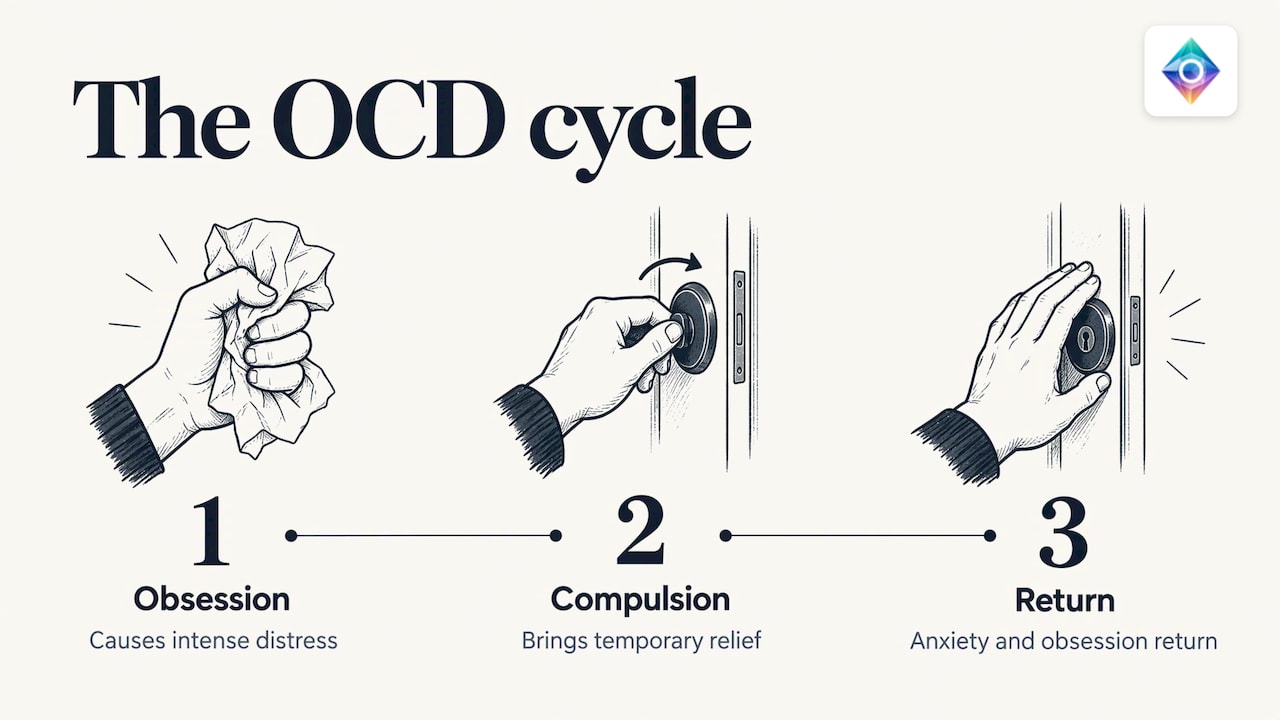
The NHS describes a cycle in which an obsession causes intense distress, a compulsion gives temporary relief, and the anxiety and obsession soon return. The same page says that intrusive violent or sexual thoughts may feel repulsive or frightening, but having them does not mean a person will act on them. The way a short-lived sense of relief can reinforce a pattern is also a familiar theme in how people learn to settle distress in everyday life, which is why noting what you do straight after a thought appears is so useful.
How common are intrusive thoughts?
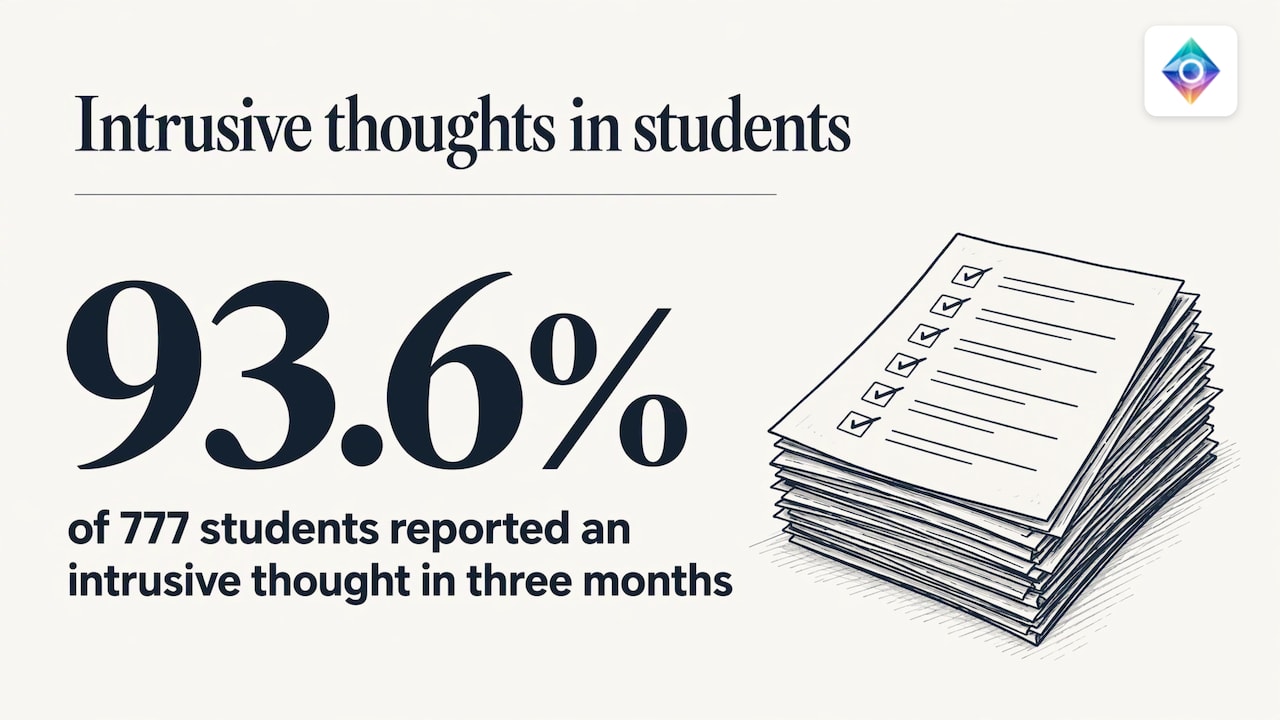
Very common. The NHS says almost everyone has unpleasant or unwanted thoughts at some point, and that an obsession is identified when a persistent thought dominates thinking enough to interrupt other thoughts and causes distress or affects quality of life. In a 2014 international study, 93.6% of 777 university students without a clinical diagnosis, across 15 sites in 13 countries, reported at least one intrusive thought in the previous three months. The authors treat such thoughts as common in people with and without OCD, though students are one group and the figure should not be read as a measure for everyone.
So a thought on its own is not the signal. The signal is how you respond to it, how long it holds you and what it costs you.
OCD traits, OCPD and perfectionism: how do they differ?
People often assume a love of order means OCD. A review in the Brazilian Journal of Psychiatry describes obsessive-compulsive personality disorder (OCPD) as an enduring pattern of orderliness, perfectionism and control at the expense of flexibility and efficiency, not necessarily involving obsessions and compulsions as OCD defines them. It also separates the two by how they feel: OCD obsessions are intrusive and distressing, generally at odds with the person’s values, while OCPD traits are generally experienced as reasonable or even desirable.
The International OCD Foundation separates ordinary preferences, such as liking things neat or occasionally rechecking a lock, from OCD by the intensity of anxiety and the degree of disruption to everyday responsibilities. Harvard Health’s 2026 update adds that having obsessions or compulsions does not by itself mean OCD, since clinicians ask whether symptoms cause distress or take enough time to interfere with work, social life or relationships.
If you want the longer comparison, our article on OCD versus OCPD goes through it, and ADHD versus OCD covers the overlap that often confuses people who also recognise attention traits.
| Feature | OCD traits | OCPD traits | Everyday preference |
|---|---|---|---|
| How it feels | Unwanted, distressing | Reasonable, even desirable | Comfortable |
| Main pattern | Intrusive thoughts plus rituals | Rigid orderliness and control | Liking things tidy |
| Effect on life | Time-consuming, disruptive | Inflexibility, difficulty delegating | Little disruption |
How do I get an OCD traits profile?
These steps take about as long as the assessment itself.
- Open our free adult self-assessment and answer as you are on a typical day, not on your best or worst one. It needs no email or account.
- Read the OCD traits result alongside the other 13 areas, because attention, sensory and masking traits can shape how obsessive patterns show up.
- Write down two or three real examples for each high area: what the thought was, what you did, how long it took and what it stopped you doing.
- Estimate the daily time. NIMH says people may spend more than an hour a day on symptoms, and the American Psychiatric Association gives the same figure as an example of time-consuming symptoms.
- If the picture fits, book a GP appointment and take the examples with you.
For a child or teen, the children and young people assessment offers a guided version, with versions for ages 7 to 10 and ages 11 to 13.
When should I seek a professional assessment?
The Finnish Current Care guideline, published in 2026, says assessment and treatment are warranted when symptoms distress the person or relatives, or impair functioning. It adds that work performance can stay intact even when symptoms heavily affect life outside work, so a good job record does not rule anything out.
NIMH advises anyone who thinks they or their child may have OCD to speak to a healthcare provider, who can review health history, consider other causes and refer to a mental-health professional. In the UK that usually starts with your GP. The NHS symptom page is a good place to read first. If you feel unable to cope, or have thoughts of harming yourself, contact your GP urgently or call NHS 111, and use 999 in an emergency.
What clinicians look for
CAMH’s screening questions ask about recurrent unwanted thoughts, repeated behaviours or mental acts, and whether they waste significant time or interfere with school, work or social life. CAMH also states that assessment should tell OCD apart from conditions with similar symptoms and weigh severity, distress and day-to-day interference. A 2024 American Family Physician review notes OCD is often underdiagnosed or misdiagnosed and names the Yale-Brown Obsessive-Compulsive Scale as a validated tool for diagnosis and tracking severity. Your examples map directly onto these questions.
What helps with OCD traits?
Treatment decisions belong with a clinician. The 2026 Finnish guideline recommends cognitive behavioural therapy methods including exposure and response prevention as a first-line psychological option, and says cognitive therapy, exposure and response prevention, and combinations reduce symptoms in adults and young people. Your GP can explain what is available locally and refer you.
Perspective
When someone has no words for what happens in their head, an appointment can go badly even if they are struggling. A profile changes that starting point, because the person arrives with named patterns and examples instead of a vague sense that something is off.
That is why we built Omniprism to give an instant plain-language profile across 14 areas, with no email, account or data collection. OCD traits sit beside ADHD, autism, dyslexia and sensory processing, because in real life they rarely arrive alone. Our Specialist Briefing is designed so a healthcare professional can read your results quickly.
The diagnosis itself belongs to a clinician. Our job is to make the first conversation clearer, and I am glad to have been diagnosed with ADHD myself at 42, because it showed me how much a clear description helps.
Valerio Cozzi
Taking your profile to a clinician
After the free assessment, the Specialist Briefing summarises your results for a clinician and costs €20 as a one-off. Parents can use the Youth Briefing, also €20 one-off. Professionals who want to see how profiles can be used with clients can visit Omniprism for Professionals.
FAQ
Is an OCD traits profile the same as a diagnosis?
No. A profile describes patterns you recognise in yourself, while a diagnosis comes from a clinician who weighs distress, time taken, daily interference and other possible explanations. The profile helps you describe your experience clearly in that conversation.
Are intrusive thoughts a sign that I have OCD?
Not by themselves. The NHS says almost everyone has unwanted thoughts at some point, and the 2014 international student study found them in most participants. It becomes a concern when the thoughts dominate your thinking, cause distress or affect your quality of life.
Can a child have OCD traits?
Yes, and the Finnish guideline covers young people as well as adults. Children may not describe thoughts the way adults do, so examples of repeated behaviours, how long they take and what they interrupt are useful. A GP is the first step, and our guided children’s assessment helps organise what you have noticed.
How long should symptoms take up before I seek help?
There is no single cut-off. The American Psychiatric Association gives more than an hour a day as an example of time-consuming symptoms, but distress or interference with daily activities is enough to raise it with your GP.
Sources
- NICE CKS: Obsessive-compulsive disorder definition
- NIMH: Obsessive-Compulsive Disorder
- NHS: Symptoms of OCD
- 2014 international intrusive thoughts study
- Brazilian Journal of Psychiatry: OCPD review
- International OCD Foundation: The D in OCD
- Harvard Health: Do obsessions or compulsions always indicate OCD?
- American Psychiatric Association: What is OCD?
- CAMH: OCD screening and assessment
- American Family Physician: Diagnosis and management of OCD
- Finnish Current Care guideline: OCD
Recommended
- OCD vs OCPD: How to Tell the Difference
- ADHD vs. OCD: Key Differences, Overlap, and Next Steps
- OCD assessment cost: €9.99 for a clinician ready Specialist Briefing
- Neurodivergence Self-Assessment Guide: What It Can and Can’t Tell You
Written and edited by Valerio Cozzi, founder of Omniprism. Omniprism began after my own ADHD diagnosis at 42.
This article is educational. It is not medical advice, not a diagnosis, and not a substitute for assessment by a qualified clinician. The Omniprism self-assessment is free, needs no account and no email address, and runs entirely in your browser — your answers are never sent to a server. The optional Specialist Briefing report is a paid add-on.