Neurodiversity in Job Interviews: How to Prepare and Ask for Adjustments
Neurodivergent candidates can do well in interviews when they prepare in a format that suits how they process information and ask for adjustments early. In the UK, Acas guidance says employers must make reasonable adjustments for applicants and interviewees who are disabled, and a formal diagnosis is not required to ask for them.
Key Takeaways
- Interviews reward fast speech, eye contact and social improvisation, which are not the same as job skill. Name that gap to yourself before you walk in.
- Prepare themes and examples rather than memorised scripts, and rehearse out loud in whichever format works for you.
- Ask for adjustments such as questions in advance, extra time or a quieter room. Disclosure is your choice, and no law obliges you to share a diagnosis.
- Plan the sensory and logistical side (route, arrival time, grounding objects) as carefully as the answers.
- Ask for feedback afterwards, tied to the role requirements.
Why are job interviews hard for neurodivergent candidates?
Most interviews are built around neurotypical communication norms. Rachel Leong-Sato at the University of Washington lists the usual demands: answering quickly, masking sensory needs, holding eye contact and following unspoken social rules. Her list of common difficulties also includes executive dysfunction, sensory overload, processing delays that can be read as disinterest, and literal thinking that makes vague questions confusing.
The University of Bath’s handbook for interviewers describes further examples for autistic people: recounting an event in context, expressing feeling through tone of voice, using expected body language and coping with sensory hypersensitivity. The IMAGE Employability Toolkit adds panels of strangers, long or ambiguous questions and the decision about declaring a disability.
There is also evidence that presentation can outweigh content. Cindi May, writing in The Conversation, reports a study of 30 young adults in which candidates with autism were rated less favourably on social dimensions, and those ratings weighed heavily on hiring decisions despite equal qualification ratings. When evaluators read only transcripts, ratings for autistic candidates were the same or better. The sample is small, but it points to the format as the obstacle, not you.
Audrey Lessard, a career coach, makes the same point from practice: the standard format expects verbal fluency, sequential thinking under pressure and comfort with improvising, and when those are missing the format becomes the main barrier.
How do you prepare for a job interview as a neurodivergent person?
Work through these steps in order. Each one lowers the load on the day.
- Write your answers in full, then shrink them. Lisa Gills of jobs.ac.uk suggests writing out answers to likely questions, distilling them to bullet points, recording yourself speaking and doing a verbal brain dump with someone you trust.
- Prepare themes, not speeches. Anne Josephson of the University of Miami notes that memorising word for word often raises anxiety. Pick experiences that show teamwork, leadership, adaptability, conflict resolution and receiving feedback, so one story can answer several questions.
- Learn the question types. The IMAGE toolkit says interviewers tend to use traditional, competency-based and behavioural questions. Check exactly what is being asked, keep answers concise and stay relevant to the job.
- Do a mock interview. Ask a friend, a careers service or a coach to run through questions with you. If you want structured practice, interview preparation coaching can give you a rehearsal partner and feedback on delivery.
- Sort the logistics. Autism AIM in Leeds advises working out the route and travel time, doing a dummy run, and planning the night before what to wear and take, including notes, water or fidget items. Find out how long the interview lasts, how many people will be there and when you will hear back.
- Pack the practical items. A pen, paper and a copy of your application and CV are the basics, and a tablet can hold previous work to show.
- Sleep and arrive with time to regulate. Gills warns against arriving so early that you burn energy in a waiting room.
How do you answer open questions like “tell me about yourself”?
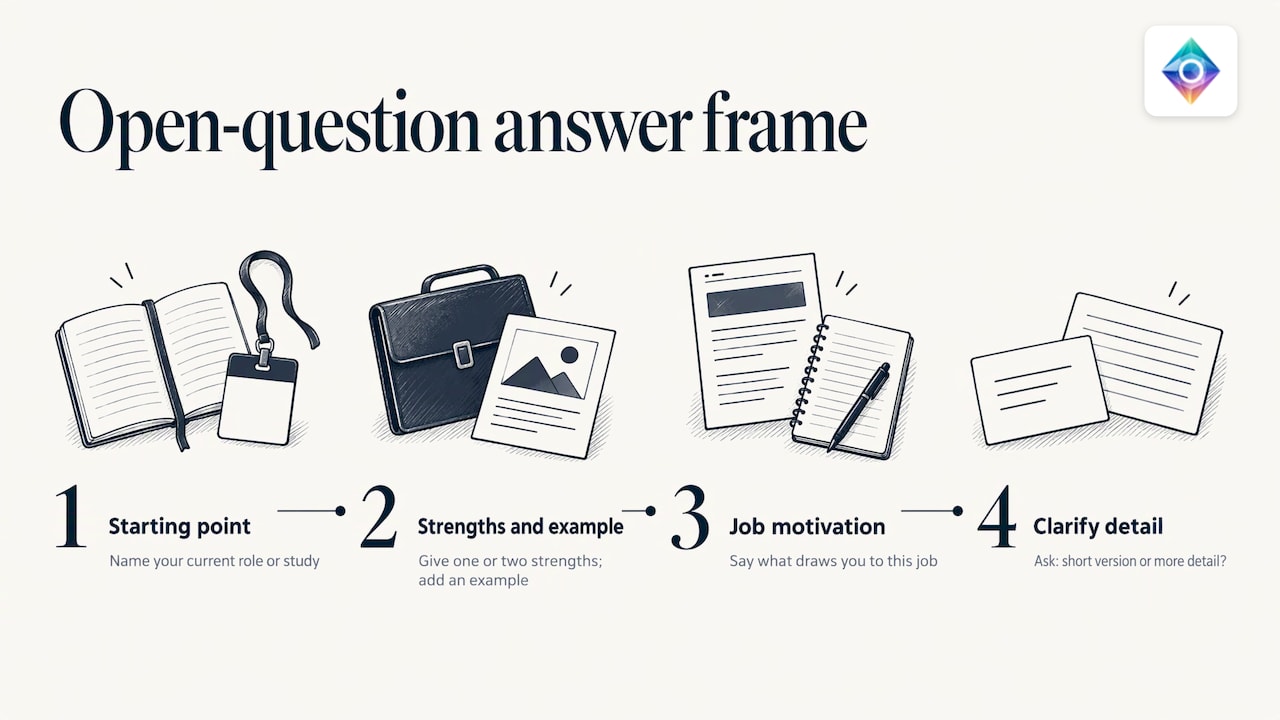
The Bath handbook explains that autistic people can struggle to know how much detail an open question wants, because such questions carry little structure. A simple frame helps: your current role or study, one or two strengths with a short example, and what draws you to this job. It is also acceptable to ask, “Would you like the short version or more detail on my recent work?”
Can you ask for reasonable adjustments for a job interview?
Yes. Acas states that under the Equality Act 2010 employers must make reasonable adjustments for disabled applicants and interviewees. The explanatory notes to the Act also list making adjustments so a disabled person can take part in the recruitment process as a permitted reason for an employer to ask about health before an offer. Gills adds that common adjustments include questions in advance, extra time, a quieter space and permission to bring notes.
From other sources, these requests are worth considering:
| Adjustment | Why it helps | Source |
|---|---|---|
| Questions in advance | Gives time to process before being put on the spot, and often produces answers that reflect your skills more accurately | BCLA toolkit |
| One interviewer instead of a panel | Reduces the load of reading several strangers | IMAGE toolkit |
| Extra time to answer | Allows for slower processing | IMAGE toolkit |
| Sensory changes (lighting, sound, clutter) and early arrival to decompress | Cuts overload before it starts | Autism AIM |
| Alternative formats, scheduled breaks, a support person | Matches the format to how you work | Reframing Autism |
A short email works well: say what would help, and that you want to show your best work. For example: “I process questions best when I can see them. Could the questions be shared beforehand, or displayed during the interview?” Once you are in work, the same thinking applies to the role itself, and our guide to workplace accommodations for ADHD covers what to ask for there.
Should you tell an employer you are neurodivergent before an interview?
That is your decision. Autism UK states there is no legal obligation to disclose, and that the main legal benefit of disclosing is telling the employer you meet the legal definition of disability, so you are entitled to reasonable adjustments and protection from disability discrimination.
Timing varies. Autism UK notes some people disclose once invited to interview so they can request adjustments, while others wait until the interview or a job trial to talk about strengths and needs in person. HireVue suggests candidates contact the recruiter before the interview and describe how their neurodivergence affects the process and what they need.
You can request adjustments by describing what helps without naming a diagnosis, though naming it makes your legal footing clearer. Our article on disclosing autism at work goes through the options and wording.
How do you handle nerves, sensory overload and a blank mind in an interview?
Build a small toolkit before the day.
- Before: Leong-Sato recommends soft lighting, soothing music or a weighted blanket, practice with scripts, stimming to release tension, and buffer time for travel and tech tests.
- On the way: Gills suggests noise-cancelling earphones, a familiar scent and a grounding object in your pocket.
- In the room: The Bath handbook notes that stimming is a soothing mechanism and that interviewers should not stop it or remove fidget objects. If a fidget item helps you, mention it in your adjustment request.
- If your mind goes blank: Josephson suggests a slow breath, a sip of water, asking for the question to be repeated, jotting a keyword, or saying you need a moment to think. She notes most interviewers know interviews are stressful and a brief pause is normal.
For video interviews, HireVue says previewing questions can reduce anxiety and that letting candidates re-record answers helps them feel in control. If a platform offers those options, use them.
Masking deserves its own planning. Josephson observes that the pressure to mask eye contact, facial expressions and enthusiasm can become exhausting over time. Decide in advance which behaviours you will not force, and if you want to understand your own patterns first, our piece on how masking hides adult autism signs is a starting point.
What can you do after an interview?
If you are unsuccessful, ask for feedback and ask that it refer to the role requirements. Reframing Autism says good feedback should focus on evidence against published requirements rather than impressions such as confidence, communication style or cultural fit. If a question confused you, a polite email asking what the panel meant is reasonable, and a note on what helped can improve the process for the next candidate.
What is Omniprism’s view on preparing for interviews?
We built Omniprism because many people reach an interview, or a clinician’s office, without words for how their mind works. Our free self-assessment gives an instant profile across 14 areas, in plain language, with no email, account or data collection.
I was diagnosed with ADHD at 42. Many adults get there late, and having a clear description of your patterns earlier makes every later conversation easier: with an employer, a coach or a doctor.
A profile is useful in an interview context because it turns a vague feeling (“I need things in writing”) into specifics you can ask for. Our Specialist Briefing is designed to summarise your results for a clinician, which can support a formal assessment if you choose to pursue one and later want your adjustments on record.
Valerio Cozzi
Where can you start with your own profile?
If you are not sure which adjustments to request, begin with the free Omniprism self-assessment. It costs €0 and shows you your profile across 14 areas, including ADHD, autism, dyslexia, masking and sensory processing. If you want a summary to take to a clinician, the Specialist Briefing is a one-off €20. For a young person preparing for their first interviews or work experience, the Youth Briefing is also €20. Omniprism is a self-assessment tool and does not replace a clinical diagnosis.
Frequently asked questions
How do you pass a job interview with autism?
Prepare themes and examples, rehearse out loud, and ask for adjustments such as questions in advance or extra time. Autism AIM also advises knowing the interview length, the number of interviewers and when you will hear back. Passing is less about hiding autism than about giving the interviewer the conditions to see your skills.
Do I need a diagnosis to ask for adjustments?
No. Lisa Gills states that a formal diagnosis is not required under the Equality Act 2010 to request adjustments. Describe what helps and why. If you want more certainty about your legal position, speak to Acas or a disability adviser.
Is the STAR method a problem for neurodivergent candidates?
The method asks for a situation, task, action and result, which can help some people and feel rigid to others. If it does not suit you, you can ask for a different format as an adjustment, or use it privately as a way to organise your own examples. Josephson’s advice to prepare themes rather than scripts fits either approach.
Can a support person come to the interview?
Some employers allow it. Reframing Autism lists the opportunity to have a support person attend among adjustments employers can offer. Ask the recruiter in advance and explain what role the person would play.
Sources
- Acas: Following discrimination law in recruitment
- Equality Act 2010, section 60 explanatory notes (legislation.gov.uk)
- Autism UK: Deciding whether to tell employers you are autistic
- University of Bath: Interviewing an autistic person for a job handbook
- University of Washington Career Center: Neurodivergent strategies for job interviews
- University of Miami: How neurodiverse business students can navigate interview anxiety
- jobs.ac.uk: Job interview tips for neurodivergent jobseekers
- IMAGE Employability Toolkit: How to prepare for an interview
- Autism AIM Leeds: Preparing for interview
- Reframing Autism: Neuro-affirming recruitment
- BCLA: Accessible job interviews toolkit
- HireVue: Interview tips for neurodiverse candidates
- HireVue: Hiring neurodivergent candidates
- The Conversation: Why people with autism struggle to get hired
- CareerWise: Neurodivergent candidates in job interviews
Recommended
- Disclosing Autism at Work: Should You, and How?
- Neurodiversity Language Guide: Which Words to Use and Why
- Workplace Accommodations for ADHD: A Practical Guide
Written and edited by Valerio Cozzi, founder of Omniprism. Omniprism began after my own ADHD diagnosis at 42.
This article is educational. It is not medical advice, not a diagnosis, and not a substitute for assessment by a qualified clinician. The Omniprism self-assessment is free, needs no account and no email address, and runs entirely in your browser — your answers are never sent to a server. The optional Specialist Briefing report is a paid add-on.